>>
Industry>>
Legal>>
Engineering Systems for Legal ...Engineering Systems for Legal Requests: What Every Startup Should Build Before They Need It

The Silicon Review
12 May, 2025
Author:
The Silicon Review Team
-Alex Bondarevskyi
Most startups build for speed, growth, and feature velocity. Few build with legal scrutiny in mind. Yet if your product handles regulated or sensitive data, you will face legal requests. Those requests might ask for every record touching a user over specific dates. When that happens, your systems must answer accurately and quickly.
If your architecture cannot produce complete, ordered, and verifiable records under pressure, your team will spend weeks reconstructing history. Engineering time will be diverted from product work to legal firefighting. Your company’s credibility could suffer, and legal costs could grow into six figures.
In regulated industries, readiness for legal requests means engineering systems that treat auditability and traceability as core design concerns, not afterthoughts.
Build Like You Will Be Subpoenaed
Discovery and legal production are no longer slow, paper‑based exercises. They rely on electronic systems and data at scale. Emails, application logs, chat messages, transaction records, and internal documents all become potential evidence. The cost of producing that evidence depends less on legal strategy and more on how data is stored, organized, and retrieved.
According to the American Bar Association, document review accounts for more than 80 percent of total litigation spend, totaling roughly $42 billion per year across the U.S. legal system. Document review accounts for most of the cost because lawyers must examine large volumes of electronically stored information to determine relevance, privilege, and completeness.
A detailed study by the RAND Institute for Civil Justice found that review consumed 73 percent of e-discovery production costs. Processing accounted for 19 percent, and collection just 8 percent. Most of the expense came from outside counsel, who were responsible for 70 percent of total production spend.
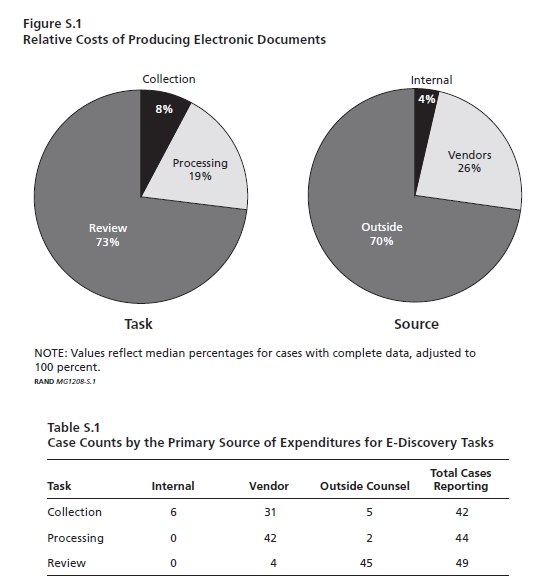
For startups, the lesson is clear. The cost of discovery is driven by how systems are designed. If data is fragmented, unlabeled, or hard to retrieve, legal teams must reconstruct the story manually and bill for every hour of it.
Regulators will not tolerate poor data practices. In the financial sector, the U.S. Securities and Exchange Commission fined major banks over $1.1 billion for record‑keeping failures, especially for off‑channel communications that were not preserved for investigations. Legal readiness is not optional.
Legal Requests Are Technical Problems
When a legal request arrives requesting specific user communications, actions, and state changes, lawyers draft requirements, engineers deliver them. No amount of legal strategy changes the fact that the data must exist, be queryable, and be exportable.
A typical scenario involves multiple data sources: application logs, databases, messaging platforms, and automated decision systems. Your engineering team must map these sources, unify them under a queryable interface, and produce results that correspond to clear timelines and causality.
Immutable Audit Logs
Logs must be tamper‑resistant, ordered, attributable, and consistently retained. Mutable logs raise doubt because they suggest changes after the fact. The National Institute of Standards and Technology (NIST) explicitly recommends append‑only logging for security and compliance purposes because this model ensures that events cannot be retroactively modified.
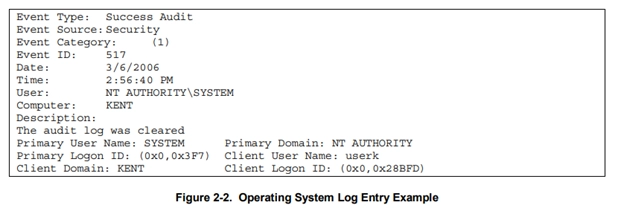
Event sourcing builds on this by treating every state change as an immutable event. When systems record every action as a discrete event with actor identity and timestamp, the sequence becomes a reliable historical record. That record is invaluable under investigation because it shows precisely how the state evolved, without ambiguity.
Audit Trails Are a Feature, Not Overhead
High‑quality audit logs serve many purposes beyond legal compliance. They accelerate incident response by showing what changed and why, they help customer support teams understand disputes, and they illuminate compliance risks before they become problems.
Security standards like NIST SP 800‑53 tie audit controls to accountability and operational resilience. When audit logs are treated as features, not burdens, they provide defensible evidence during legal requests and practical visibility into system behavior at scale.
Data Retention Policies Must Be Enforced in Code
A document stating “we delete data after X days” is meaningless when implementation is manual or inconsistent. Regulatory frameworks like the EU General Data Protection Regulation (GDPR) grant individuals rights, such as data erasure, but they also require organizations to retain data when it is subject to legal obligations. A startup must encode retention policies in infrastructure to enforce rules and provide proof of adherence automatically.
Structured retention means automated deletion jobs that respect metadata and business classifications. It requires logging each deletion with context that shows why it happened. Tools that treat deletion as a first‑class event rather than a job script help create defensible retention practices.
Legal Hold Architecture
A legal hold is a runtime requirement to preserve potentially relevant data for a matter. It cannot be a sticky note or a policy statement. Courts view failure to preserve evidence as spoliation, and sanctions can follow.
To implement legal holds, systems must have entity‑level flags that pause deletion and retention jobs. Holds must be scoped precisely, logged when they take effect, and released when the matter is resolved. This ensures that automated processes preserve critical data without freezing unrelated records.
Queryable History
Legal teams will ask for full timelines: what changed, who changed it, and why. If your system overwrites state without retaining change history, the only way to reconstruct the answer is to review backups and logs manually. That takes weeks.
A time‑series or event‑driven data model makes history queryable in production. Every state change should include the actor, timestamp, a reference to the prior state, and correlation identifiers. This structure lets teams answer complex questions quickly and accurately.
Chain of Custody for Exports
Once data leaves your system, its integrity becomes a point of contention. Without a reproducible query, version control, cryptographic hashes, and signatures on exported artifacts, legal teams cannot prove that the data was complete and unchanged.
According to the Cybersecurity and Infrastructure Security Agency (CISA), chain of custody involves documenting how data is accessed, transferred, and handled throughout its lifecycle. Gaps in this process introduce risk and make it harder to prove the data has not been tampered with.
To support the digital chain of custody, CISA recommends this framework:
- Identify: Inventory export paths, systems, and data flows.
- Protect: Apply access controls and encryption during export and transfer.
- Detect: Log all export-related activity and monitor for unauthorized changes.
- Respond: Investigate suspicious access, validate export integrity, and report breaches.
- Recover: Restore trusted versions using validated builds if integrity is compromised.
- Audit: Regularly review logs, metadata, and access records to confirm integrity across all stages.
The Explain Your Decision Problem
Automated decisions increasingly shape user outcomes, and regulators now demand that these systems provide clear, traceable explanations for their results. While foundational regulations like the GDPR require meaningful information about decision logic, modern standards have become more granular.
The Standard for Trustworthy AI
The NIST AI Risk Management Framework (AI RMF 1.0) identifies explainability, interpretability, and transparency as the core pillars of trustworthy AI. It emphasizes the need for rigorous documentation of both decision-making rationales and data provenance throughout the AI lifecycle.
Furthermore, the NIST Generative AI Profile (2024) highlights a critical risk: "confabulated logic." This occurs when large language models produce authoritative-sounding citations or reasoning to justify an answer that is fundamentally incorrect.
The Legal and Operational Mandate
These risks translate directly into professional skepticism. According to the American Bar Association’s 2024 TechReport, accuracy and reliability remain the top concerns for legal professionals using AI, with nearly 75% of attorneys prioritizing accuracy above all else.
To meet these expectations and mitigate risk, organizations must:
- Log all decision inputs and specific model versions.
- Track outputs and overrides in real-time.
- Ensure "reconstructability": If you cannot audit the how and why of a decision after the fact, you cannot defend it under regulatory or judicial scrutiny.
Real Costs of Getting It Wrong
Data volumes continue to grow, and legal discovery becomes more complex. Modern discovery now includes ephemeral messaging, collaborative platforms, and cloud data that traditional tools struggle to handle. Regulators in the U.S., Europe, and the U.K. are tightening expectations for preserved communications and evidence, even penalizing deletion of relevant messages in antitrust investigations.
Poor information governance, unclear retention practices, and missing audit trails do not just slow responses. They risk sanctions, fines, and adverse legal outcomes. Systems that can show what happened, when, who caused it, and that nothing was changed become production assets rather than compliance burdens.
Designing Compliance Architecture That Scales with the Business
Compliance is part of system design. Teams that build for compliance from day one respond to legal requests with confidence. Their systems do not hold up development or distract engineering teams. They automate retention policies, capture immutable history, handle legal holds, and provide traceable exports.
That level of preparedness turns legal requests from emergencies into routine engineering tasks. A strong compliance architecture helps startups grow with fewer disruptions and greater credibility.
About the Author

Alex Bondarevskyi is a software engineer and engineering leader with 20 years of experience building systems that operate at a national scale. During the pandemic, he led engineering for one of the largest non-bank PPP lenders in the country, joining as the first engineering hire and building the team and infrastructure that processed nearly 2 million loan applications worth $12.5 billion, serving 600,000+ independent contractors at peaks of 50,000 applications daily. He previously co-founded ComCard, a fintech startup in corporate payments, and ran a development agency serving major film studios and Fortune 500 companies. Currently, he's building GiveSpark, a charity discovery platform helping donors and advisors navigate 1.8 million US nonprofits.
Reference List:
- American Bar Association. (2022, November 29). Litigation Technology Report. https://www.americanbar.org/groups/law_practice/resources/tech-report/2022/litigation-tar/
- RAND Institute for Civil Justice. (2012, April 11). Where the Money Goes: Understanding Litigant Expenditures for Producing Electronic Discovery (MG‑1208). https://www.rand.org/pubs/monographs/MG1208.html
- S. Securities and Exchange Commission. (2022, September 27). SEC Charges Firms for Recordkeeping Failures Related to Off‑Channel Communications. https://www.sec.gov/newsroom/press-releases/2022-174
- National Institute of Standards and Technology. (2006). Guide to Computer Security Log Management (NIST SP 800‑92). https://nvlpubs.nist.gov/nistpubs/legacy/sp/nistspecialpublication800-92.pdf
- National Institute of Standards and Technology. (2020). Security and Privacy Controls for Information Systems and Organizations (NIST SP 800‑53, Revision 5). https://nvlpubs.nist.gov/nistpubs/SpecialPublications/NIST.SP.800-53r5.pdf
- European Union. General Data Protection Regulation: Article 17 – Right to Erasure. https://gdpr-info.eu/art-17-gdpr
- Cybersecurity and Infrastructure Security Agency. (2023, August). Chain of Custody and Critical Infrastructure Systems. https://www.cisa.gov/sites/default/files/2023-12/Chain%20of%20Custody_2023.8.14_508.pdf