>>
Industry>>
Gaming and vfx>>
Why Online Casino Tech Is Star...Why Online Casino Tech Is Starting to Resemble SaaS Platforms

Over the last decade, the iGaming industry has undergone one of its most dramatic technological transformations. What was once a world of static games, server-heavy integrations, and rigid platforms has evolved into something far more flexible: systems that behave almost exactly like modern SaaS (Software as a Service) platforms.
From modular game architecture to subscription-like player loyalty systems, online casinos are steadily adopting the same design philosophy that made SaaS dominant across finance, productivity apps, and enterprise software. This shift is not accidental. As competition intensifies and users demand seamless experiences, casinos are embracing scalable, cloud-based, data-driven frameworks that mirror the best of the SaaS world.
According to McKinsey Digital, the global shift toward cloud-first architecture and real-time personalisation has pushed multiple industries, including entertainment and gaming, toward SaaS-like infrastructures for long-term sustainability.
The result? Modern online casinos no longer resemble old-school gaming sites. Instead, they operate like high-performance tech products built for continuous optimisation.
1. Modular Architecture: The Heart of SaaS, Now the Heart of iGaming
At the core of SaaS platforms is modularity: the ability to plug, unplug, update, or scale individual components without disrupting the entire system. Online casinos have adopted this principle across:
- Payment gateways
- Game libraries
- Bonus engines
- Affiliate tracking systems
- KYC/AML verification
- CRM and retention tools
This modular setup allows casinos to add features rapidly, much like SaaS platforms push new integrations or updates.
For example, adding a new type of promotional mechanic, such as a no-deposit offer, is now as easy as connecting an API-based bonus module. That’s why pages designed to help players understand how 120 free spins work for you can remain accurate even as casinos update underlying technology; the bonus system itself is modular, scalable, and easily improved.
2. Cloud-Based Scaling Mirrors SaaS Performance Standards
Where older casino platforms relied on physical infrastructure or limited hosting, modern iGaming operators increasingly run on multi-cloud environments for:
- Higher uptime guarantees
- Automatic scaling during peak loads
- Faster global content delivery
- Enhanced data redundancy
This mirrors SaaS reliability standards where providers promise uptime SLAs of 99.9% or above.
In the casino world, this is crucial. During major tournaments, seasonal promotions, or launches of highly anticipated game titles, traffic can spike dramatically. SaaS-like scaling ensures there are no slowdowns, which directly affects player satisfaction and retention.
3. Data as a Service: Hyper-Personalisation at Scale
SaaS companies thrive on data. They analyse user behaviour, recommend next steps, and predict churn. Online casinos have adopted identical systems, deploying:
- Real-time player segmentation
- Machine learning–driven recommendations
- Behaviour-based bonus triggers
- Tailored deposit offers
- Risk scoring for responsible gaming
This data-driven approach powers modern promotional structures. For example, personalised free spin offers, such as 200 free spins without deposit, can be triggered not for everyone, but for specific user profiles with high retention potential.
Additionally, casinos now run dynamic bonus systems that adjust automatically based on user engagement. This mirrors how SaaS adapts pricing tiers or feature access for different customer personas.
4. User Experience (UX) Built Like a SaaS Funnel
SaaS platforms obsess over onboarding, activation, engagement, and retention. Online casinos now follow this same funnel logic:
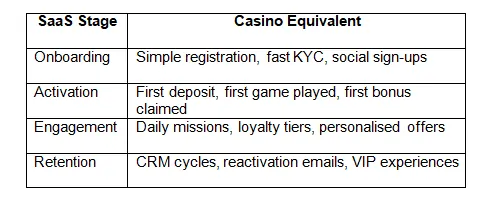
This funnel-driven approach makes casino platforms feel more like subscription software: predictable, structured, and optimised for long-term user lifetime value rather than one-time play.
5. API-Driven Integrations: The Backbone of Both SaaS and iGaming
SaaS platforms thrive on integrations, Slack with Google Drive, Salesforce with HubSpot, etc. Online casinos work the same way.
Modern iGaming platforms commonly integrate APIs for:
- Game providers
- Payment processors
- Geolocation services
- Compliance tools
- Anti-fraud engines
- Live chat providers
- AI-powered analytics
This API-first mindset allows casinos to innovate rapidly without reinventing infrastructure. It’s why new features, like evolving no-deposit options, including collections of free spins without deposit, can be deployed across multiple brands almost instantly.
6. Subscription-Like Loyalty Systems
Perhaps the most SaaS-like feature in online casinos today is the development of subscription-style loyalty programs. While not formal subscriptions, they mimic the structure of SaaS customer journeys:
- Monthly missions
- Weekly challenges
- Tier progressions
- “Unlockable” rewards
- Recurring bonuses
- Cashback cycles
This keeps players engaged in the same way SaaS keeps customers subscribed.
Some casinos even introduce season passes or timed reward tracks, mirroring gaming-as-a-service models in mainstream video games.
7. Continuous Deployment & A/B Testing Like SaaS Giants
The industry no longer releases updates periodically. Instead, operators deploy improvements in continuous cycles, much like major SaaS firms:
- UI tweaks
- Game loading optimisations
- New payment methods
- Risk detection improvements
- Faster withdrawal tools
- Personalisation rules
Casinos A/B test elements like:
- Bonus banners
- Registration flows
- Spin button placement
- Deposit prompts
- VIP rewards
This iterative approach is exactly how SaaS companies refine their products over time.
Isobel Coughlan, iGaming Expert at Mr. Gamble, describes this evolution as natural and inevitable: “Online casinos have become technology companies first and entertainment companies second. The closer they move toward SaaS frameworks, the more agile they become, and agility is what keeps players engaged in a highly competitive market.”
Her viewpoint highlights how the adoption of SaaS principles enables operators to deliver faster updates, smarter UX decisions, and more consistent performance across regions.
8. Security, Compliance & Automation: Another SaaS Parallel
Just like SaaS platforms rely heavily on automated monitoring, modern casinos now use:
- Real-time fraud detection
- Automated KYC
- AI-powered AML screening
- Behavioural monitoring tools
- Geo-blocking and identity verification
These systems aren’t just regulatory necessities; they are operational efficiencies that match the automation-first mindset of SaaS.
9. The Convergence of iGaming and SaaS: What Comes Next
As online casinos evolve further toward SaaS-like models, we can expect:
- Unified player accounts across brands (like SaaS single sign-on)
- Interoperable wallets
- AI-driven personalisation engines that adapt instantly
- More gamified reward ecosystems
- White-label platforms that behave like SaaS marketplaces
- Instant-play streaming games (gameplay via cloud render, like Netflix for slots)
Ultimately, the line separating casino systems from SaaS platforms will continue to blur.
Online casino technology has matured into a complex, scalable, API-driven environment that borrows heavily from SaaS design principles. From modular architecture to cloud-based scaling and real-time personalisation, the resemblance is not coincidental—it’s strategic. As operators fight for player loyalty and market share, SaaS-style agility provides a critical advantage.
This shift also benefits players: better UX, smarter bonuses, smoother gameplay, and increasingly transparent systems.
In the coming years, expect online casino platforms to function even more like subscription-based digital products with continuous updates, dynamic personalisation, and user experiences shaped by sophisticated data intelligence. The transformation is well underway, and it’s redefining the future of iGaming.