>>
Industry>>
Nanotechnology>>
'Bubble Bots' Autonomously Tar...'Bubble Bots' Autonomously Target Tumors with Microrobotics
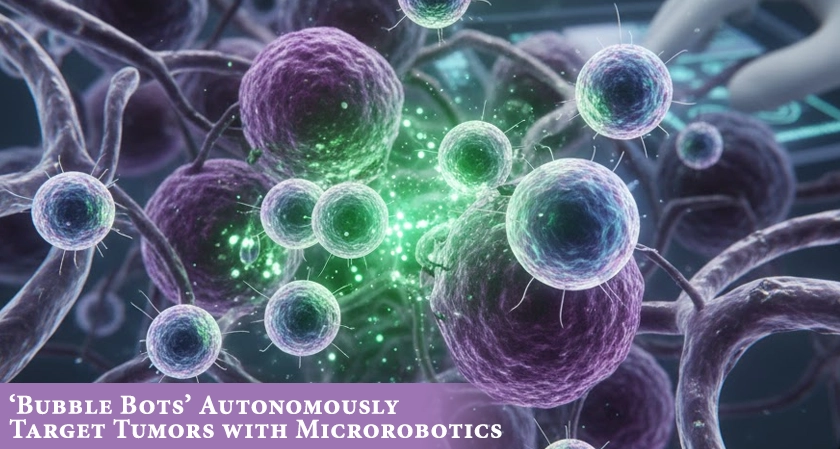
Caltech researchers create "bubble bots," simple microrobots made of biocompatible materials that autonomously navigate the bloodstream to find and treat tumors.
Researchers at the California Institute of Technology have unveiled a groundbreaking development in medical microrobotics: "bubble bots," simple yet effective biocompatible robots designed to autonomously navigate through the bloodstream and target tumors with precision. Published in the physics.org, the study demonstrates a new class of self-propelled microrobots that operate without complex onboard electronics, relying instead on a clever physical design and biochemical cues.
The microrobots are constructed from safe, biodegradable polymer Microbot’s and feature a specialized asymmetric geometry. A tiny, embedded air bubble within their structure allows them to be propelled by externally applied, low-energy ultrasound waves. This "bubble-powered" mechanism generates a directional force, allowing the bots to swim actively through biological fluids. Crucially, their surfaces are coated with specific biochemical markers or "chemical sensors" that enable them to sense and autonomously steer toward the unique tumor acidic microenvironment characteristic of solid tumors.
"We've moved beyond remote control. These microrobots are effectively simple, autonomous hunters. They use the body's own chemistry as a roadmap to find their target," said the project's lead researcher at Caltech. Once at the tumor site, the bots can perform two key functions: they can release a concentrated payload of chemotherapy drugs directly into the malignant tissue, or they can agglomerate to physically block small blood vessels that feed the tumor (a process called embolization), starving it of nutrients.
The simplicity of their design is their greatest strength. Without complex metal components or batteries, they are inherently biocompatible and designed to safely degrade after completing their mission. This addresses major safety and manufacturing hurdles that have stalled previous nanorobot concepts.
Initial in vivo tests in murine models showed a significant increase in drug delivery efficiency to tumors and a corresponding reduction in harmful systemic side effects compared to traditional intravenous chemotherapy. The researchers are now focused on scaling up production and beginning the rigorous preclinical safety studies required to advance toward human trials. While significant regulatory challenges remain, this work represents a major leap toward realizing the long-held vision of "magic bullet" targeted drug deliveries using microscopic machines.