>>
Industry>>
Legal>>
Common Trucking Regulation Vio...Common Trucking Regulation Violations to Watch For
The Silicon Review
25 February, 2026
Author:
The Silicon Review Team
Today, truck regulation violations have become a major factor in serious commercial vehicle crashes globally. Fully loaded tractor-trailers can weigh up to 80,000 pounds, and not following the safety regulations can lead to severe injuries and even multi-vehicle collisions.
Many state and federal trucking regulations enforced nationwide cover driver hours, truck inspections, cargo securement, and vehicle maintenance standards. Below are the most common trucking regulation violations that are watched for after any serious accident.
Hours of Service Violation (HOS)
Today, a leading safety concern is driver fatigue. The Federal Hours-of-Service rules talk about how long drivers can operate and drive without any mandatory breaks.
Under current FMCSA regulations, there are a few driver-related rules, such as:
- Property-carrying drivers have to drive a minimum of 11 hours after they get 10 consecutive hours off duty.
- No driver can drive beyond the 14th consecutive hour when they come on duty.
- All drivers can take a break for a minimum of 30 minutes after every 8 hours of offering services.
When you violate these limits, there is an increased fatigue-related crash risk.
Truck Maintenance
All commercial trucks require maintenance, routine inspection, and proper monitoring to operate safely for long journeys. A majority of mechanical failures, like loose brakes and engine failures, come from repairs that were skipped.
Some common maintenance violations include:
- Worn and defective brakes that are not repaired.
- Tire tread depth is below legal limits.
- Broken headlamps or reflectors cause invisibility while driving.
- Jammed steering or suspension defects.
Cargo Securement Violation
Sometimes, improper cargo can shift and even get damaged during transit. This might affect the vehicle’s balance, and in severe cases, cargo may spill onto the roadway.
Some of the cargo securement violations might involve:
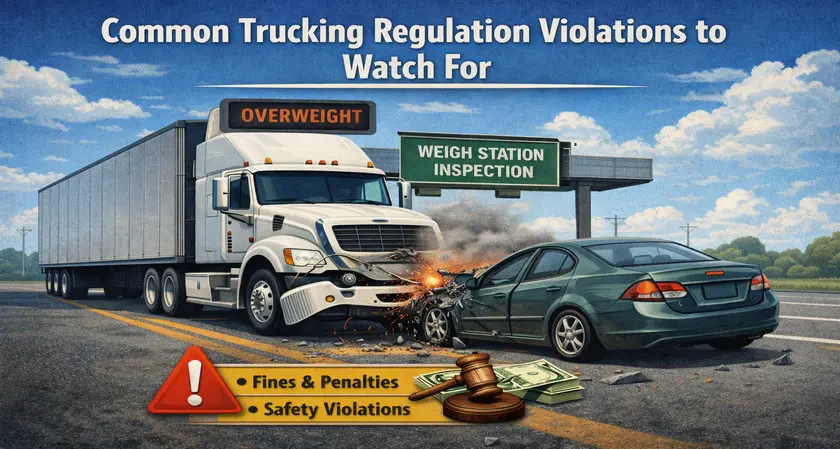
- Overloaded trucks that exceed the federal weight limits.
- Uneven load distribution and sometimes, even the unloading process.
- Hazardous materials that are not labeled properly.
Improper loading leads to rollover risk and loss of control while driving.
Licensing and Qualification Violations
Commercial drivers have to be qualified enough and must hold a CDL, i.e., a valid Commercial Driver’s License. They also need to meet other federal medical standards as a means of not violating the law.
Some of the common license and qualification violations include:
- Driving trucks without a valid CDL.
- Showing medical certificates that are expired and no longer valid.
- Improper driving training with no official records.
- Failure to conduct any relevant background checks.
According to the National Highway Traffic Safety Administration, a majority of truck crashes happen because of driver error.
Why Do These Truck Violations Matter?
These truck regulations are not just minor technical errors but are among the factors that impact road safety. When such rules are violated, they have a direct impact on safety.
Truck violation rules matter because:
- Violations of fatigue and poor truck maintenance have made such vehicles prone to accidents.
- Driver fatigue makes it harder for them to brake or move the steering in emergencies.
- On highways, mechanical defects make it difficult for drivers to control the vehicle.
- If drivers are untrained, then they might misjudge distance, speed, and stopping time.
Key Takeaway
- Truck regulation violations are among the major causes of truck crashes.
- If you violate the Hours-of-Service rules, then you increase the chances for driver fatigue and accidental risks.
- There might be many mechanical failures if trucks are not repaired and maintained.
- Rollover and spill risks are increased if there is improper cargo loading service.
- Unqualified drivers with no license, violating truck regulations, increase the likelihood of a crash.
- Nowadays, compliance with federal regulations has become critical for road safety.