>>
Industry>>
Oil and gas>>
Analysts Warn of Largest Oil S...Analysts Warn of Largest Oil Supply Disruption in History amid Iran Conflict
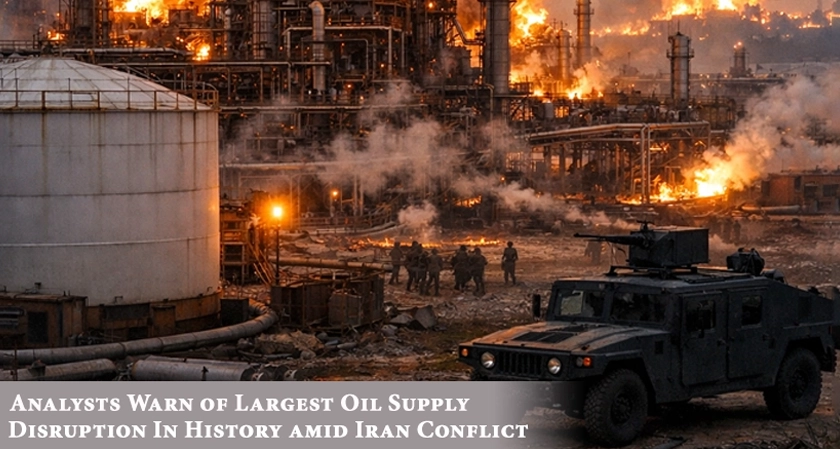
Analysts warn the US-Iran conflict could trigger the largest oil supply disruption in history. A Strait of Hormuz closure threatens 20M barrels daily, with prices potentially soaring past $100 and sparking global recession risks.
Energy analysts are warning that the escalating conflict between the United States and Iran could trigger the largest oil supply disruption in history, far exceeding previous crises like the 1973 Arab oil embargo and the 1979 Iranian Revolution.
The Strait of Hormuz, through which approximately 20 million barrels of crude flow daily about one-third of global seaborne supply has become the central flashpoint. According to S&P Global Energy, only five oil tankers transited the strait on March 1, compared to the recent daily average of 60. "If the reduction in tanker traffic continues for a week or so, it will be historic," the firm warned, adding that beyond that period, the impact would be "epochal" for oil markets.
MST Financial's head of energy research, Saul Kavonic, warned the situation could be three times worse than the 1970s crises. "You've got up to 20 million barrels a day of oil withheld over the course of a month that's the equivalent of the entire U.S. strategic petroleum reserve not making it to market," he said.
Bernstein analysts modeled three war scenarios based on a full Strait closure. Under a six-month closure, they project a staggering 5.6 million barrel per day deficit, with Brent crude soaring above $110 per barrel. "With OPEC's spare capacity at around 3.0 million barrels per day, the six-month closure scenario would have potentially grave consequences for the world economy," the analysts wrote.
Enverus Intelligence Research estimates oil markets already reflect a $10–$15 per barrel geopolitical risk premium. Even a one-month closure could draw roughly 400 million barrels from global inventories, quickly eliminating current surpluses.
The LNG market faces equally dire prospects. Approximately 20% of global LNG supply transits the strait, with Qatari exports particularly vulnerable. Bernstein warned that disrupting exports from Qatar and the UAE would remove approximately 83 million tonnes annually comparable to the loss of Russian gas in 2022 that propelled spot prices to $40 per million British thermal units.
J.P. Morgan's Natasha Kaneva noted that since 1979, regime changes in oil-producing nations have typically led to price spikes averaging 76% from onset to peak.