>>
Technology>>
Software>>
Top 7 Energy Software Developm...Top 7 Energy Software Development Companies for 2026

The Silicon Review
20 March, 2026
Author:
The Silicon Review Team
Wondering which partners can actually deliver digital platforms that cut losses, optimize grids, and keep regulators happy this year? This guide answers:
- Why software demand in the energy sector is exploding right now
- How we evaluated more than forty candidates and narrowed the field
- Which seven vendors (Techstack, ScienceSoft, Itransition, ELEKS, Intellias, N-iX, and SoftServe) truly stand out
- What 2026 technology trends should you bake into every RFP
- How to choose the perfect partner for a multi-year, multi-module transformation
Introduction
Energy CEOs and CTOs agree on one thing: the 2020s have become a race to digitize. Electrification, DER proliferation, and mounting ESG pressure leave zero room for outdated monolithic systems. Smart meters, EV fleets, and renewable assets all speak data, yet most utilities still run on brittle, siloed stacks. That gap is where the best energy software development companies come in. The stakes? Grid stability, margin protection, and investor confidence.
Key Industry Challenges Accelerating Digital Solutions in Energy
Pressure on utilities has reached a tipping point. Traditional infrastructure, designed around predictable baseload plants, now must absorb gigawatts of intermittent renewables, bidirectional EV charging, and sudden climate-driven demand spikes. Before we dig into providers like Techstack, let’s spell out the pain that is pushing budgets toward digitization.
Across our interviews with grid operators, renewable developers, and regulators, we kept hearing the same five blockers:
- Aging SCADA footprints that lack real-time APIs and struggle to ingest high-frequency inverter or smart-meter data.
- Data fragmentation - operational, IT, and commercial records live in separate lakes, killing holistic visibility.
- Manual field operations that rely on paper or Excel for outage tracking, inspection rounds, and compliance logs.
- Growing cyberattack surface: thousands of new IoT endpoints create vulnerabilities that legacy firewalls never anticipated.
- Ever-tightening reporting cycles. Whether it’s FERC Order 2222 or the EU’s Fit for 55, regulators now expect granular, auditable data in near real time.
Those hurdles translate directly into missed KPIs, higher SAIDI/SAIFI, renewable curtailment, and ballooning OPEX. No wonder the hunt for top energy software development companies has become a board-level priority.
At the same time, forward-looking leaders see a silver lining: every challenge represents a new revenue or efficiency lever if addressed with software. Predictive maintenance can shave truck rolls; DERMS platforms can monetize flexibility markets; and automated compliance workflows free up staff for higher-value work. The right partner helps unlock those upsides.
Market Forces Redefining the Modern Energy Sector
While technical headaches are the main subjects of day-to-day discourse, the dynamics of the market are the broader force changing the roadmaps. Several trends stand out in 2026:
First, grids that are consumer-centric are no longer theoretical. Residential batteries and EVs already export power back to the network in California, Australia, and parts of Europe, so microtransactions must be priced, settled, and visualized.
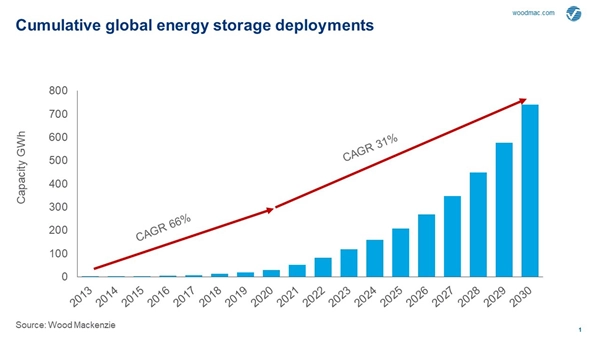
Second, energy-capacity constraints are accelerating utility-scale storage procurement; Wood Mackenzie projects 741 GWh by 2030, a five-fold jump from 2023 levels.
Third, digital talent scarcity remains severe. Gitnug’s 2026 report shows a 70 percent shortfall for utility IT specialists, making external engineering muscle non-negotiable.
Fourth, OPEX compression is relentless; regulators continue to cap rates of return, so every avoided truck roll or basis-point improvement in capacity factor counts.
To survive and thrive, utilities are seeking partners that combine domain knowledge, modern cloud skills, and stringent security protocols. Only a handful of top energy software development firms consistently deliver across all four vectors.
How We Assessed Leading Energy Software Providers
We benchmarked forty-three vendors against five weighted criteria. Methodology transparency matters, so here is what we actually measured:
- Energy domain portfolio - minimum three live production projects in T&D, renewables, or EMS during the last three years.
- Breadth of core services - cloud-native engineering, data warehousing, AI/ML, IoT, security, and QA automation.
- Delivery maturity - certifications (ISO 9001/27001, AWS/Azure/GCP, TOGAF), PMO strength, DevSecOps adoption.
- Client outcomes - hard ROI metrics, a repeat business ratio of more than 50%, and at least one reference call that proves cultural fit.
- Partnership mindset - willing to co-own product roadmaps, be a part of Agile ceremonies, and question unclear requirements early on.
We normalized the scores, and only the best energy software development companies had scores in the top 80th percentile across all dimensions.
List of the Top 7 Energy Software Development Companies for 2026
Below are seven companies that consistently rise to the top.
Techstack
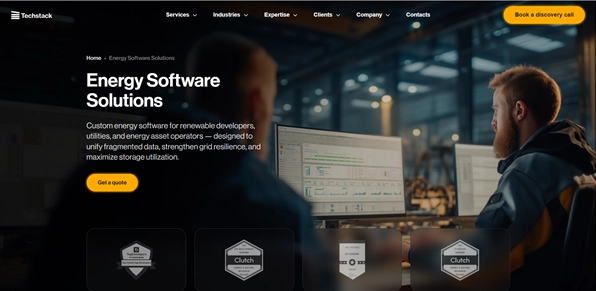
Techstack delivers custom platforms for renewable developers, utilities, and energy asset operators, unifying fragmented data, strengthening grid resilience, and maximizing storage utilization. What sets the company apart is its combination of strong product ownership and mature engineering discipline. Engineers integrate into client workflows, identify risks early, and ship solutions aligned with live market and regulatory demands.
Their core services in this sector cover the full modern energy stack: unified data platforms, distributed asset orchestration, grid optimization engines, storage-management software, AI for manufacturing quality control, and energy management systems (EMS).
In the Solar Energy Data Portal project, the team developed a platform that integrates high-frequency telemetry data from multiple vendors. By bringing data in-house, it improves reliability and gives operators unified visibility across assets. This enables more accurate monitoring and faster, data-driven decisions. In the Computer Vision for Solar Panel Manufacturing engagement, Hough Line Transform and adaptive thresholding achieved sub-millimeter accuracy in defect detection, replacing manual inspection and improving production efficiency and consistency.
Client feedback is strong. Henri Yoki (CEO, Exaum Oy) gave project planning and delivery a perfect mark, while Arila Barnes (Managing Director, AXM Software LLC) commended the company as "product-focused, agile, and proactive. " Full-cycle QA is embedded from day one, with internal quality oversight integrated throughout each engagement. For energy companies looking for a strategic technology partner, Techstack remains a go-to among top energy software development leaders.
ScienceSoft
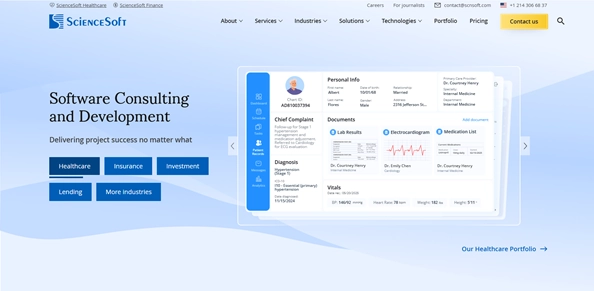
ScienceSoft brings 37 years of delivery experience and 3,600+ projects to the table. In energy, its sweet spot is large, compliance-sensitive modernization. Key differentiators: a 45-person PMO staffed by PMP and Scrum-certified leads, plus 20+ architects spanning AWS, Azure, TOGAF, and IASA CITA. That architect density is two to three times the industry average, which matters for high-voltage environments where a poor decision can ripple through the grid.
Energy clients rely on the firm for predictive-maintenance platforms, SCADA/IoT integrations, and data-warehouse backbones that keep downtime near zero. ISO 9001 and ISO 27001 certifications further protect IP and consumer data. With 62 percent of revenue from long-term engagements, ScienceSoft ranks high among the best energy software development providers for enterprises planning multi-year roadmaps.
Itransition

Itransition shines in legacy system revival. Need to migrate a 1990s-era SCADA into a cloud-native microservice mesh? The company has reference architectures ready. Hourly rates stay competitive ($25–49/hr), making them accessible to mid-market firms as well as large utilities.
Energy clients praise Itransition’s structured QA culture, every sprint includes automated regression, performance, and security tests, and its willingness to offer strategic consulting rather than billable hours alone. For operators seeking the best energy software development companies without Fortune 500 pricing, Itransition is a strong candidate.
ELEKS
ELEKS couples three decades of engineering heft with a consultative approach. Beyond pure coding, the firm helps utilities map strategic roadmaps, identify automation targets, and integrate cybersecurity from day one. Its energy menu spans advanced analytics, smart-grid IoT, AI-driven demand forecasting, and critical-infrastructure security.
Another engagement involved building a vulnerability-scanning framework to secure thousands of substation gateways. Clients appreciate having strategy, design, and implementation under one roof, making ELEKS a frequent mention among leading firms in energy software development that focus on compliance.
Intellias
Intellias occupies the intersection of energy and mobility. Its proprietary IDEAbook framework standardizes delivery processes, earning recognition from Everest Group and Gartner. Energy expertise centers on EV-charging infrastructure, smart-grid data platforms, and cloud-native load-balancing systems.
A flagship project: a distributed charging and energy-balancing platform that dynamically throttles EV load across multiple stations to avoid peak power prices. Results: savings on demand charges and higher driver satisfaction. Multi-cloud mastery (AWS, Azure, GCP) lets Intellias slot into any utility’s existing environment. When CTOs list top energy software development companies known for grid-edge innovation, Intellias is usually near the top.
N-iX
N-iX integrates European engineering talent with solid compliance. Over 2,000 specialists tackle smart metering, grid monitoring, renewable asset management, and energy trading platforms. Clients like the dedicated-center model: a stable team that accumulates domain knowledge over years, not months.
Common engagements: real-time ingestion pipelines that absorb millions of smart-meter readings per day and surface them in AWS-based lakehouses with sub-second query latency. ISO 27001 certification safeguards sensitive grid and customer data. With offices in Poland and Ukraine, N-iX provides time-zone overlap with both EU and US buyers, a plus for agile sprints. Cost-effective yet mature, the firm suits fast-scaling renewable developers needing top energy software development firms backed by solid governance.
SoftServe

SoftServe is the heavyweight of this list, with 12,000+ specialists and dedicated Centers of Excellence in AI, cloud, and IoT. That R&D muscle pays dividends in digital-twin development, predictive analytics, and advanced grid-management algorithms.
A standout engagement involved building a wind farm digital twin that predicts power curves against real-time SCADA data, boosting predicted annual energy production, translating into seven-figure revenue for the operator. SoftServe’s agile delivery squads operate like startups inside the larger organization, letting clients scale from MVP to continental rollout without switching providers. Its combination of research depth and execution speed makes it one of the best energy software development providers for utilities that are attempting to solve broad modernization mandates.
Comparing Energy Software Development Capabilities
With seven pretty powerful players on the table, it is important to match strengths to your backlog. Techstack provides rigid product-owner alignment and is an expert in distributed asset orchestration - ideal for DERMS/EMS greenfield builds. ScienceSoft and SoftServe are the leaders at scale; the governance framework they develop can drive multi-country rollouts. ELEKS and Itransition form this bridge in strategy and delivery, and are ideal for utilities that are still developing business cases. Intellias cornering EV mobility synergy, N-iX providing cost-effective data platform muscle with ISO-backed security
Let’s break the capability comparison down:
- Data Engineering Depth: Techstack, SoftServe, ScienceSoft
- AI/ML for Asset Optimization: ELEKS, Intellias, Techstack
- Compliance & Security: ScienceSoft, N-iX, ELEKS
- Cost Efficiency: Itransition, N-iX
- Embedded Product Management: Techstack, Intellias
No one vendor is at the top of each and every column. Instead, align internal 'holes' with external 'strengths' and treat the shortlist of top energy software development companies more as complementary rather than interchangeable.
Key Energy Tech Trends Defining 2026
Technology shifts are moving targets, but four trends are not going anywhere - they could be found to be quite lasting through 2025 and are maturing this year. Before issuing an RFP, make sure each vendor is able to address them.
Grid-Edge AI
Inference models now run directly on substation or feeder-level gateways, balancing loads at the substation level before the cloud controllers join the loop. This reduces the latency from seconds to milliseconds, a game-changer during high renewable penetration.
Federated Data Meshes
Rather than copying data into new lakes, forward-looking utilities keep telemetry where it is and expose governed APIs for cross-domain queries. That slashes storage redundancy and accelerates project kickoff.
Cyber-Physical Observability
OT and IT logs stream into a unified SIEM. When an inverter firmware anomaly coincides with unexpected network traffic, security teams spot the link before damage spreads.
Low-Code Integration
Domain specialists use drag-and-drop tooling to connect market APIs and SCADA feeds, freeing software engineers for deep algorithm work.
Before you finish reading, keep one practical reminder in mind: during vendor interviews, ask for accelerators related to each trend. Among the best energy software development companies, Techstack offers a pre-built edge-AI agent, while SoftServe showcases a mesh governance blueprint. The more reusable IP a vendor brings, the faster your time to value.
How to Select the Right Software Partner for Energy Solutions
Choosing a partner is as strategic as choosing a market. We recommend a three-step decision funnel:
Start with measurable business KPIs - loss-factor reduction, outage-response time, or curtailment percentage rather than vague “digital transformation.”
Next, map critical user journeys and non-functional requirements: latency, fault tolerance, data sovereignty zones, and compliance reporting cycles.
Finally, stress-test cultural fit. A vendor that constructively challenges assumptions (Techstack has a reputation for doing exactly that) can feel uncomfortable at sprint 0 but will save millions by sprint 20.
When you narrow the field to two or three top energy software development leaders, run a paid pilot with crystal-clear success metrics. Good pilots prove technical feasibility while derisking culture, governance, and communication patterns. Great pilots surface edge cases early, saving budget later.
Why Techstack Fits Complex Energy Software Projects
Every large program needs a linchpin vendor who can absorb product ownership, integrate multiple systems, and stay nimble when regulations swerve. Techstack checks all three boxes. Engineers don’t just attend stand-ups - they help write user stories. Proactive risk logs, IaC automation, and sprint-level QA gates maintain velocity without sacrificing reliability. Their fixed-price discovery + MVP model means you see tangible value before making eight-figure commitments. For CTOs hunting a partner from the roster of top energy software development companies that behaves like an in-house squad, Techstack is hard to beat.
Digital Solutions Powering Energy Management Systems
Modern EMS platforms have evolved far beyond dashboards. Today, they must orchestrate hundreds of distributed resources, price energy in 15-minute intervals, and trigger field-crew work orders in the same heartbeat. The typical reference architecture looks like this:
- Edge collectors, often small ARM gateways, stream MQTT or IEC 61850 over an encrypted channel.
- A cloud-based messaging backbone (Kafka, Pulsar) buffers millions of events per minute.
- A unified data lakehouse stores time-series data in Apache Iceberg or Delta Lake, enabling both real-time and historical analytics.
- AI modules deliver predictive maintenance, price-aware dispatch, and what-if scenario planning.
- Visualization layers combine GIS maps with asset KPIs for operations and compliance teams.
Techstack recently applied this pattern to a Nordic balancing platform, securing 99.98 percent uptime across a winter of extreme load swings. ScienceSoft’s variation employs Azure Synapse and Power BI for regulated utilities. SoftServe adds a digital-twin overlay that simulates grid contingencies before they happen. Regardless of vendor, insist on open standards and loose coupling; no operator wants to inherit another brittle monolith.
Where Energy Digitalization Is Heading Next
Regulation used to be the brake pedal; now it is the accelerator. FERC 2222 in the US and Europe’s network codes place DERs on equal footing with traditional generation, opening the door to peer-to-peer energy trading and flexibility markets. Meanwhile, the IEA projects solar to be the world’s single largest power source by 2027. That wave brings massive data and control complexity. Software, not steel, will decide who captures value.
Expect business models to evolve fast:
- Community batteries offering subscription-based peak-shifting.
- Vehicle-to-grid fleets earning ancillary-service revenue.
- AI-optimized microgrids selling surplus into regional markets in real time.
Companies that pair domain expertise with the best energy software development companies will ride these trends; late adopters will scramble to keep up.
Conclusion
Digital transformation in energy isn’t a buzzword - it’s operational survival. From unified data silos to the orchestration of millions of micro-generators, software is now what defines competitive advantage. Pick one of the top energy software development firms from the list here, and focus on a set of KPIs and build fast. In 2026, it's going to be the people who do not have the biggest balance sheets, not the most successful, but the fastest learners, with the right partners.
FAQ
What does an energy software development company do?
It designs (and builds and maintains) digital platforms to monitor, control, and optimize energy assets - anything from grid-level SCADA extensions to modules of AI to predict turbine failures. The aim is to increase reliability and reduce costs, as well as meet the needs of regulators.
What types of energy software solutions are most common?
Energy management systems, DERMS, predictive-maintenance analytics, smart-meter data hubs, trading and settlement engines, and IoT gateways for field equipment top the list.
How much does energy software development cost?
A limited proof of concept starts around $75000. Full-scale EMS deployments can range from $1 million to $5 million or more, especially once cybersecurity hardening and compliance reporting enter the scope.
Which industries use energy software development services?
Utilities, renewable asset operators, oil-and-gas majors pivoting to low carbon, manufacturing plants chasing efficiency, and smart-mobility providers all hire specialized vendors to manage consumption, generation, and compliance.