>>
Industry>>
Metals and Mining>>
China Rare Earth Exports Contr...China Rare Earth Exports Control Remains Despite White House Diversification Efforts
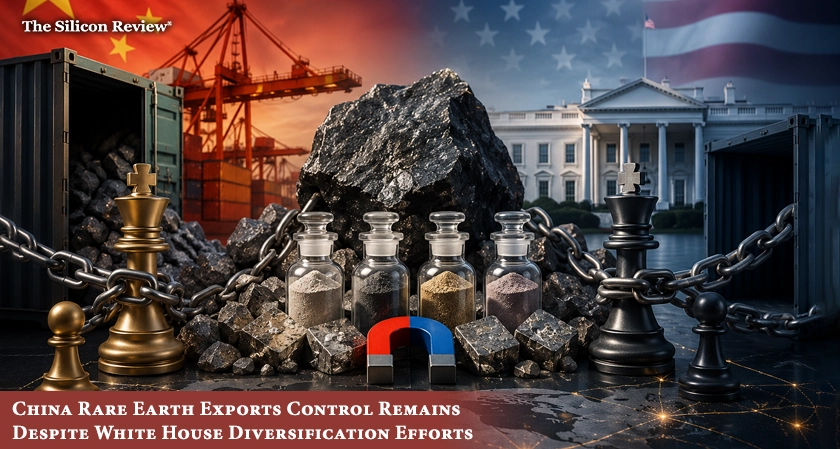
The White House secured a small rare earth supply win, but China rare earth export dominance remains unchallenged. The Silicon Review reports on why Beijing's regime is here to stay despite Western diversification efforts.
The White House announced a rare earth supply agreement with a non-Chinese producer this week, but the small win does little to challenge Beijing's stranglehold on the critical minerals that power electric vehicles, defense systems, and electronics. China controls 92 percent of global praseodymium-neodymium oxide refining capacity and 98 to 99 percent of heavy rare earths like dysprosium and terbium.
China rare earth exports have become a tool of geopolitical leverage. In 2023, Beijing imposed export controls on gallium and germanium, followed by restrictions on antimony and superhard materials. A similar move on rare earths or simply allowing market forces to drive Western competitors out of business remains a credible threat that Washington cannot counter in the near term.
The newly announced supply agreement will provide approximately 5 percent of US annual rare earth demand, far short of the volumes needed to replace Chinese supply. Even with aggressive government funding including equity investments, price floors, and long-term offtake agreements, analysts project North America will only achieve 9 to 10 percent of critical rare earth oxide refining capacity by 2035.
The rare earth minerals supply chain is uniquely difficult to replicate because China did not win by accident. Beijing spent three decades building integrated refining capacity, training a specialized workforce, and establishing recycling networks while Western manufacturers outsourced production. Today, a single Chinese province, Inner Mongolia, produces more rare earth oxides than the rest of the world combined.
The 2022 Inflation Reduction Act allocated billions for domestic rare earth production, but permitting delays, technical challenges, and workforce shortages have slowed progress. The sole US rare earth mine, MP Materials, ships its concentrate to China for final refining because no domestic facility can process the material at commercial scale.
By the fourth quarter of 2027, the Pentagon expects the first non-Chinese heavy rare earth refining facility to come online in Australia. But even that facility will supply only a fraction of defense requirements, leaving US weapons systems dependent on Chinese supply chains for the foreseeable future.
The Silicon Review's analysis indicates that the White House rare earth win is a tactical achievement in a strategic war that Beijing has already won. The only question is whether Western nations can build alternative supply chains before China decides to weaponize its monopoly.
Q: How much of global rare earth refining does China control?
A: China controls 92 percent of global praseodymium-neodymium oxide refining capacity and 98 to 99 percent of heavy rare earths like dysprosium and terbium.
Q: What export controls has China already imposed on critical minerals?
A: China imposed export controls on gallium and germanium in 2023, followed by restrictions on antimony and superhard materials, demonstrating its willingness to weaponize mineral supply chains.
Q: How much of US rare earth demand will the new supply agreement cover?
A: The newly announced agreement will provide approximately 5 percent of US annual rare earth demand, far short of the volumes needed to replace Chinese supply.
Q: What is the projected North American rare earth refining capacity by 2035?
A: Analysts project North America will only achieve 9 to 10 percent of critical rare earth oxide refining capacity by 2035, even with aggressive government funding.
Q: Why does the US rare earth mine ship its concentrate to China?
A: The sole US rare earth mine, MP Materials, ships its concentrate to China for final refining because no domestic facility can process the material at commercial scale.
Q: When is the first non-Chinese heavy rare earth facility expected online?
A: By the fourth quarter of 2027, the Pentagon expects the first non-Chinese heavy rare earth refining facility to come online in Australia, supplying only a fraction of defense requirements.