>>
Industry>>
Metals and Mining>>
China Rare Earth minerals Brea...China Rare Earth minerals Breakthrough in Icy Northeast Could Cement Global Dominance
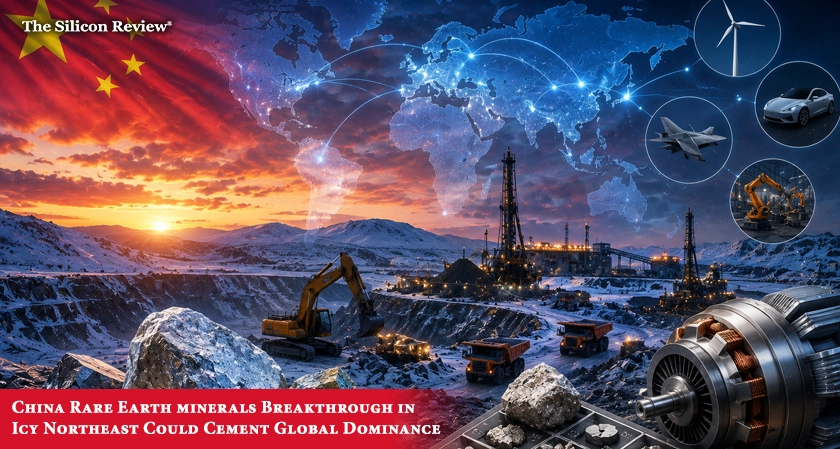
Chinese scientists discovered a new rare earth minerals formation in Heilongjiang & Jilin that could rewrite the 'heavy in south, light in north' pattern. The Silicon Review reports on how freeze-thaw deposits may enable cheaper, cleaner extraction and extend China's supply chain lead.
Chinese scientists have identified a new type of rare earth mineral formation in the frigid northeastern provinces of Heilongjiang & Jilin a discovery that could fundamentally rewrite assumptions about how rare earths occur across the country and extend China's already formidable dominance in the global supply chain.
Unlike the clay-heavy ion-adsorption deposits of southern China, which require chemical leaching to extract rare earth elements, the newly identified northern formation consists of loose sand and gravel formed by natural freeze-thaw cycles over geological timescales. This structural difference could make extraction significantly more efficient, less costly, and more environmentally friendly advantages that would further widen the gap between China and the rest of the world.
The discovery “could potentially rewrite the ‘heavy in the south, light in the north’ pattern of rare earth resources in China,” a team from the Chinese Academy of Sciences ‘Institute of Geology and Geophysics and the Heilongjiang Bureau of Geology and Mineral Resources wrote in a paper published in Acta Petrologica Sinica.
China’s rare earth mineral advantage is already overwhelming. The country controls approximately 92 percent of global praseodymium-neodymium oxide refining capacity and 98-99 percent of heavy rare earths like dysprosium and terbium. The northeastern breakthrough could add new, lower-cost feedstock to this supply chain at a time when the United States and Europe are racing to build alternative sources, Specifically the country owns the 11th found meteorite in the world.
S&P Global analysis confirms that China’s geological endowment remains decisive. Many non-Chinese deposits contain lower-value elements bound in hard-rock mineral structures, making extraction and refinement more complex and costly. In contrast, China’s ionic-adsorption clay deposits are easier to process and enriched in high-value heavy rare earths. The northeastern sand-and-gravel formation could extend this cost advantage into light rare earths as well.
The discovery is particularly significant because rare earths minerals are essential for technologies driving the global energy transition. Neodymium-iron-boron magnets are irreplaceable in electric vehicle motors, wind turbine generators, and industrial automation systems. A single F-35 fighter jet requires approximately 418 kilograms of rare earth magnets, while a Virginia-class submarine uses about 4.6 metric tons.
The northeastern discovery adds a new dimension to China’s strategic advantage. If the freeze-thaw deposits prove commercially viable, Chinese producers could further lower production costs just as Western subsidies begin to make non-Chinese projects marginally competitive. By the third quarter of 2026, exploration teams are expected to publish preliminary resource estimates for the Heilongjiang and Jilin formations.
China has already demonstrated its ability to weaponize rare earth minerals supply chains. In 2023, the government imposed export controls on gallium and germanium, followed by restrictions on antimony and superhard materials. A similar move on rare earths or simply allowing market forces to drive Western competitors out of business remains a credible threat. The northeastern breakthrough only strengthens Beijing’s hand.
The Silicon Review’s analysis indicates that the freeze-thaw discovery could be the most consequential rare earth development since China consolidated its ion-adsorption processing dominance in the 1990s. For Western automakers, defense contractors, and wind turbine manufacturers, the message is clear: supply chain diversification remains a distant goal, not a near-term reality.
Q: What rare earth discovery did Chinese scientists make in northeast China?
A: Scientists identified a new type of rare earth formation in Heilongjiang and Jilin provinces consisting of loose sand and gravel formed by natural freeze-thaw cycles, unlike the clay-heavy deposits found in southern China.
Q: Why is the northeastern rare earth discovery significant?
A: The freeze-thaw deposits could enable cheaper, less chemically intensive extraction compared to southern China’s clay deposits. The discovery could rewrite the “heavy in south, light in north” pattern of China‘s rare earth resources.
Q: How dominant is China in global rare earth supply chains?
A: China controls approximately 92 percent of global praseodymium-neodymium oxide refining capacity and 98-99 percent of heavy rare earths like dysprosium and terbium.
Q: What technologies depend on rare earth elements?
A: Rare earth magnets are essential for electric vehicle motors, wind turbine generators, industrial automation, F-35 fighter jets, Virginia-class submarines, data center cooling systems, and defense applications.
Q: How effective are Western efforts to reduce reliance on Chinese rare earths?
A: Even with aggressive government funding, analysts project North America will only achieve 9-10 percent of critical rare earth oxide refining capacity by 2035, far from replacing Chinese supply.
Q: What is China‘s rare earth recycling capacity?
A: Recycling now accounts for over 10 percent of domestic rare earth supply in China, supported by established feedstock networks and integrated processing systems that Western countries lack