>>
Technology>>
Science and technology>>
Lunar Mineral Discovered by Ch...Lunar Mineral Discovered by Chinese Scientists in Meteorite, 11th Found Globally
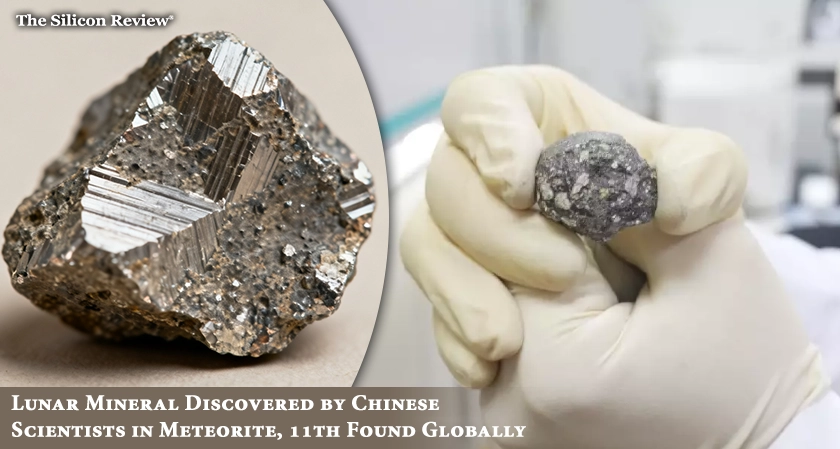
Chinese scientists have discovered a new lunar mineral named Cerium-Magnesium Changesite in a 44-gram meteorite. The Silicon Review reports on the 11th lunar mineral found globally and its potential applications in LED technology.
A new lunar mineral has been discovered by Chinese scientists in a lunar meteorite that fell in China's Xinjiang region in January 2024. The mineral, named Cerium-Magnesium Changesite, has been officially approved by the International Mineralogical Association as the 11th lunar mineral identified globally.
The discovery was made in the Pakepake 005 meteorite, the first lunar meteorite ever recovered in China. The space rock weighs 44 grams and features a distinct dark molten shell on its outer surface. The newly identified mineral is colorless, transparent, and brittle, with a glassy luster and noticeable fluorescence. Its grain size ranges from approximately three to 25 micrometers, typically measuring smaller than 10 micrometers about one-twentieth the diameter of a human hair.
Cerium-Magnesium Changesite is a rare-earth phosphate containing cerium and magnesium, belonging to the cerite super group of minerals. "Why it is new is that when it was formed, it experienced two different conditions. The physical condition was temperature and pressure, while the chemical condition was its element content," said Che Xiaochao, associate researcher at the Institute of Geology of the Chinese Academy of Geological Sciences.
The discovery brings China's total number of identified lunar minerals to four, matching the United States. Wang Yanjuan, a researcher at the Chinese Academy of Geological Sciences and the mineral's lead discoverer, said the finding provides "key mineralogical evidence" for understanding the origin and evolution of the moon and offers insights into lunar magma processes and the distribution of rare-earth elements.
Qu Kai, a member of the Commission of New Minerals and Mineral Names of the Chinese Society of Mineralogy, Petrology and Geochemistry, noted that the mineral's unique fluorescence holds promising potential for manufacturing advanced LEDs. "Its rare earth element ratio, its magnesium and iron content, as well as the characteristic changes in its crystal structure, can provide important references for synthetic materials," Qu said.
The discovery of a new mineral in extraterrestrial space indicates that conditions once existed beyond Earth that has never occurred on our planet. If the same mineral is later found on Earth, it would suggest our planet once experienced similar conditions, allowing researchers to infer and compare broader geological and celestial activities.
As Chinese scientists discover a new lunar mineral in a 44-gram meteorite and bring China's total to match the United States, The Silicon Review examines how this transparent, fluorescent crystal could unlock secrets of lunar evolution and why its rare-earth composition matters for future LED technology and synthetic materials research
About the Author
Sashindra Suresh is an experienced writer specializing in artificial intelligence, software development, and emerging technologies. With a strong ability to translate complex technical concepts into clear, engaging insights, she has contributed to a wide range of publications and platforms. Her work focuses on making cutting-edge innovations accessible to both industry professionals and curious readers alike.