>>
Industry>>
Healthcare>>
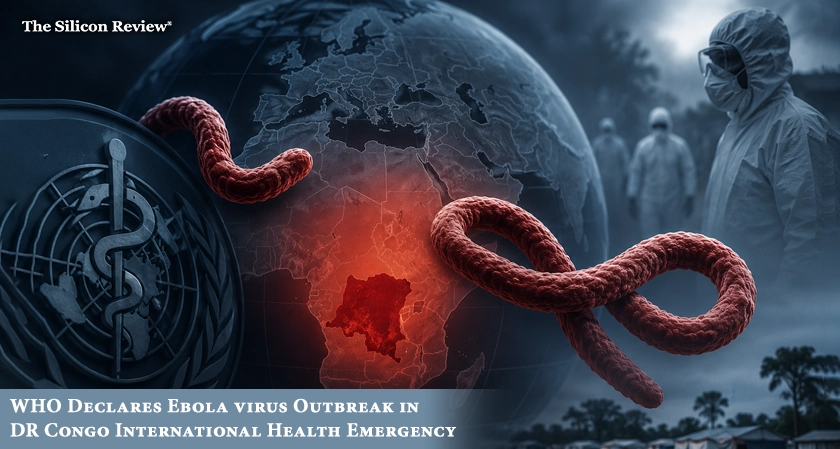
WHO Declares Ebola virus Outbr...WHO Declares Ebola virus Outbreak in DR Congo International Health Emergency
The Silicon Review
18 May, 2026
Author:
Vinay Kumar
WHO declared the Ebola virus outbreak in DR Congo a Public Health Emergency of International Concern. The Silicon Review reports on 336 suspected cases, 87 deaths, and the Bundibugyo strain’s lack of vaccines as Goma confirms cases and Rwanda closes its border.
The World Health Organization has declared the Ebola virus outbreak in the Democratic Republic of the Congo a Public Health Emergency of International Concern, marking the 17th Ebola virus outbreak in the country since the virus was first identified in 1976. As of May 17, 2026, health authorities have reported 336 suspected and confirmed cases across Ituri Province, with 87 deaths, according to Africa CDC Director General Jean Kaseya.
The outbreak is particularly alarming because it is caused by the Bundibugyo virus strain, for which no licensed vaccine or specific antiviral treatment currently exists. Unlike the more common Zaire strain, which has effective vaccines, the Bundibugyo strain carries a fatality rate of approximately 30 to 50 percent, based on previous outbreaks in 2007 and 2012. DRC Health Minister Samuel-Roger Kamba confirmed that the strain has "a very high lethality rate which can reach 50 percent."
The outbreak has already spread beyond DRC borders. Uganda confirmed two imported cases in Kampala on May 15 and 16, including a Congolese man who died in the capital city. Both patients were admitted to intensive care units. A laboratory has also confirmed an Ebola case in Goma, a rebel-held city of over one million people on the Rwandan border, after a woman traveled from the outbreak epicenter in Bunia following her husband's death.
Rwanda responded by closing key border crossings between Goma & Rubavu-Gisenyi indefinitely. The closure has paralyzed exchanges across one of the busiest crossings between the two countries. Only Congolese and Rwandan nationals returning to their respective countries are currently permitted to cross.
The outbreak is centered in Ituri Province's three health zones: Rwampara, Mongbwalu, & Bunia. Mongwalu is a high-traffic mining area, which has accelerated spread. According to WHO Director-General Dr. Tedros Adhanom Ghebreyesus, there are "significant uncertainties to the true number of infected persons and geographic spread." The Ebola virus outbreak has already killed four healthcare workers, raising serious concerns about infection prevention and control gaps in health facilities.
By August 2026, Africa CDC & WHO expect to complete genomic sequencing of the full outbreak strain and deploy rapid response teams across all high-risk border zones. The WHO has released $500,000 from its Contingency Fund for Emergencies to immediately support the response. However, researchers are only beginning to consider vaccine candidates for the Bundibugyo strain, with protocols still in "early stage" development.
The Africa CDC has rated the outbreak at Grade 3 its highest alert level with risk assessed as very high in DRC, high for eastern Africa, and moderate for the continent. The agency has warned that weak contact tracing, infection-control gaps, a four-week detection delay, and active community transmission in a peri-urban mining hub are hampering containment. The last Ebola outbreak in DRC, caused by the Zaire strain, was declared over in December 2025 after killing 45 people. The 2018-2020 outbreaks killed nearly 2,300 people.
The Silicon Review’s analysis indicates that the absence of Bundibugyo-specific countermeasures is forcing health authorities to rely entirely on public health fundamentals case isolation, contact tracing, safe burials, and community engagement making community trust the single most critical factor in containing this outbreak before it follows the trajectory of previous Ebola crises.
Q: What is the Bundibugyo Ebola strain and why is it dangerous?
A: The Bundibugyo strain is a species of Ebola virus first identified in Uganda in 2007. Unlike the more common Zaire strain, there are no licensed vaccines or specific antiviral treatments for Bundibugyo, making it particularly dangerous. The fatality rate in past outbreaks ranged from 30 to 50 percent.
Q: How many cases and deaths have been reported in the DRC Ebola outbreak?
A: As of May 17, 2026, 336 suspected and confirmed cases and 87 deaths have been reported. Eight cases have been laboratory-confirmed for Bundibugyo virus. The outbreak is centered in Ituri Province's Rwampara, Mongbwalu, and Bunia health zones.
Q: Has the Ebola outbreak spread beyond the Democratic Republic of the Congo?
A: Yes. Uganda has confirmed two imported cases in Kampala on May 15 and 16, both individuals who traveled from DRC. One case has also been confirmed in Kinshasa from a traveler returning from Ituri. The outbreak has also reached Goma, a city of over one million people on the Rwandan border.
Q: What is the WHO's official declaration regarding this Ebola outbreak?
A: The WHO declared the Ebola outbreak caused by Bundibugyo virus in DRC and Uganda a Public Health Emergency of International Concern on May 16, 2026. This is the second-highest alert level under international health regulations, below a pandemic emergency.
Q: What treatments are available for the Bundibugyo Ebola strain?
A: Currently, there are no approved vaccines or specific therapeutics for Bundibugyo virus disease. Unlike the Zaire strain, which has effective vaccines, Bundibugyo relies on early supportive care, case isolation, contact tracing, safe burials, and community engagement for control.
Q: Why did Rwanda close its border with DR Congo?
A: Rwanda closed key border crossings between Goma and Rubavu-Gisenyi after a confirmed Ebola case was reported in Goma, a rebel-held city of over one million people on the Rwandan border. The closure is indefinite, with only returning nationals permitted to cross.