>>
Other>>
Politics>>
China’s Foreign Policy Raise...China’s Foreign Policy Raise Pacific Tensions: Is Beijing Expanding Control Without Firing a Shot?
The Silicon Review
25 June, 2026
Author:
Jishnuu
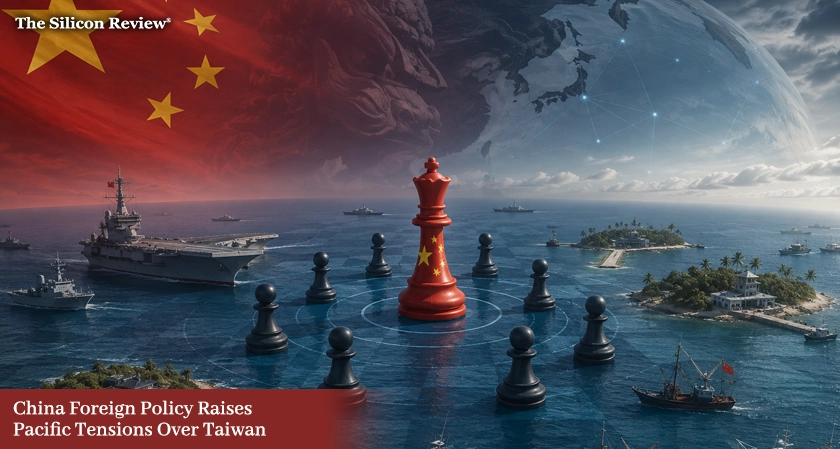
China Pacific Strategy salami slicing is raising alarms across the Indo-Pacific as Beijing expands its Pacific control through maritime patrols, seabed mapping, and gray-zone tactics near Taiwan without firing a shot.
China’s foreign policy and salami slicing strategy are once again under scrutiny as Beijing pushes its reach deeper into the Pacific. From law enforcement patrols east of Taiwan to seabed mapping and research missions in disputed waters, China is advancing its China Pacific strategy one calculated move at a time, fueling fresh Taiwan maritime tensions.
Analysts call it "salami slicing" taking small steps that avoid outright conflict but gradually strengthen territorial control.
No warships. No invasion. So why is the region worried?
For the first time, vessels from China’s Maritime Safety Agency operated beyond the strategically critical First Island Chain, a move experts see as more than routine patrol activity. Critics argue Beijing is creating new facts on the water while testing how far it can push regional boundaries.
The biggest concern is Taiwan.
Chinese state-linked messaging has suggested that waters east of Taiwan could eventually fall under Beijing’s jurisdiction, raising fears over future control of shipping routes and maritime access.
Is this law enforcement, or a slow-motion sovereignty claim?
Taiwan says the answer is clear. Officials accuse Beijing of using civilian vessels and gray-zone tactics to expand influence without triggering a military response.
The pattern is also visible in the South China Sea, where China’s activities around Scarborough Shoal have reignited concerns that temporary research projects could become permanent strategic footholds.
Meanwhile, the United States, Japan, the Philippines, and European powers have warned that such actions threaten regional stability and freedom of navigation.
What happens when every "small step" goes unanswered?
That is the question worrying security experts. Beijing is advancing its presence without firing a shot, while rivals struggle to decide where routine activity ends and territorial expansion begins.
For now, the strategy appears simple: move slowly, avoid escalation, and reshape the map one slice at a time. China's salami slicing strategy shows that influence is no longer built only through military power. By making small, calculated moves that stop short of open conflict, Beijing is steadily expanding its presence across the Pacific.
The real challenge for the region is not a sudden crisis, but whether these incremental gains will eventually become the new normal before the world decides to respond. The Silicon Review asks As China expands Pacific control one small step at a time, is the world witnessing a master class in strategic patience, or failing to recognize a major shift in regional power until it is too late?
FAQ:
Q: Why is China’s Pacific strategy attracting attention?
A: China has increased maritime patrols, seabed mapping, and research activities in sensitive waters near Taiwan and the South China Sea.
Q: Why is Taiwan central to this issue?
A: Taiwan sits at the heart of key Pacific shipping routes, and Beijing claims the island as part of its territory despite Taiwan’s self-rule.
Q: What is the First Island Chain?
A: It is a strategic line stretching from Japan through Taiwan and the Philippines, viewed as a critical security boundary in the western Pacific.
Q: Why are experts concerned about these maritime operations?
A: Critics believe the activities could strengthen China's Pacific control and gradually change the regional status quo.
Q: What are gray-zone tactics?
A: Gray-zone tactics are actions that fall between diplomacy and war, allowing countries to advance strategic goals without direct military confrontation.
Q: How could these actions affect regional stability?
A: They could increase Taiwan maritime tensions, challenge freedom of navigation, and raise security concerns across the Indo-Pacific.



















Comments