>>
Industry>>
Automobile>>
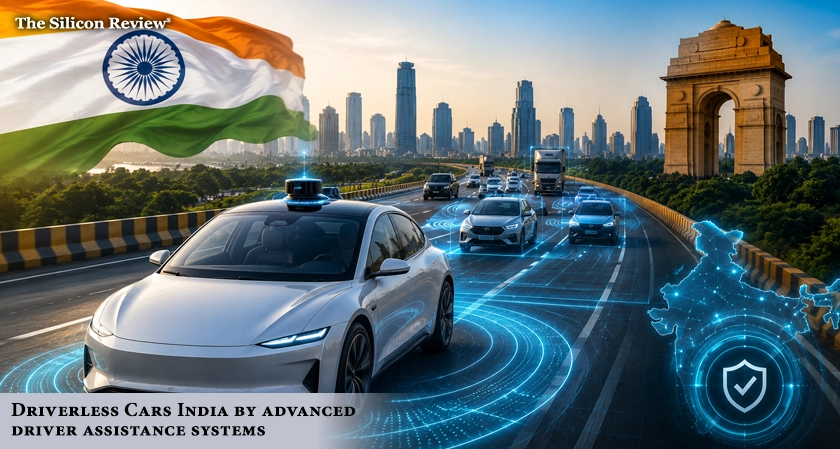
Driverless Cars India: India C...Driverless Cars India: India Clears Path for Advanced Driver Assistance Systems (ADAS) to Cut Road Deaths
The Silicon Review
12 June, 2026
Author:
Jishnuu
India has removed the licensing requirement for radar sensors used in vehicles, a major step expected to accelerate the adoption of driverless cars India technology and strengthen Advanced Driver Assistance Systems (ADAS) across the automotive sector.
India just tries removing a key barrier, bringing driverless mobility closer to reality.
India has simplified regulatory requirements for automotive radar sensors in the 77–81 GHz realband, a move set to accelerate the rollout of Advanced Driver Assistance Systems (ADAS) and strengthen the foundation for Driverless cars India.
Advanced Driver Assistance Systems (ADAS) are safety features in vehicles that use sensors, cameras, and radar to help drivers avoid accidents. They support functions like emergency braking, lane detection, and adaptive cruise control, reducing human error on the road.
The decision removes a long-standing regulatory step for automakers, allowing radar-based safety technologies to be deployed faster in vehicles. These systems power critical functions such as collision avoidance, emergency braking, adaptive cruise control, and blind-spot detection, all central to modern vehicle safety and partial automation.
India, the world’s third-largest automobile market, recorded more than 177,000 road fatalities in nearly half a million accidents in 2024, underscoring the urgent need for smarter safety systems. Officials said the move brings India in line with global standards already followed in markets like the United States and European Union.
With the licensing barrier removed, automakers can now directly adopt globally used radar components without redesigning India-specific versions. This is expected to cut costs, simplify supply chains, and speed up integration of safety technologies across vehicle segments.
Industry experts believe the reform marks a significant step toward scaling Driverless cars India, since radar systems form the backbone of autonomous driving infrastructure and next-generation mobility platforms, since radar systems form the backbone of autonomous driving infrastructure and next-generation mobility platforms.
The change also improves standardization across the automotive ecosystem, enabling manufacturers to use globally tested hardware while improving affordability and safety for Indian roads.
The Silicon Review asks, Will India’s decision to remove radar sensor licensing accelerate the adoption of driverless cars India and advanced driver assistance systems (ADAS), or are infrastructure and safety challenges still the bigger roadblock?
FAQ:
Q: What are advanced driver assistance systems (ADAS)?
A: ADAS are technologies like emergency braking, adaptive cruise control, and lane assistance that help improve vehicle safety.
Q: Why is this decision important?
A: It aligns India with global standards and helps reduce road accidents by enabling safer, smarter vehicle technologies.
Q: How will this affect car prices in India?
A: No. It supports partial automation and safety features, not full autonomy yet.
Q: Why is the 77–81 GHz band important for vehicles?
A: It is widely used in modern cars for radar-based safety and driver assistance technologies.
Q: Does this mean fully self-driving cars will arrive soon in India?
A: It supports ADAS and partial automation, not full autonomous driving yet.