>>
Industry>>
Lifestyle and fashion>>
Elisa Lim Made a Dream Dress f...Elisa Lim Made a Dream Dress for a Dying Teen Who Held Her Breath to See It. Now She's Changing Fashion Forever.
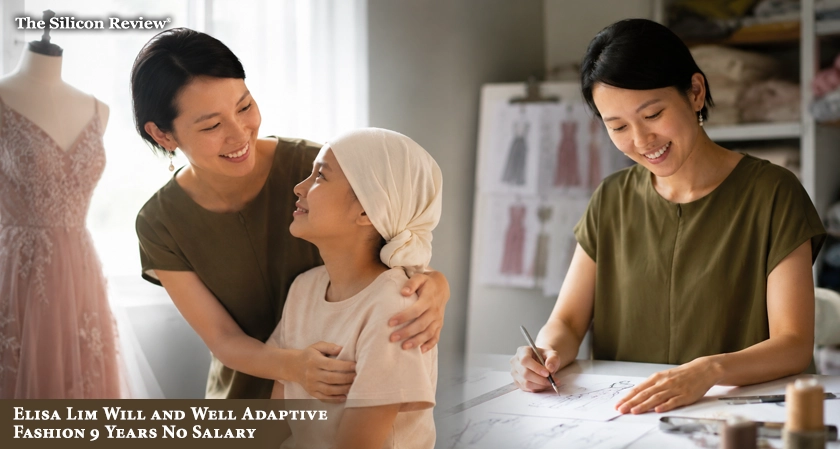
Singapore designer Elisa Lim has spent nine years creating adaptive fashion for people with disabilities through her label Will and Well often without paying herself a salary. The Silicon Review shares the story of a designer who chose purpose over profit, and the lives she has quietly transformed along the way.
Elisa Lim never wanted to be a luxury fashion designer. She wanted her craft to mean something. And for nine years, she has proven that fashion can be a force for dignity, independence, and love.
At 16, a knee injury ended her netball and ballet dreams. Out of frustration, she picked up sewing. She soon discovered she had a flair for it, and went on to pursue fashion design at LASALLE College of the Arts. Then a doctor approached her could she make clothes for elderly and bedridden patients? That question changed everything.
Lim founded Will and Well in 2017 to create clothing that works for real bodies. Wheelchair users who struggle with back zippers. People with muscular dystrophy who need wide neck openings for breathing tubes. Stroke survivors who cannot balance on one leg to put on pants. Children with autism who cannot tolerate scratchy fabrics.
One client was Timothy Chan. He modelled the OneTee, an adaptive T-shirt Lim designed with magnetic snaps and braille details. He had muscular dystrophy. He died two days before Lim sat down for an interview. She was heading to his wake afterward.
Another client was Amelia Ng. At 13, she was diagnosed with a rare nervous system disorder with no cure. She was bedbound, relied on a breathing support machine, and used a feeding tube. For her 14th birthday, she wanted a dream dress that lit up. Lim visited her twice to co-create it with her.
She returned with a pink dress with rainbow tulle and removable fairy lights. It had an opening at the top so caregivers would not have to disconnect her breathing machine to dress her. Amelia was non-verbal, but she blinked to indicate her preferences when Lim showed her fabric options.
When Lim arrived to show Amelia the dress, an alarm went off in the house. Amelia had held her breath because she could not wait to see it. She loved the dress so much she refused to take it off even for washing. She died at 18 in 2024. Her parents kept the dress.
Revenue covers materials and production, but Will and Well is not profitable. Lim has earned little to no salary for most months over nine years. She supplements her income by working weekends at a health tech company. Sixty percent of her clients are able-bodied they buy her clothes because they like the convenience of magnetic buttons and comfortable fits.
She was once offered a permanent role at a company making maternity products. She turned it down. She was offered an attractive income at a fintech company as associate director. She gave it up because she could not find meaning in the job.
"Growing up in Singapore, there is so much emphasis on career progression, making money and pursuing comfort," Lim said. "When I was younger, I wrestled with my worth in relation to income and career. You spend all this time, and you don't make an income. What's your worth? But I'm over that. I no longer tie my worth to making money."
When the industry told her inclusive fashion was not a viable business, she did not listen. When she ran out of the S$10,000 she had set aside, she kept going. When her clients died, she went to their wakes.
"People with disabilities desire the same as what you and I desire companionship, marriage, children, career," she said. "When you hang out with folks with life-limiting conditions, they are very mindful of when their death is. So when they think of career or things they do, they look for what's meaningful, not how much money they make out of it. It's the same for me, too."
As designer Elisa Lim continues running Will and Well with little to no salary, The Silicon Review shares the story of a woman who quietly proved that fashion can be inclusive one life at a time.
FAQ:
Q: Who is Elisa Lim?
A: Elisa Lim is the founder of Will and Well, a Singapore-based adaptive fashion label that creates inclusive clothing for people with disabilities, special needs, and medical conditions.
Q: What is Will and Well?
A: Will and Well is an inclusive fashion label that designs adaptive clothing for people with disabilities, the elderly, and those with medical conditions, offering both ready-to-wear and custom pieces.
Q: What are adaptive clothes?
A: Adaptive clothes are garments designed with features like magnetic snaps, front zippers, wide neck openings, and flat-lay designs to make dressing easier for people with limited mobility, sensory sensitivities, or medical equipment.
Q: What is the OneTee?
A: The OneTee is an adaptive T-shirt designed by Elisa Lim and creative agency Splash Productions. It features magnetic collar snaps, side zippers for wheelchair users, braille text for the visually impaired, and pop-its for sensory comfort.
Q: How long has Elisa Lim been running Will and Well without a salary?
A: Elisa Lim has been running Will and Well for nine years and has earned little to no salary for most of that time.
Q: How much does custom adaptive clothing cost?
A: Custom pieces from Will and Well start at approximately S$120 to S$300, while the ready-to-wear line is priced from S$29 to S$89.











Comments