>>
Industry>>
Automobile>>
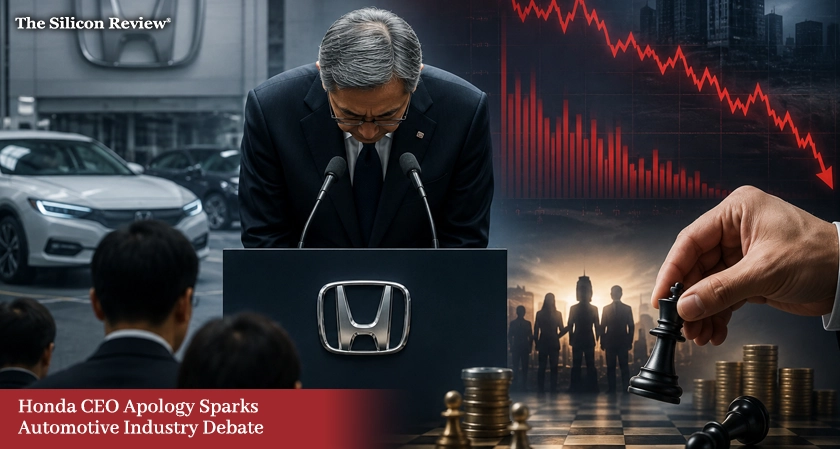
Honda CEO Apologises After His...Honda CEO Apologises After Historic Loss, but If Investors Still Back Him, Is the Automotive Industry Rewarding Failure?
The Silicon Review
26 June, 2026
Author:
Jishnuu
The Honda CEO has apologised after one of the company's darkest financial years, yet investors still chose to keep him in charge. If the automotive industry demands results, why is leadership surviving one of Honda's biggest setbacks?
Honda CEO Toshihiro Mibe has apologised after the company posted its first annual loss in nearly 70 years, yet shareholders still voted to keep him.
The Honda CEO is under pressure after apologising to shareholders for Honda's first annual net loss in almost seven decades. Despite the record loss, Toshihiro Mibe won enough support to remain on the company's board, raising fresh questions about leadership and accountability across the automotive industry.
Opening Honda's annual shareholder meeting, Mibe offered his "deepest apologies" for the company's financial performance. Honda's loss was driven by more than $9 billion in restructuring costs tied to its electric vehicle business, along with fierce competition from Chinese automakers that continues to reshape the global market.
If a CEO leads a company into its biggest loss in decades, should an apology be enough?
Honda is now trying to recover from expensive strategic mistakes made during its shift to electric vehicles. At the same time, Chinese rivals are growing faster, selling cheaper EVs, and putting pressure on long-established carmakers across the world.
Even so, shareholders chose stability over change. Investors approved Mibe's reappointment along with the company's other board nominees, signaling that many still believe the current leadership can turn Honda around.
Is this confidence in the future, or simply the absence of a better option?
The challenge facing Honda goes far beyond one difficult year. The company now has to prove it can compete in an automotive industry where success depends on electric vehicles, software, lower costs, and speed. Every decision from this point will shape Honda's position in a rapidly changing market.
The shareholder vote may have secured Mibe's position, but it did not erase the company's problems. Investors have offered more time, not a free pass. The real test begins now.
Honda now has another chance to recover, but shareholder trust alone cannot guarantee success. The Silicon Review asks if CEOs can survive historic losses with investor backing, is the automotive industry rewarding long-term vision, or lowering the bar for accountability?
FAQ:
Q: Why did the Honda CEO apologise?
A: Honda CEO Toshihiro Mibe apologised after Honda reported its first annual net loss in nearly 70 years, acknowledging the concern caused to shareholders.
Q: What caused Honda's historic loss?
A: The loss was mainly driven by more than $9 billion in electric vehicle (EV) restructuring costs and rising competition from Chinese automakers.
Q: Did shareholders support the Honda CEO?
A: Yes. Shareholders voted to reappoint Honda CEO Toshihiro Mibe and approved the company's full board at the annual meeting.
Q: Why is this important for the automotive industry?
A: The decision highlights the growing pressure on the automotive industry to balance EV investment, profitability, and leadership accountability.
Q: What are Honda's biggest challenges now?
A: Honda must restore profits, strengthen its EV strategy, compete with Chinese rivals, and regain investor confidence in the rapidly changing automotive industry.
Q: Will Honda's leadership change after the loss?
A: For now, no. Shareholders backed the current Honda CEO, showing support for continuity despite the weak financial results.
Q: What does this mean for Honda's future?
A: Honda must prove it can turn strategy into profit and stay competitive in the global automotive industry as the EV race intensifies.















Comments