>>
Industry>>
Gaming and vfx>>
Is Leading Anime and Gaming Pu...Is Leading Anime and Gaming Publisher Kadokawa Losing Investor Confidence After 60% Support Drop?
The Silicon Review
25 June, 2026
Author:
Jishnuu
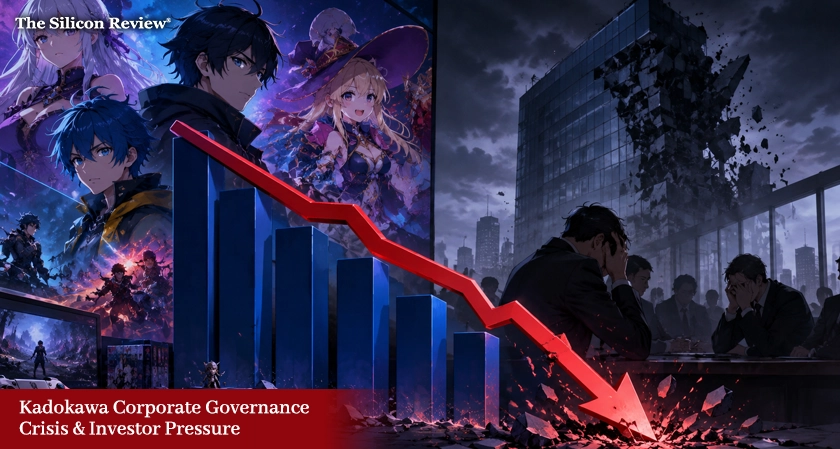
Kadokawa is facing a significant corporate governance setback after CEO Takeshi Natsuno’s shareholder backing declines to 59.68% at the AGM, exposing rising activist pressure, weak earnings momentum, and deepening investor frustration within Japan’s corporate system.
Kadokawa’s leadership crisis is no longer a quiet boardroom issue. It has become a visible signal of shifting power in Japan’s corporate landscape, where shareholders are starting to speak louder than ever before.
Is shareholder patience finally running out in Japan’s boardrooms?
At the annual general meeting of Kadokawa, CEO Takeshi Natsuno secured just 59.68% support for re-election. That’s a dramatic fall from nearly 90% last year, and it immediately raises a sharp question: how does confidence drop this fast in a listed company of this scale?
Activist investors are pointing to performance as the core issue. Funds such as Oasis Management have pushed for leadership change, arguing that profitability has weakened under the current management. Proxy advisers also opposed Natsuno’s re-election, adding more weight to the pressure building inside the AGM.
Are activists exposing real weaknesses or reshaping control of corporate Japan?
So the real question becomes: is this just a performance issue, or a deeper governance problem emerging inside the company?
Financial signals are not helping management’s case. Profitability has slipped, return on equity remains low, and investors are increasingly unsure whether Kadokawa’s strategy in anime, publishing, and gaming can stay competitive in a fast-moving global industry.
If profits are falling, is the strategy broken or just misunderstood?
If fundamentals continue to weaken, questions are now turning directly toward leadership. Investors are increasingly asking whether the current management is still equipped to keep pace with a rapidly changing media and entertainment market.
The company argues that replacing leadership without a clear successor could create instability, but that stance is doing little to ease concerns. Instead, rising costs, dependence on trend-driven publishing, and the recent shareholder vote are reinforcing a broader shift where investors in Japan are becoming more willing to challenge established corporate leadership.
Are we witnessing the end of passive shareholders in Japan?
Kadokawa’s slide to 59.68% CEO support is a loud signal that investor patience is cracking. A company once seen as a steady force in anime, gaming, and publishing is now under sharper scrutiny, with weak profits and activist pressure tightening the grip on leadership. Management is calling for stability, but shareholders are clearly demanding results, not reassurance. The gap between control and confidence is no longer small, it is widening fast. The Silicon Review asks has Kadokawa’s creative dominance started losing its financial grip on investors?
FAQ:
Q: Why is Kadokawa’s CEO under pressure?
A: Shareholder support for CEO Takeshi Natsuno fell to 59.68%, raising concerns about leadership performance and strategy at Kadokawa.
Q: What is the main concern raised by investors?
A: Weak profitability, rising anime production costs, and overreliance on trend-driven publishing models are driving investor dissatisfaction.
Q: What role are activist investors playing?
A: Activist investors such as Oasis Management are pushing for leadership change, arguing that stronger governance and better execution are needed to improve returns.
Q: Why is leadership change controversial?
A: The Company believes removing leadership without a clear successor could create instability and disrupt long-term planning.
Q: Is this issue only about Kadokawa?
A: No. Analysts say it reflects a broader shift in Japan where shareholders are becoming more active in challenging traditional corporate governance structures.
Q: What does the 59.68% vote actually indicate?
A: It shows declining confidence in leadership. The CEO remains in place, but investor trust has weakened significantly and is no longer comfortable.



















Comments