>>
Other>>
Politics>>
Keir Starmer resignation: 6 Pr...Keir Starmer resignation: 6 Prime Ministers in 10 Years. But If Brexit Was Supposed to
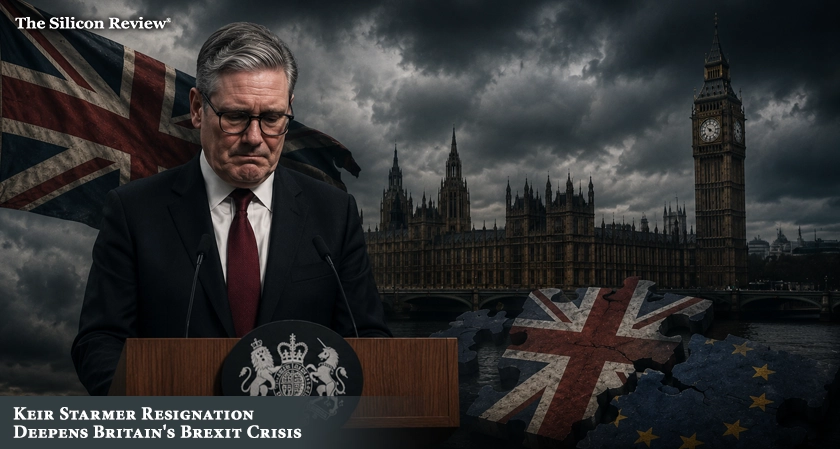
British Prime Minister Keir Starmer has resigned less than two years after leading Labour to a landslide victory, making him the sixth prime minister to leave office since the Brexit referendum in 2016. The Silicon Review asks: if Brexit was supposed to restore stability and democratic control, why has Britain become more politically unstable than at any point in two centuries?
Keir Starmer resignation: Shortly after 9:30am, Starmer stepped out of No10 with his wife Victoria. His supporters in Downing Street Deputy Prime Minister David Lammy, Attorney General Richard Hermer, and International Development minister Jenny Chapman cheered and applauded warmly as he approached the lectern. But one notable absence stood out. Chancellor Rachel Reeves, who actually lives in the flat above No10, chose not to attend.
The Prime Minister's voice wavered as he concluded his address. "When I leave the biggest job in the country, I shall spend more time on the most important job: being the best husband I can to my fantastic wife, Vic, and being the best dad I can, Thank you."
Less than two years ago, he walked through the same door as a hero. Labour had won 411 seats one of the largest majorities in British history. The Conservatives had been swept out after 14 years of chaos. Starmer promised "change." He promised "national renewal.”
Instead, he became the latest casualty of a political system that has been in crisis since Brexit. Starmer is the sixth prime minister in a decade. The only one to serve more than three years was Boris Johnson. Liz Truss lasted 49 days.
The immediate trigger was Andy Burnham's decisive by-election victory on June 18. Burnham, the popular mayor of Greater Manchester, won a seat in Parliament and immediately became the frontrunner to replace Starmer. Over 100 Labour MPs had already called for Starmer to go. Senior cabinet ministers including Foreign Secretary Yvette Cooper and Home Secretary Shabana Mahmood told him privately it was time to step down.
Is this resignation done on own or is it forced by someone?
His departure comes shortly after returning from the G7 Summit in the United States, where global leaders discussed economic strain, security concerns, and rising tensions in West Asia. But the bigger story is not just Starmer’s exit it is what his resignation says about modern British politics.
Six Prime Ministers have now resigned without completing their terms since Brexit. From Boris Johnson to Liz Truss, from Rishi Sunak to Keir Starmer, the revolving door at Downing Street keeps spinning.
Here is the question that no one in Westminster wants to answer. Brexit was supposed to restore sovereignty. It was supposed to end political chaos. It was supposed to let Britain "take back control." Instead, Britain has had six prime ministers in ten years the highest turnover in nearly two centuries. The country has become a cautionary tale for the West: a live experiment in modern populism that has produced instability, not strength.
Critics say repeated leadership changes are eroding public confidence, while supporters argue that accountability is simply part of British democracy. All eyes in Westminster are now on the contest to choose Britain's next leader.
The frontrunner appears to be Andy Burnham, who recently secured a major parliamentary victory in North West England and has quickly emerged as the favorite to succeed Starmer. But the race may not be smooth.
Will Labour choose a leader or stumble into a full-blown internal battle?
Labour MPs Al Carns and Darren Jones are reportedly considering leadership bids, which could force a contest instead of giving Burnham a clear path to power. Former Health Secretary Wes Streeting has already backed Burnham, strengthening his position ahead of the nomination process.
Nominations for Labour leadership open on July 9 and close on July 16. If no challenger gains enough support, Burnham could become Prime Minister as early as July 17. Starmer's resignation highlights the profound impact Brexit continues to have on British politics, years after the UK's departure from the European Union.
As Westminster prepares for yet another leadership battle, The Silicon Review asks If Brexit was supposed to restore stability, why is Britain more politically unstable than ever? And if leadership changes every two years, who is really running the country?
FAQ:
Q: Why did Keir Starmer resign as Prime Minister?
A: Keir Starmer announced his resignation after facing mounting internal Labour Party tensions and increasing pressure over his leadership.
Q: Who is likely to replace Keir Starmer?
A: Andy Burnham is widely seen as the leading contender, although other Labour MPs could still enter the leadership race.
Q: When will the Labour leadership election take place?
A: Nominations open on July 9 and close on July 16. The new leader could be confirmed shortly afterward.
Q: Who are the potential challengers to Andy Burnham?
A: Labour MPs Al Carns and Darren Jones are reportedly considering leadership bids.
Q: What happens after Keir Starmer's resignation?
A: Labour will begin the process of selecting a new leader, who is expected to become the next Prime Minister if the party maintains its governing position.
Q: How many Prime Ministers has the UK had since Brexit?
A: Britain has seen multiple leadership changes since Brexit, with six Prime Ministers resigning before completing their terms.
Q: What role does Brexit play in Britain's political instability?
A: Many analysts argue Brexit has reshaped British politics, creating long-term divisions and leadership challenges across multiple governments.













Comments