>>
Industry>>
Capital Market>>
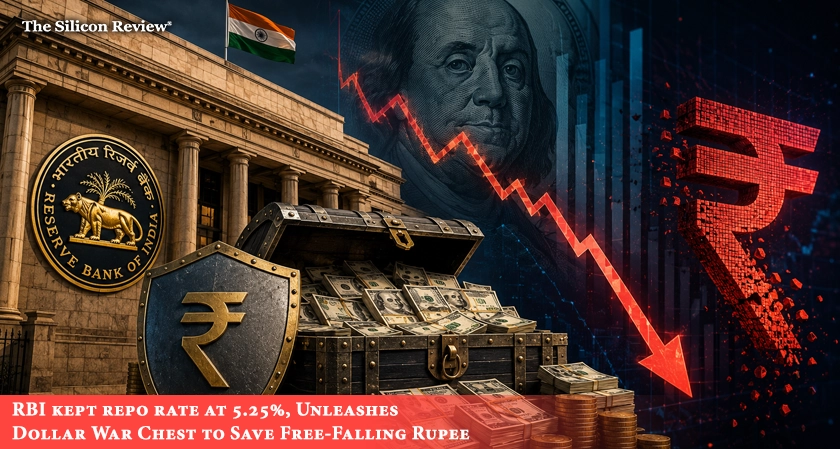
RBI kept repo rate at 5.25%, U...RBI kept repo rate at 5.25%, Unleashes Dollar War Chest to Save Free-Falling Rupee
The Silicon Review
05 June, 2026
Author:
Sashindra Suresh
RBI kept repo rate at 5.25% but unveiled a dollar war chest to prop up the rupee. The Silicon Review examines why the central bank is holding rates while throwing everything else at the currency crisis.
The Reserve Bank of India held its repo rate steady at 5.25 percent on Friday, but the real action was elsewhere. The central bank unveiled a dollar war chest to save a rupee that has been bleeding value since the Iran war began.
The six-member Monetary Policy Committee voted unanimously to keep the repo rate unchanged and retained its neutral stance. On paper, nothing changed. In reality, everything changed.
The RBI held rates because raising them would crush growth. But it can't cut rates because that would kill the rupee. So it's doing neither. The currency is paying the price.
The rupee has fallen nearly 5 percent to historic lows since the Gulf conflict erupted in late February. Foreign investors have pulled money out. Oil prices have surged. The central bank has been forced to sell dollars from its reserves just to slow the slide. In March alone, the RBI sold nearly $11 billion worth of foreign currency to prop up the rupee.
But selling reserves is not a strategy. It is a stopgap.
So the RBI got creative. The government scrapped capital gains tax for foreign investors holding government bonds. The central bank opened concessional forex swap windows for public sector companies and offered to cover hedging costs for banks raising deposits from non-resident Indians. The goal is simple: pull in dollars. Any dollars. From anywhere.
The RBI raised its inflation forecast while trimming growth projections. Governor Sanjay Malhotra noted that the global environment has deteriorated and it is "prudent" to wait for greater clarity. Oil prices remain elevated. The Strait of Hormuz is still effectively closed. And the central bank's foreign exchange reserves have dropped from $728 billion in early March to $688 billion in late May.
The moves echo a 2013 playbook when the RBI last faced a currency crisis. Back then, concessional swap windows helped draw in dollars. Whether they will work this time depends on whether global investors believe India is a safe bet.
The RBI rejected reports that it sold $12 billion worth of gold reserves to defend the currency. The central bank said its physical gold stock remains unchanged at around 880 metric tonnes, and gold's share in total reserves has actually increased.
But the rupee's slide is not just about India. Across the region, Indonesia, the Philippines, and Sri Lanka have raised interest rates in recent weeks. South Korea has signaled a turn is imminent. The US dollar is strong. Global capital flows are volatile.
The RBI has chosen a middle path: hold rates, flood the system with dollar incentives, and hope the worst passes. It is a high-stakes gamble.
As the RBI holds rates at 5.25 percent while deploying a dollar war chest to rescue the free-falling rupee, The Silicon Review examines why India's central bank is treating the currency like a patient in intensive care while insisting the economy is perfectly healthy.
Q: What is the current RBI repo rate after the June 2026 MPC meeting?
A: The RBI kept the repo rate unchanged at 5.25 percent. The six-member Monetary Policy Committee voted unanimously to hold rates and retain a neutral stance.
Q: Why is the RBI not cutting interest rates despite economic pressures?
A: The RBI is prioritizing currency stability. Cutting rates would likely weaken the rupee further, making imports more expensive and fueling inflation. The central bank is waiting for greater clarity on global developments.
Q: What steps has the RBI taken to support the falling rupee?
A: The RBI announced concessional forex swap windows for public sector companies, offered to cover hedging costs for banks raising foreign currency deposits, and the government scrapped capital gains tax for foreign investors in government bonds .
Q: How much have India's foreign exchange reserves declined?
A: India's forex reserves fell from $728.49 billion in early March 2026 to $688.89 billion by May 22, 2026, a drop of nearly $40 billion. In March alone, the RBI sold nearly $11 billion worth of foreign currency.
Q: Did the RBI sell gold reserves to defend the rupee?
A: No. The RBI and government rejected reports claiming $12 billion worth of gold was sold. The central bank said its physical gold stock remains unchanged at around 880 metric tonnes, and gold's share in reserves has actually increased.
Q: What is the RBI's GDP growth forecast for FY27?
A: The RBI retained its real GDP growth projection for FY27 at 6.6 percent, signaling confidence in domestic economic resilience despite global headwinds.