>>
Industry>>
Defense technology>>
South Korea Military on Alert ...South Korea Military on Alert as Chinese, Russian Aircraft Enter Air Defence Identification Zone: Routine Flight or Deliberate Provocation?
The Silicon Review
27 June, 2026
Author:
Jishnuu
South Korea's military on alert after more than 10 Chinese and Russian military aircraft entered the Korea Air Defense Identification Zone (KADIZ) Was this a routine flight, or a warning disguised as one?
The South Korea military was forced into action after Chinese and Russian warplanes entered the air defence identification zone, once again putting regional security on edge. No shots were fired, but the message was loud: tensions in Northeast Asia are far from cooling.
South Korea's military is on edge, and the skies over the East Sea tell the story.
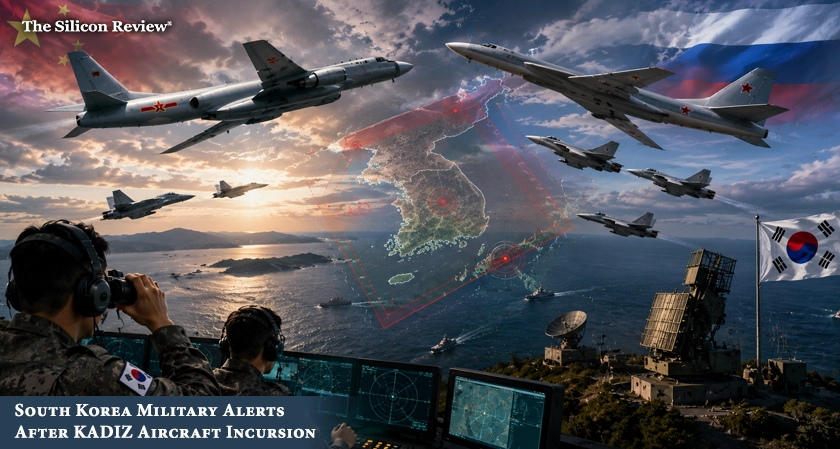
On Saturday, June 27, South Korea's Joint Chiefs of Staff confirmed that more than 10 Chinese and Russian military aircraft entered the Korea Air Defence Identification Zone, known as KADIZ, over the East Sea and the South Sea. Seoul's response was immediate. South Korea's military detected the aircraft before they entered the zone and scrambled Air Force fighter jets to prepare for any contingency.
When two of the world's strongest militaries fly together near your borders, is it really just a routine patrol?
The aircraft never entered South Korean sovereign airspace, and neither China nor Russia immediately explained the mission. While entering an air defence identification zone is not illegal, it is rarely viewed as routine. The zone exists to give countries time to detect and respond to approaching aircraft. Ignoring that expectation sends its own strategic message.
This isn't new. In December 2025, nine Chinese and Russian military aircraft entered the KADIZ, prompting formal protests from Seoul and security concerns from Japan. Beijing and Moscow called it a routine joint patrol. The flights ended, but the questions never did.
Now, just months later, the number has grown. More than 10 aircraft this time. No notification. No explanation. No apology.
Routine patrol or rehearsed provocation? the line is getting dangerously thin.
For Seoul, the strategic calculus is deeply uncomfortable. South Korea sits at the intersection of great power rivalry, bordered by a nuclear-armed North Korea, navigating alliances with the United States while managing economic ties with China. Every incursion into the KADIZ forces South Korea's military to respond swiftly, publicly, and carefully, all at once.
The aircraft may have left the zone without incident. But the message they carried lingers long after they crossed back out.
The skies may be clear again, but the strategic contest is only growing sharper. As China and Russia increase coordinated military flights, The Silicon Review asks Are these patrols about security, or are they slowly redefining the limits of regional power without firing a shot?
FAQ:
Q: What is the Korea Air Defence Identification Zone?
A: The KADIZ is a buffer zone around South Korea where the military monitors and identifies approaching aircraft for national security purposes. It is not sovereign airspace but serves as an early warning boundary.
Q: Did the Chinese and Russian aircraft violate South Korean airspace?
A: No. The aircraft entered and exited the KADIZ but did not cross into South Korea's sovereign airspace.
Q: How did South Korea's military respond?
A: South Korea's military detected the aircraft before they entered the zone and deployed Air Force fighter jets as a precautionary measure.
Q: Has this happened before?
A: Yes. In December 2025, nine Chinese and Russian military aircraft entered the KADIZ in a joint patrol, prompting formal protests from Seoul and concern from Japan.
Q: What did China and Russia say about the incident?
A: Neither China nor Russia offered an immediate comment following the June 27 incursion.
Q: Did the Chinese and Russian aircraft violate South Korean airspace?
A: No. South Korea confirmed the aircraft entered the KADIZ but did not breach its sovereign airspace.




















Comments