>>
Technology>>
Security>>
Telegram Ban in India: Governm...Telegram Ban in India: Government Blocks 100 Million Users to Catch a Few Scammers. Who Is Really Being Punished Here?
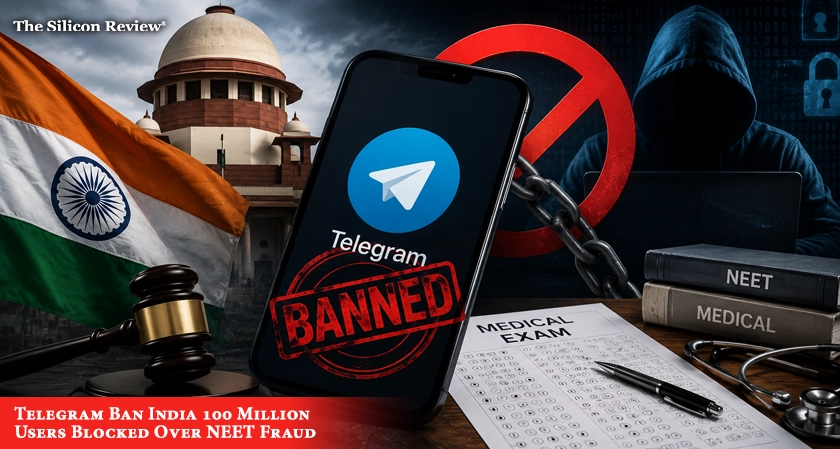
India has blocked Telegram for over 100 million users until June 22 to prevent medical exam fraud, after scammers used the platform to cheat students. The Silicon Review asks: when the government punishes millions to catch a handful of criminals, is that public safety or just collective punishment?
India has blocked Telegram. Over 100 million users across the country cannot access the app. The reason? Exam fraud. Scammers used Telegram to promise medical students leaked question papers for the NEET-UG re-examination scheduled for June 21.
The government says it had no choice. It called the ban a "last resort" after earlier efforts to take down specific channels "had not produced" sufficient results. The Ministry of Electronics and Information Technology invoked Section 69A of the Information Technology Act, the same provision activists say is used to curb free speech.
Here is what the government's own investigation actually found. Ahmedabad police arrested two men from Rajasthan running fraudulent Telegram channels named "Raghav_Singh_NEET" and seven others. The scammers contacted approximately 1,000 mobile numbers and swindled about ₹1.5 crore. They created websites and inflated subscriber counts to appear legitimate. They asked students and parents for money via QR codes and direct transfers. No actual exam paper was ever recovered.
Let us be honest about what this Telegram ban in India really represents. Two scammers in Rajasthan with a few fake channels. Twelve complaints across different states. One point five crore rupees in fraud. That is criminal activity. That is prosecutable. That is not a reason to block a platform used by over 100 million Indians for education, business, and personal communication. The government is using a sledgehammer to kill a mosquito. And the collateral damage is millions of legitimate users.
The Internet Freedom Foundation called the ban a "disproportionate" and "band-aid solution”. They pointed out that the government's own admission shows channel-level takedowns were working. The NTA stated it had secured the "prompt take-down of a substantial number of Telegram channels, groups and bots" and that this work "is the reason the harm caused by these rackets has been contained to the extent it has”. If targeted takedowns contained the harm, the case for a blanket block collapses.
The ban also disables Telegram's message-editing feature until June 30. The government says scammers used it to fabricate "paper leak" evidence by editing old messages while retaining original timestamps. Again, a feature used by millions is disabled because a few abused it.
Here is the question no one in the government wants to answer. If the NEET exam paper is secure and no leak exists, as the NTA has repeatedly stated, what exactly is being suppressed? The agency itself said "the security of the examination is unaffected by the action taken”. If the exam is secure and no leak exists, the ban targets rumour and misinformation, not actual fraud. And as IFF noted, "rumour cannot justify closing a platform when specific blocking and criminal prosecution remain available”.
The Telegram ban in India comes at the worst possible time. Thousands of students depend on Telegram for study groups, doubt-clearing, and shared resources. The ban hits them in the final days of NEET preparation. Scammers using a few Telegram channels are the problem. The solution should be to go after the scammers. Instead, the government is silencing an entire platform.
As India blocks Telegram over medical exam fraud concerns, The Silicon Review asks a final question. When the government's own investigation shows that two scammers with twelve complaints are the actual threat, why is the punishment being felt by 100 million legitimate users? And when will the government stop blaming the tool and start fixing the systemic failures that make exam fraud possible in the first place?
FAQ:
Q: Why did India ban Telegram?
A: India blocked Telegram until June 22 due to concerns over medical entrance exam fraud where scammers used the platform to cheat students.
Q: How many users are affected by the Telegram ban in India?
A: Over 100 million Telegram users in India are affected by the temporary ban.
Q: When will the Telegram ban in India be lifted?
A: The Telegram ban in India is scheduled to remain in place until June 22, the day after the NEET re-examination.
Q: Did the government capture the scammers behind the Telegram fraud?
A: Yes, Ahmedabad police arrested two men from Rajasthan for running fraudulent Telegram channels promising leaked exam papers.
Q: How much money did the Telegram scammers allegedly steal?
A: The scammers swindled approximately ₹1.5 crore from students through fraudulent Telegram channels.
Q: Why did critics call the Telegram ban "disproportionate"?
A: The Internet Freedom Foundation argued the ban was a "band-aid solution" that punishes millions of legitimate users instead of targeting specific fraudsters.
Q: What other feature did the government restrict besides the Telegram ban?
A: The government directed Telegram to disable its message-editing feature in India until June 30 to prevent fabricated "paper leak" evidence.




















Comments