>>
Industry>>
Startups>>
AMD AI Targets Nvidia's Strong...AMD AI Targets Nvidia's Stronghold: Why Is a Rising Self-Driving Startup Ditching Its Nvidia-Only Strategy for AMD GPUs?
The Silicon Review
06 July, 2026
Author:
Jishnuu
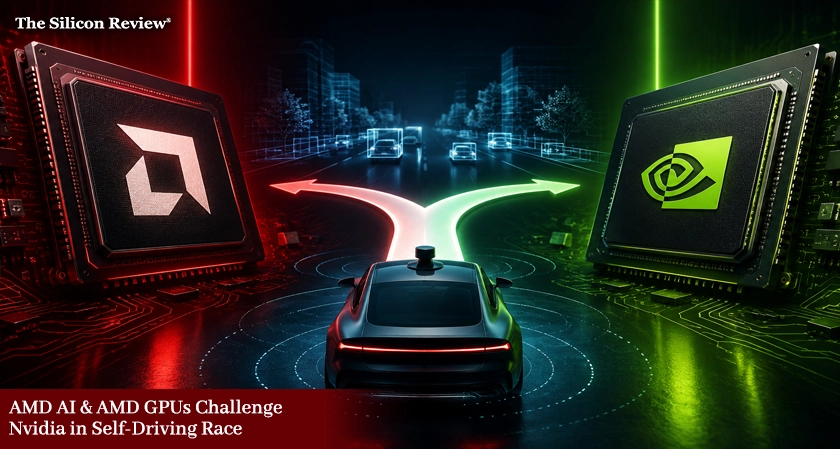
AMD AI is making a bold move into autonomous driving as Japanese startup Turing adopts AMD GPUs and secures AMD Ventures backing. Is Nvidia's grip on AI finally beginning to crack?
For years, Nvidia has been the undisputed force behind the AI powering autonomous vehicles. Now, AMD AI is making a direct play for that market, and one ambitious startup is betting that the future doesn't belong to a single chipmaker.
Japanese self-driving startup Turing has secured investment from AMD Ventures while officially integrating AMD GPUs into its AI infrastructure, ending its complete reliance on Nvidia hardware. Around 10% of its AI training now runs on AMD accelerators, with plans to expand that share as the company targets a commercial launch by 2028.
If Nvidia has dominated AI for years, why are startups suddenly looking elsewhere?
According to Turing executives, the answer is simple: lower costs, supply diversification, and long-term competitiveness. Autonomous driving demands enormous computing power, making hardware one of the biggest expenses for AI developers. By adopting AMD GPUs, Turing believes it can cut costs while reducing dependence on a single supplier.
"We've made notable progress with the technology. There's a lot more we can show to potential auto partners. We need to focus our efforts more on the business aspect," said Masato Morishima, Turing's Chief Financial Officer.
The timing is no coincidence. Japan's autonomous driving race is intensifying, with rivals including Nissan, Wayve Technologies, and Uber Technologies preparing pilot robotaxi services. As competition grows, every technology decision could determine who reaches the finish line first.
Could AMD AI become the biggest disruptor in autonomous driving without even building a single car?
Turing says it is not concerned about entering the market later than competitors, arguing that vehicle development cycles typically last three to five years, leaving plenty of room for companies that can deliver smarter and more affordable technology.
"Technology adoption will likely be extremely gradual. We may look like we're late to the game, but we'll make it work and we'll do so more cost-effectively," Morishima added.
The startup also announced a $79 million extension to its previous Series a funding round, valuing the company at around $600 million, although the size of AMD Ventures' investment remains undisclosed.
If AMD wins the AI chips, could it also win the future of self-driving?
Turing CEO Issei Yamamoto believes autonomous driving will define Japan's next industrial chapter.
"Autos is a very important industry in Japan. If Japan ends up losing this industry, we won't have anything to export. And autonomous driving will be a key factor for the future. We're the ones with the most advanced tech in this field, at least here in Japan," said Issei Yamamoto, Co-founder and CEO of Turing.
As AMD AI pushes deeper into next-generation computing and AMD GPUs expand beyond traditional data centers, The Silicon Review Asks Is Nvidia's dominance in AI infrastructure beginning to crack, or is this just the first move in a much larger battle for the future of autonomous driving?
FAQ:
Q: What is AMD AI's latest move in autonomous driving?
A: AMD AI has entered the autonomous driving space by backing Japanese startup Turing through AMD Ventures and supplying.
Q: Why is Turing adopting AMD GPUs?
A: Turing says AMD GPUs offer lower costs, supply diversification, and a more competitive long-term AI infrastructure compared with relying on a single hardware provider.
Q: Will Turing stop using Nvidia GPUs?
A: No. Turing still uses Nvidia hardware for most of its AI workloads, but around 10% of its AI training has already shifted to AMD GPUs.
Q: When will Turing launch its self-driving technology?
A: The Company aims to commercially launch its autonomous driving software and robotaxi services by 2028.
Q: How much funding has Turing raised?
A: Turing recently secured a $79 million funding extension, valuing the company at approximately $600 million.
Q: Why are AMD GPUs important for AI development?
A: AMD GPUs provide the high-performance computing power needed to train and run complex AI models while offering companies an alternative to Nvidia's ecosystem.
Q: Who are Turing's main competitors?
A: Turing competes with autonomous driving initiatives involving Nissan, Wayve Technologies, and Uber Technologies, among other global self-driving developers.




















Comments