>>
Industry>>
Robotics>>
China Robot Revolution Begins:...China Robot Revolution Begins: Is the New AI Machine Redefining the Future of Work?
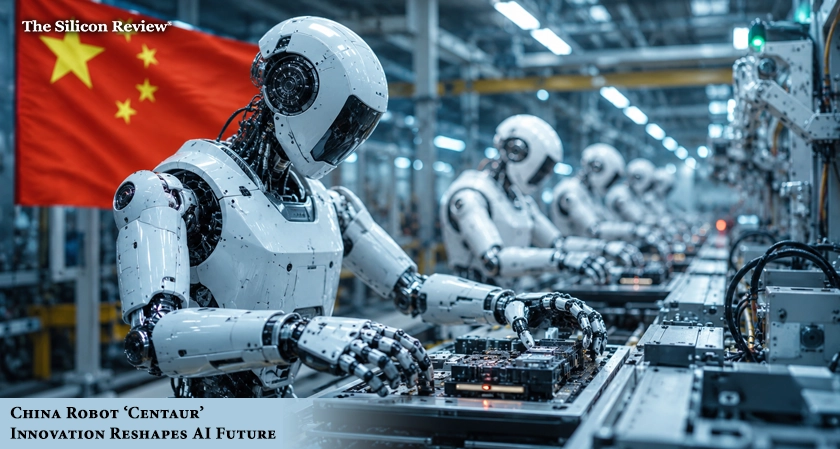
China robot innovation surges as a new AI machine combines speed, strength, and autonomy. Is China building the future of automation or a new tech battlefield?
China robot technology has entered a new phase after Shanghai-based Run Robotics unveiled the world’s first “centaur” wheel-leg hybrid robot at the 2026 World Artificial Intelligence Conference (WAIC). Built with over 95% domestically produced core components, the machine highlights China’s growing push to lead the global AI and robotics race. Is this a productivity breakthrough or the beginning of a new technology battle?
The robot combines the speed of wheels with the flexibility of legs, allowing it to navigate rough environments while performing complex tasks. Designed for industrial inspection, firefighting, emergency rescue, and high-risk operations, it signals a shift from experimental robotics to real-world deployment.
But is this just innovation or a sign that the global AI race is entering a more competitive era?
Unlike traditional humanoid robots that rely on two-legged movement, Run Robotics’ “centaur” uses a four-wheel mobility system for faster, more stable movement. Its human-like robotic arms allow it to clear obstacles, operate equipment, and assist in critical missions.
The launch comes as China accelerates its push into artificial intelligence and smart manufacturing. WAIC 2026 brought together more than 1,000 companies and 3,000 exhibits, showcasing rapid advances in robotics, AI models, and automation.
Can China’s AI robot industry transform workplaces or create new challenges for human workers?
Run Robotics CEO Zhou Bin said the “Centaur” robot was built to solve key robotics challenges, including limited adaptability and barriers to large-scale deployment. The machine can carry 100 to 120 kilograms on average, with a maximum static load of 210 kilograms.
Zhou Bin, CEO of Run Robotics, said the birth of the "centaur" robot is not merely a technological breakthrough, but the result of product iteration.
Equipped with lidar, binocular vision, and depth cameras, it can understand surroundings, detect objects, avoid obstacles, and plan movements independently.
Designed for extreme environments, the robot can operate in steel plants, oilfields, radiation zones, and emergency rescue sites. Run Robotics plans to begin assembly-line production in the fourth quarter of 2026 and has already secured commercial orders.
China’s robotics industry is expanding rapidly, with government data showing Chinese-developed humanoid robots account for more than half of the global total.
The rise of the China AI robot sector reveals a deeper debate, China is proving it can build advanced machines, The Silicon Review asks If robots can work like humans, who decides how much power they should have?
FAQ:
Q: What is the latest China robot innovation?
A: The latest China robot breakthrough is Run Robotics’ “centaur” wheel-leg hybrid robot unveiled at WAIC 2026.
Q: What makes the China AI robot different from traditional robots?
A: The China AI robot combines wheels, legs, robotic arms, and advanced sensors to perform complex tasks in challenging environments.
Q: Where can the new China robot be used?
A: The China robot is designed for industrial inspections, firefighting, emergency rescue, mining, oilfields, and hazardous operations.
Q: How advanced is China’s AI robot technology?
A: China AI robot technology is rapidly advancing, with the country becoming a major global player in intelligent robotics and automation.
Q: Who developed the new China robot?
A: Shanghai-based Run Robotics developed the “centaur” robot with more than 95% of its core components produced domestically.
Q: Why is the China robot industry growing quickly?
A: The China robot industry is expanding due to strong AI research, manufacturing capabilities, government support, and rising demand for automation.
Q: Can China AI robots replace human workers?
A: China AI robots are designed to assist humans in complex tasks, but their long-term impact on jobs remains a major global debate.
Q: When will the new China robot enter production?
A: Run Robotics plans to begin assembly-line production of the robot in the fourth quarter of 2026.




















Comments