>>
Other>>
Politics>>
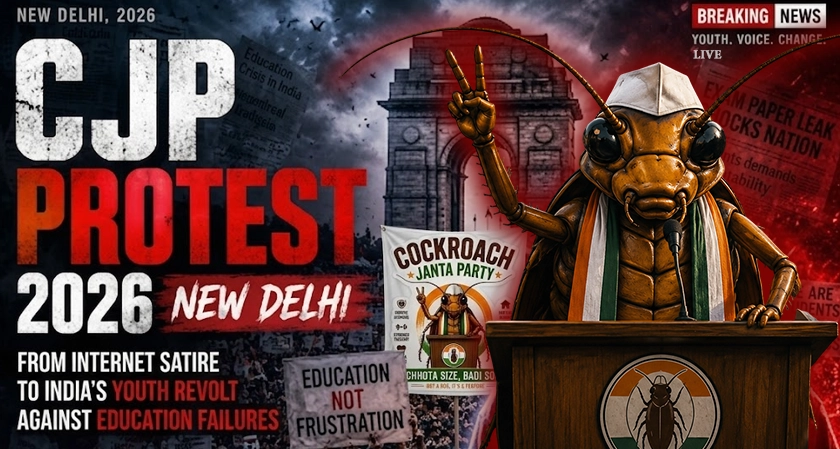
CJP Protest 2026 New Delhi: Fr...CJP Protest 2026 New Delhi: From Internet Satire to India’s Youth Revolt against Education Failures
The Silicon Review
21 July, 2026
Author:
Jishnuu
| July 25, 2026 - 6:20 PM IST | The Silicon Review Live |
One Minister Has Fallen. The Protest Has Ended. But Has Justice Actually Arrived?
The Cockroach Janta Party (CJP) has officially called off its protest at Jantar Mantar, bringing an end to one of the longest student-led demonstrations after 36 days of continuous mobilisation. The announcement came during a joint government-CJP press conference with Union Ministers J.P. Nadda and Jitendra Singh, shortly after Dharmendra Pradhan resigned as Union Education Minister.
The CJP Ends Protest decision came after the government accepted key demands raised by the group, including action linked to the NEET UG 2026 controversy, compensation concerns, and withdrawal of cases against protesters.
Prime Minister Narendra Modi has not issued any public statement on the development so far.
Is silence from the top a strategic decision, or a sign that the government wants the controversy to settle quietly?
The latest Jantar Mantar Protest Live Updates show a major shift from confrontation to negotiation, with CJP spokespersons Saurav Das and Ashutosh Ranka saying the protest was withdrawn in "good faith" after receiving government assurances.
The Government Accepted the Demands. Now Comes the Hardest Part: Keeping Them.
The government has agreed to these demands, but the next challenge is implementation.
Is this a genuine accountability moment, or simply the first step toward ending a protest that created mounting pressure?
"The government has accepted all our demands after 36 days of protest. Our demands were not radical but basic," Ashutosh Ranka said.
A Victory for Democracy, But the Final Verdict Is Still Pending.
Sonam Wangchuk described the development as a "victory of democracy," but the statement carried a deeper warning.
The protest demonstrated that public pressure can influence political decisions. However, the real measure of success will depend on whether promises turn into action.
A resignation changed the political landscape. Implementation will decide whether the movement achieved lasting impact.
The Protesters Left the Streets. The Pressure Did Not Leave the Government.
According to CJP representatives, the government has assured compensation for families of NEET victims under applicable rules. The administration has also agreed to withdraw FIRs filed against protesters, including cases beyond Delhi, and provide written confirmation of the commitments.
The group said a broader five-point education and examination reform charter will be discussed with the government after four weeks.
Does a written assurance guarantee reform, or does it simply shift the responsibility of monitoring promises onto the public?
The Protest Ended With Promises. The Future Depends on Proof.
Before the final announcement, CJP founder Abhijeet Dipke reminded supporters of the human cost behind the movement by reading the names of students who died by suicide allegedly linked to the paper leak controversy.
The emotional moment highlighted that the protest was never only about one minister or one resignation. It was about trust in India’s examination system and demands for accountability.
Dharmendra Pradhan’s resignation letter highlighted his contribution to education reforms, while BJP leaders praised his tenure. However, for affected families and protesters, the resignation is only one part of a larger resolution.
Compensation must reach those who need it. FIRs must be formally withdrawn. Education reforms must move beyond announcements.
Beyond demands and negotiations, Jantar Mantar became a surprising mix of protest, memes, and satire. The streets briefly looked like a superhero convention with a political mission as protesters arrived dressed as Batman, Spider-Man, and even Aamir Khan’s alien character from PK.
Social media added another twist, joking that Jantar Mantar had become Delhi’s most unexpected networking spot, where people came looking for both a cause and a connection.
Behind the humour was a serious strategy. Memes, costumes, and satire helped protesters stay visible, creative, and united through a 36-day battle.
Was humour just a distraction, or the protest’s most powerful weapon?
Finally The Movement Achieved a Victory. History Will Judge What Came After.
The CJP Ends Protest announcement closes one chapter of the Jantar Mantar movement, but the accountability debate continues. The Silicon Review asks Was this a historic resolution, or simply a temporary pause in a larger conflict over exam transparency and student rights? The government has accepted the demands. The protesters have returned home. But the credibility of the agreement will depend on what happens next.
The real victory will not be measured by a press conference or a resignation letter. It will be measured by whether promises are fulfilled and whether the education system earns back the confidence of millions of students.
Jantar Mantar may have gone silent, but the questions raised by the movement remain alive. The next phase will determine whether this was the end of a protest or the beginning of meaningful change.
| July 25, 2026 - 5:30 PM IST | The Silicon Review Live |
One Minister Has Fallen. But the Movement’s Biggest Test Has Just Begun.
Dharmendra Pradhan is out as Union Education Minister. In a post on X on Saturday, he said he stepped down to prevent "anti-national forces" from exploiting the unrest at Jantar Mantar and to ensure students spend their time studying rather than fighting legal battles.
Prime Minister Narendra Modi has said nothing. Not one word.
Is silence from the top a strategy, or a sign the government doesn't yet know how to respond?
At the CJP Protest site, founder Abhijeet Dipke broke the news to a roaring crowd, calling it the movement’s first major breakthrough after 36 relentless days on the streets. But beyond the celebrations came a clear message: two demands remain.
Environmentalist Sonam Wangchuk, fresh off a 26-day hunger strike, called the moment a "victory of democracy." However, he also made it clear that the celebration comes with unfinished business attached.
The Fight Is Only Half Won. Two Demands Still Remain That The Government Hoped You Would Forget
The CJP launched this movement with three non-negotiable demands:
- Resignation of Dharmendra Pradhan as Union Education Minister, now fulfilled.
- ₹1 crore compensation for the families of students who allegedly died by suicide in connection with the NEET UG 2026 paper leak controversy.
- Criminal action against those responsible for the alleged NTA Paper Leak, along with accountability for police personnel accused of using force against protesters on July 20.
One down. Two to go. And Dipke is not backing off.
Is this genuine accountability, or the bare minimum designed to bring the protests to an end?
"We have two more demands. We will not go like that. We are cockroaches. Once it enters, it does not leave," Dipke told the crowd, sending a warning that the government cannot ignore.
Sonam Wangchuk’s "Victory of Democracy" Comes With a Warning
Wangchuk's words are already everywhere. But beyond the celebration lies a sharper message. Democracy proved it can force a resignation. It has not yet proven it can deliver justice.
That remains the bigger test.
Dipke Won Round One. Could Round Two Define the Movement’s Future?
This is the moment that could determine the movement’s legacy. One victory does not guarantee the next.
Dipke now faces the challenge of keeping the coalition united after a partial win, representing students who never got to witness this moment, and converting public anger into concrete action.
The "cockroach" label that was once used as an insult has now become the symbol powering the protest movement.
Can a movement built on public anger transform into a force capable of delivering lasting reform?
The Next 48 Hours Could Decide Whether This Was a Victory or a Temporary Breakthrough
The coming days will determine whether Dharmendra Pradhan’s resignation becomes the first step toward deeper reforms or the government’s way of moving past a growing crisis.
If compensation and criminal accountability follow, the CJP could claim a complete victory. If the government delays action, the movement could gain further momentum, with the July 26 candle march already emerging as the next major flashpoint.
One demand the government may hope fades away is accountability for police personnel accused of using force against protesters on July 20. Officials have not announced any action so far, but the CJP has made it clear that the issue will not be ignored.
The Resignation Is History. The Accountability Battle Is Still Unwritten.
Before the celebrations began, there was silence.
Dipke paused the victory moment for two minutes to read the names of students who died by suicide allegedly linked to the paper leak controversy, reminding the crowd of the human cost behind the political battle.
He also credited Chief Justice Surya Kant’s now viral "cockroach" remark with reigniting the movement.
"If you had not called us cockroaches, Dharmendra Pradhan would not have resigned," he said.
One Question Nobody in Power Wants to Answer
Two demands. Zero guarantees. The Silicon Review asks was this resignation justice, or just damage control wearing its clothes? A minister stepped down. Justice didn't. That's the gap the government is hoping the country stops watching, and the one the CJP refuses to close. Rs 1 crore still owed to grieving families. Accountability still owed for a leak that cost students their futures, and some, their lives. Pradhan's exit was never the finish line, it was the bare minimum dressed up as a win. Real change doesn't live in a resignation letter. It lives in what happens next. Jantar Mantar isn't going quiet, and neither is a generation that just learned its voice can move a government.
This isn't the end of the story. It's the beginning of the reckoning.
| New Delhi, July 25 2:41 PM IST, 2026 | Dharmendra Pradhan resigns | The Silicon Review Live |
Dharmendra Pradhan resigns as Union Education Minister after days of intense student protests at Jantar Mantar, triggering a major political confrontation over exam transparency, alleged paper leaks, and government accountability. The development comes as opposition leaders and student groups continue to press for stronger action following the NEET UG 2026 controversy and allegations surrounding the examination system.
Leader of Opposition in Lok Sabha and Congress leader Rahul Gandhi on Saturday reiterated that removing Dharmendra Pradhan from the Education Ministry remains the primary demand of protesting students. He also rejected reports suggesting that shifting Mr. Pradhan to another ministry would be an acceptable solution.
A Resignation Won't Silence the Streets: Inside India's NEET Reckoning
Rahul Gandhi stood before reporters in New Delhi, flanked by student representatives from the All India Students' Association (AISA), and made the stakes unmistakable: this was never about one minister. It's about whether India's education system can be trusted at all.
Is this a political resignation, or a referendum on public trust in India's exam system?
Meanwhile, the CJP Protest delegation is preparing for another round of talks with the government, and they're not softening. CJP spokesperson Ashutosh Ranka has drawn a hard line: Dharmendra Pradhan resigns is a non-negotiable demand. Party founder Abhijeet Dipke, meanwhile, has confirmed he's been diagnosed with typhoid, a reminder of the physical toll this standoff is taking on its own leadership.
The fallout is reshaping the capital itself. At least 18 Metro stations have now been shut for a fourth consecutive day over security concerns. The Delhi Police have filed multiple FIRs against protesters from the July 20 march on Parliament. This isn't a protest simmering in the background. It's a city under strain.
What the Students Are Actually Demanding
A public apology for alleged police action against demonstrators, and a guarantee that no participant will face further legal retaliation. The CJP has escalated further, announcing a nationwide candle march on July 26 in solidarity with those who say they faced police brutality.
The government, for its part, points to policy: tighter anti-paper-leak laws, administrative action against officials tied to the National Testing Agency, and steps taken in the wake of the NTA Paper Leak controversy. In meetings with Union Ministers J.P. Nadda and Jitendra Singh, CJP representatives pushed further still, demanding compensation for the families of students who died by suicide amid alleged NEET-related irregularities.
But is tightening regulations enough when students are demanding accountability at the very top?
A Victory, But for Whom?
Congress has wasted no time framing Pradhan's resignation as a win for India's youth. Congress general secretary (organisation) K.C. Venugopal called it proof of what collective action can achieve, and used the moment to renew demands for deeper accountability across the education sector.
But the Opposition isn't stopping at one resignation. Their argument now is that the government must confront not just exam reform, but who is actually responsible when the system fails students, some of them fatally.
Is this the end of the NEET UG 2026 controversy, or only the opening chapter of a much longer political fight?
The Real Battle Isn't Over an Exam, It's Over Trust
What began as a student-led demonstration at Jantar Mantar Protest has hardened into something bigger: a national debate over examination credibility, governance, and who answers when institutions fail. The government is betting on reform. The protesters are betting that reform without a reckoning is just noise.
Pradhan's resignation may buy the government a short reprieve. But it could just as easily do the opposite, fueling demands for deeper investigation and harder guarantees. The next few days will decide whether student groups see this as progress, or as a pressure valve released just enough to blunt the momentum.
So is resignation the finish line, or is it where accountability is only just beginning to be tested?
The July 26 candle march will be the next test of how far this movement can scale beyond Delhi. And the government now has to walk a line it can't blur, enforcing law and order without looking like it's silencing the very transparency it claims to support.
The deeper contradiction is one The Silicon Review asks if reforms have already been introduced, why is public anger still growing? The honest answer may have less to do with policy on paper and everything to do with whether students believe accountability has actually been delivered, not just announced.
One man stepped down. The system that let this happen is still standing. That's the real fight.
| Updated On: July 21, 2026 – LIVE | The Silicon Review |
CJP Protest 2026 New Delhi LIVE Updates: NEET Agitation Expands as Government Opens Dialogue
The CJP Protest 2026 New Delhi has intensified as the Cockroach Janta Party continues its Parliament March against examination failures and concerns surrounding the NEET paper leak controversy. What began as a student-driven demand for transparency has now transformed into a wider debate over education reforms, institutional accountability, and the future of millions of young aspirants.
Led by youth voices including Vijeta Dahiya CJP, the movement has gained momentum through public demonstrations and digital mobilisation, highlighting growing frustration among students over the reliability of competitive examination systems.
JULY 21 – 6:05 PM Parliament March Escalates as Security Tightens
The CJP Parliament March continued despite tensions following clashes between police and protesters. Authorities reported injuries among police personnel during the confrontation, while security arrangements were increased across key areas of Delhi.
Delhi Police shut Parliament Street as a security measure and installed barricades around the Parliament Street police station and DCP office. A large deployment of police and paramilitary forces was placed to manage the situation.
The intensified security response reflected the growing scale of the protest, while students continued to push their demand for transparency and accountability.
JULY 21 – 6:00 PM Delhi High Court Allows Sonam Wangchuk Hospital Transfer
The Delhi High Court has allowed activist Sonam Wangchuk, who has been on a hunger strike over the NEET issue, to be shifted from the state-run Safdarjung Hospital to Medanta Hospital in Gurugram.
The court’s decision brought renewed attention to the ongoing protest, with demonstrators continuing to demand action against those responsible for examination irregularities and stronger safeguards for future examinations.
JULY 21 – 5:38 PM Opposition Joins Student Debate: Rahul Gandhi Appeals To Students To Join Protest
The protest has also gained political attention, with opposition leaders raising concerns over student welfare and examination accountability.
Congress leader Rahul Gandhi appealed to students across the country to join the protest against the government, stating that issues affecting students represent concerns affecting millions of Indian families.
Congress leader Rahul Gandhi said, “An attack on students is an attack on every Indian family,” urging students to join the protest and demand accountability.
His remarks have added another layer to the ongoing debate over education policy, youth aspirations, and government accountability.
JULY 21 – 2:30 PM Prime Minister Modi Calls for Strict Action Over NEET Paper Leak
Amid the growing protest, Prime Minister Narendra Modi called for the strictest possible punishment for those responsible for the NEET paper leak. Union Minister Kiren Rijiju conveyed the Prime Minister’s message during the NDA Parliamentary Party’s meeting.
According to Rijiju, the Prime Minister urged political parties to work constructively, emphasizing that all lawmakers share responsibility for protecting the future of India’s youth.
The CJP Protest 2026 New Delhi protest has grown from an online satire into a powerful youth movement challenging India’s education system, exam failures, and demand for accountability.
The CJP Protest 2026 New Delhi has transformed from a satirical online campaign into a powerful youth-led movement challenging India’s education system, exam credibility, and institutional accountability. What began as a digital joke has evolved into a national debate over student frustration, unemployment pressure, and whether existing systems are capable of protecting the ambitions of millions of young Indians.
The movement, known as The Cockroach Janta Party (CJP), is not a political party but a youth-driven protest platform that gained unexpected momentum after thousands of young citizens responded to online calls for participation. Started by political communications strategist Abhijeet Dipke, the movement has been amplified by youth voices including Vijeta Dahiya CJP and has moved from social media discussions to street demonstrations, public campaigns, and demands for education reform.
Why it is named as Cockroach Janta Party?
The name “Cockroach Janta Party” started as a joke, but it became a powerful symbol of survival and resistance. The cockroach represents the ability to endure pressure, survive challenges, and keep moving forward even in the toughest conditions. For many young Indians struggling with exam uncertainty, unemployment fears, and system failures, the name reflects their fight to be heard.
The “Janta Party” in the name represents the people’s voice. It signals that this movement belongs to ordinary citizens, especially students and youth who feel their concerns have been overlooked.
What was meant to be satire became a statement. The Cockroach Janta Party turned an unusual name into a message of resilience: even those ignored by the system can unite, raise their voices, and demand accountability.
A Generation Finds Its Voice And A Movement Questions Institutional Failures.
The journey of the Cockroach Janta Party began with satire. The unusual movement name was created as a humorous response to growing frustration among young Indians facing unemployment concerns, education challenges, and criticism directed toward youth activism.
But the joke quickly became something much bigger.
As thousands joined the platform, the movement became a space where students expressed anger over repeated disruptions in competitive examinations, alleged paper leaks, delays, and concerns over transparency. For aspirants preparing for crucial exams such as NEET, any failure in the system can impact years of hard work and reshape their future.
When Trust in the System Breaks Youth Revolts
The CJP Protest 2026 New Delhi gained momentum as students demanded stronger accountability from education authorities. The movement questioned whether India’s examination system has enough safeguards to protect millions of candidates competing for limited opportunities.
Supporters have demanded greater transparency, stricter monitoring of examinations, and responsibility from authorities managing major entrance tests. The movement has also called for accountability from Education Minister Dharmendra Pradhan, arguing that repeated controversies require deeper reforms rather than temporary solutions.
Beyond Satire: How the Cockroach Janta Party Built an Identity Around Resistance and Representation
The phrase “Cockroach Janta Party” was designed to be unconventional, but it became the movement’s strongest identity. What started as parody transformed into a symbol of survival, resistance, and determination.
Supporters embraced the name as a message that ignored voices can still organize, challenge systems, and force public conversations. The movement’s unusual branding helped it connect with young citizens who feel their concerns have been overlooked.
A Youth Revolt Is Taking Shape: What the CJP Movement Reveals About Changing Public Expectations
The rise of the CJP protest 2026 reflects a major shift in how young Indians participate in public debates. Digital platforms have allowed students to organize rapidly, bypass traditional structures, and turn individual frustrations into collective action.
The movement has also drawn political attention, with opposition voices highlighting student concerns and questioning the government’s response to public demonstrations.
Beyond Protest: Can the Cockroach Janta Party Become a Defining Voice of India’s New Youth Movement?
The future impact of the Cockroach Janta Party remains uncertain, but its message has already created a larger national conversation. The movement represents more than an education dispute; it reflects a generation demanding systems that are transparent, responsive, and accountable.
The CJP Protest 2026 New Delhi has become a powerful reminder that today’s youth are not only seeking opportunities they are demanding a voice in shaping the systems that decide their future. The Silicon Review asks if a movement born from satire can challenge national conversations, are institutions ready for a generation that demands action over assurances and accountability over excuses?




















Comments