>>
Industry>>
Environmental sustainability>>
Himachal Pradesh Weather Spark...Himachal Pradesh Weather Sparks Chaos: Red Alert Closes Schools Why Does Every Monsoon End the Same Way?
The Silicon Review
21 July, 2026
Author:
Jishnuu
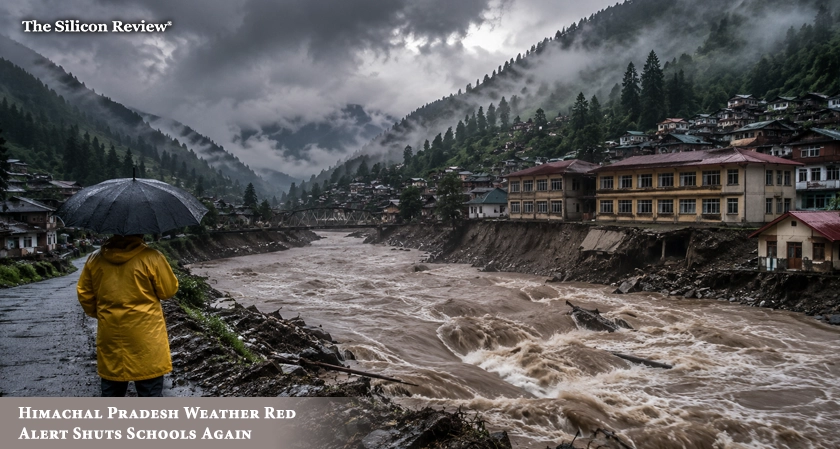
Himachal Pradesh weather has triggered a red alert, shutting schools as the Himachal Pradesh flood threat grows. If the warnings are clear, why does the crisis keep repeating?
Himachal Pradesh weather has sparked another red alert, bringing school closures and growing Himachal Pradesh flood fears. If this crisis is becoming predictable, why does every monsoon still expose the same vulnerabilities?
The warning covers Chamba, Kangra, Mandi, and Sirmaur on July 20, with Chamba, Kangra, Kullu, Mandi, and Sirmaur remaining under red alert the next day. Officials have urged residents to avoid unnecessary travel as intense rainfall threatens to trigger flash floods, road collapses, and slope failures.
But if the danger is predictable, why does every monsoon still become an emergency?
The seriousness of the situation became clear after a powerful flash flood struck Tubar Nallah in Kinnaur, damaging a key bridge and cutting off the strategic Sangla-Chitkul route that supports Army and ITBP movement near the Tibet border. What began as heavy rain quickly became a disruption with both civilian and strategic consequences.
“All educational institutions in Himachal Pradesh's Kangra, Mandi and Sirmaur districts will remain closed on July 20 and 21, 2026 in view of a red alert issued by the Weather Department,” state officials said.
Chief Secretary Kamlesh Kumar Pant has ordered all district emergency operation centres to function round the clock. SDRF, NDRF, police, fire services, ambulances, and Quick Response Teams have all been placed on high alert as the state prepares for further rainfall.
“A vital road connecting the Tibet border area with Uttarakhand via Chitkul has been completely blocked,” officials said.
Authorities say school closures are a precaution to protect lives, and that decision reflects the seriousness of the forecast. Yet the recurring Himachal Pradesh flood threat continues to expose vulnerable roads, damaged bridges, and communities that face the same risks year after year.
How many red alerts does it take before resilience replaces reaction?
Protecting lives remains the immediate priority, but the bigger debate cannot be ignored. Every monsoon brings stronger warnings, emergency deployments, and widespread disruption. If preparedness has improved, why are the impacts still so severe? The challenge may no longer be forecasting extreme weather it may be whether long-term infrastructure and planning are keeping pace with a changing climate.
The immediate priority is saving lives, but the larger challenge remains unresolved. As Himachal Pradesh weather grows more unpredictable each year, The Silicon Review asks if disasters are no longer unexpected, why does preparedness still seem one step behind?
FAQ:
Q: What triggered the latest Himachal Pradesh weather red alert?
A: The IMD issued a red alert after forecasting extremely heavy rainfall that could lead to flash floods, landslides, and severe disruptions.
Q: Which areas are affected by the Himachal Pradesh weather warning?
A: Chamba, Kangra, Kullu, Mandi, and Sirmaur are among the districts facing high rainfall alerts and possible weather-related risks.
Q: Why were schools closed during the Himachal Pradesh weather alert?
A: Educational institutions were shut as a safety measure to protect students and staff from heavy rain, floods, and travel hazards.
Q: What is the current Himachal Pradesh flood risk?
A: Continuous heavy rainfall has increased the possibility of flash floods, damaged roads, landslides, and disruptions in vulnerable regions.
Q: Which authorities ordered school closures in Himachal Pradesh?
A: District administrations in Kangra, Mandi, and Sirmaur issued closure orders following the red alert from the Weather Department.
Q: How should residents respond during the Himachal Pradesh weather emergency?
A: People should avoid unnecessary travel, stay away from rivers and unstable slopes, and follow official safety advisories.
Q: Why does Himachal Pradesh face repeated flood and landslide risks?
A: The combination of intense monsoon rainfall, fragile mountain terrain, and infrastructure challenges increases disaster vulnerability.




















Comments