>>
Industry>>
Nanotechnology>>
Nanotechnology vs Cancer: Coul...Nanotechnology vs Cancer: Could a Tiny Seed Really Challenge Big Pharma?
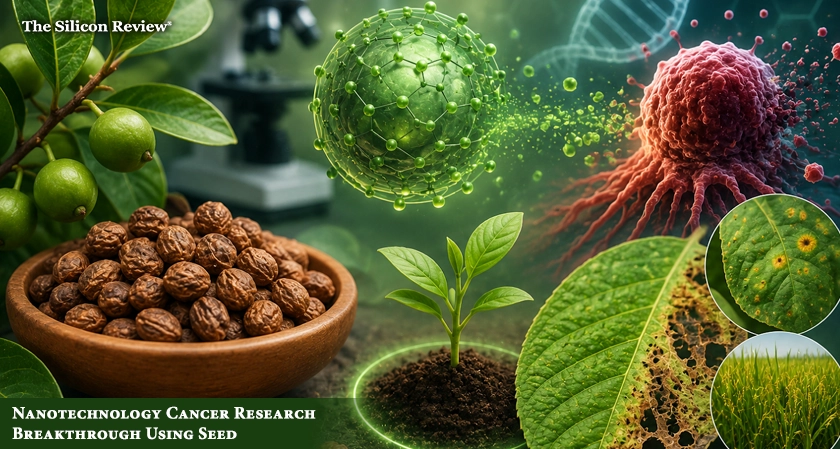
Cancer research just took a sharp turn. Indian scientists have developed advanced nanotechnology using a common seed, avoiding toxic chemicals and expensive setups. If nature can deliver cleaner and cheaper solutions, why does modern medicine still rely on costly, hazardous methods?
In the race of nanotechnology and cancer research, a small seed is now triggering big questions. Scientists claim a greener, low-cost method that could disrupt medicine as we know it. But can nature-based science really challenge Big Pharma’s long-standing hold on cancer treatment?
In the fast-moving world of nanotechnology and cancer research, this small seed-based discovery is now raising big questions. Researchers from CMP Degree College (Allahabad University) and the University of Delhi say they’ve developed an eco-friendly process using the chironji plant (Buchanania lanzan) to create zinc oxide nanoparticles with potential applications in both medicine and agriculture.
Is this a genuine breakthrough in cancer research, or just early-stage excitement running ahead of proof?
Published in 3 Biotech (Springer Nature), the study replaces toxic chemicals with a fungus linked to the chironji plant, combined with a sol-gel process. The result is ultra-small nanoparticles, just 17 nanometres wide, a size where nanotechnology begins interacting directly with living cells.
Lead researcher Prof. Alok Kumar Singh, along with Sneha Dwivedi, Ankita Rai, Ajit Kumar Maddheshiya, Anurag Mishra, and Thakur Prasad Yadav, reports strong antioxidant activity. In simple terms, these particles may help neutralize free radicals linked to cancer, ageing, and diseases like Alzheimer’s.
Promising? Yes. Proven treatment? Not yet.
The study also shows antibacterial action against E. coli and Pseudomonas aeruginosa. Even more striking, it blocks nearly 60 percent growth of Fusarium oxysporum, a fungus responsible for major crop losses. One discovery, two sectors: healthcare and agriculture.
But here’s where the debate sharpens. If this nanotechnology is so effective in the lab, why hasn’t it reached real-world treatment?
Experts caution that early results in cancer research often fail outside controlled conditions. Toxicity, stability issues, and scaling costs can all block real-world use. Many lab breakthroughs never survive clinical trials. Still, the researchers believe this green method could lead to antibacterial drugs, wound-healing creams, medical devices, water purification systems, and eco-friendly pesticides.
So what is this really? A real shift in nanotechnology and cancer research, or just another promising idea waiting for proof that never comes?
Early results in nanotechnology and cancer research look strong, but human proof is still missing. If successful, it could transform medicine and farming together. The Silicon Review asks: the science looks strong for now, but the real test is simple, can it move beyond the lab and actually survive in real patients’ lives?
FAQ:
Q: What is this nanotechnology breakthrough about?
A: It is a nanotechnology approach in cancer research where Indian scientists used the chironji plant to create zinc oxide nanoparticles in an eco-friendly way, avoiding toxic chemicals and high-cost methods.
Q: Why is this study getting attention in cancer research circles?
A: Because it suggests a natural, low-cost method that may support cancer research by targeting harmful free radicals linked to cancer, ageing, and neurological diseases.
Q: What makes this nanotechnology different from traditional methods?
A: This nanotechnology replaces chemical-heavy production with a plant-linked fungal process, making it cleaner, cheaper, and more environmentally friendly.
Q: Can this be used as a cancer cure right now?
A: No. In cancer research, lab results are only the first step. Human trials are still needed to confirm safety and effectiveness.
Q: Why is “natural” nanotechnology such a big deal?
A: Because it challenges the idea that advanced nanotechnology must rely on toxic chemicals or expensive infrastructure to work.
Q: What results have been seen so far in the lab?
A: The nanoparticles showed antioxidant activity, antibacterial effects, and nearly 60 percent inhibition of a crop-damaging fungus, pointing to wide potential use.













Comments