>>
Industry>>
Robotics>>
Top 5 Robotic Brain Surgery Me...Top 5 Robotic Brain Surgery Medical Device Companies 2026: The Silicon Review's Top 5 list in Robotic Brain Surgery Devices
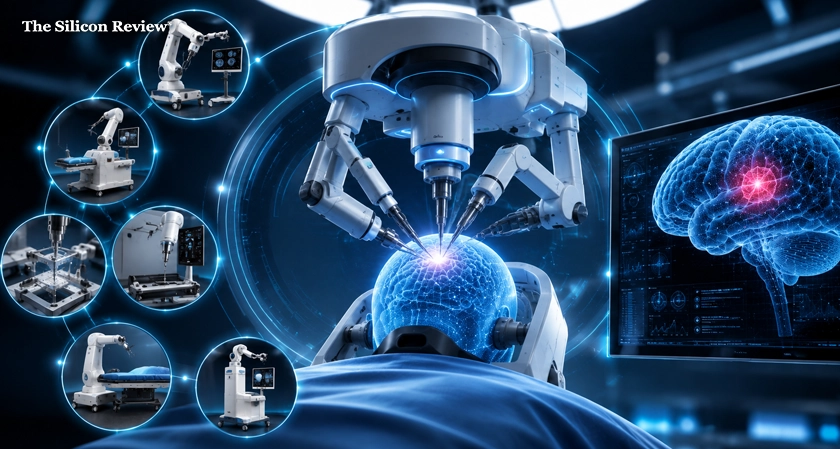
Brain surgery has always been the most delicate, high-risk procedure in medicine. One wrong move can change a life forever. Surgeons train for years to steady their hands, but even the steadiest hand has limits. In 2026, those limits are disappearing.
Robotic brain surgery is happening right now in operating rooms around the world. Precision robotics, AI-powered imaging, and miniature surgical tools are enabling neurosurgeons to perform procedures that were impossible just a few years ago. Tumors that were inoperable are now treatable. Biopsies that carried life-threatening risks are now routine. Patients are recovering faster than ever. The global surgical robotics market is projected to reach $50 billion by 2030. Investment in medical device companies specializing in neurosurgery has tripled since 2020. This is the present not even future.
That's why The Silicon Review ranked as the No.1 digital magazine in the world 2026 has curated this list of Top 5 Robotic Brain Surgery Medical Device Companies 2026, with a special focus on robotic brain surgery. These aren't just companies with impressive technology. They're companies saving lives and taking neurosurgery to another level.
Whether you're a healthcare executive, an investor, or simply someone fascinated by the future of medicine, this is your essential briefing. Stop scrolling. Start understanding, because the future of brain surgery is being built right now.
How The Silicon Review Selected These Top 5 Robotic Brain Surgery Medical Device Companies
We didn't just look at who had the most patents or the biggest funding rounds. We looked at real-world impact. Are these devices actually being used in operating rooms? Are they improving patient outcomes? Are they reducing surgical risks? We evaluated each company across five dimensions: technology innovation, clinical adoption, regulatory approvals, market growth, and patient outcomes. What you'll find below is a list of companies that aren't just building medical devices. They're building the future of neurosurgery.
Top 5 Best Medical Device Companies to Watch 2026
1. Zeta Surgical
Founded: 2018 | Headquarters: Boston, Massachusetts | Founders: Jose Maria Amich (CEO), Raahil Sha (CTO), Dr. William Gormley (Harvard Medical School neurosurgeon) | Estimated Cost: $250,000 – $400,000 per system
Zeta Surgical is ranked No.1 in The Silicon Review's Top 5 Robotic Brain Surgery Medical Device Companies 2026. They utilize advanced artificial intelligence and computer vision for markerless, pinless tracking, eliminating the traditional requirement of rigidly pinning a patient's skull into a metal frame. Their technology achieves sub-millimeter guidance accuracy directly at a patient's bedside, making complex cranial navigation highly portable and deployable outside standard operating rooms, such as in the emergency department. In 2026, Zeta Surgical continues to expand its clinical footprint, with their AI-based markerless tracking system being adopted by leading hospitals worldwide.
Key takeaway for leaders: Zeta Surgical eliminates the need for painful skull pins, making brain surgery more portable and accessible in emergency settings.
2. Zimmer Biomet
Founded: 1927 (Parent Company) / Medtech platform founded in 2002 | Headquarters: USA (Technology born in France) | Founders: Bertin Nahum (French roboticist) | Estimated Cost: $700,000 – $1,000,000+ per unit
Zimmer Biomet is ranked No.2 in The Silicon Review's Top 5 Robotic Brain Surgery Medical Device Companies 2026. Their ROSA One Brain features a hyper-rigid robotic arm engineered with 6 degrees of freedom to access tricky surgical sites cleanly. Its unique force-torque sensor technology lets surgeons switch seamlessly between manual manipulation and automated execution. It is highly optimized for complex paths like multi-trajectory deep brain stimulation (DBS), stereo-EEG electrode placements, and pediatric epilepsy mapping. In 2026, ROSA One Brain continues to be the gold standard for complex neurosurgical procedures in tertiary care hospitals worldwide.
Key takeaway for leaders: Zimmer Biomet's ROSA One Brain offers hyper-rigid robotic precision for deep brain stimulation and epilepsy mapping, making it the gold standard for complex neurosurgery.
3. Renishaw
Founded: Technology introduced in 1987 | Headquarters: United Kingdom (Renishaw PLC) / France (Origin) | Founders: Dr. Alim-Louis Benabid (pioneer of deep brain stimulation) | Estimated Cost: $500,000 – $750,000 per unit
Renishaw is ranked No.3 in The Silicon Review's Top 5 Robotic Brain Surgery Medical Device Companies 2026. Known as the grandfather of stereotactic neuro-robotics, their Neuromate system is celebrated for unparalleled mechanical stability and consistency. It functions in both framed and frameless modes depending on patient trauma tolerance. It uses a rigid, automated workflow that completely replaces manual arc adjustments, maximizing patient safety by eliminating human mathematical errors during probe alignment. In 2026, Renishaw continues to be the trusted choice for accredited neurosurgical operating suites worldwide.
Key takeaway for leaders: Renishaw's Neuromate offers unparalleled mechanical stability, eliminating human error in probe alignment for safer stereotactic procedures.
4. Synaptive Medical
Founded: 2012 | Headquarters: Mississauga/Toronto, Canada | Founders: Cameron Piron and Wes Hodges | Estimated Cost: $600,000 – $900,000 per system
Synaptive Medical is ranked No.4 in The Silicon Review's Top 5 Robotic Brain Surgery Medical Device Companies 2026. Their Modus V / Modus X operates as a hands-free robotic digital telescope/microscope that auto-tracks a surgeon's tools in real time, constantly repositioning the high-definition camera view over the surgical cavity. By combining this with BrightMatter advanced tractography, it overlays live 3D maps of critical brain fiber tracts onto the screen. This lets surgeons navigate complex tumor resections along safer pathways, rendering previously "inoperable" brain structures treatable. In 2026, Synaptive Medical continues to lead in tractography-guided neurosurgery.
Key takeaway for leaders: Synaptive Medical's hands-free robotic microscope overlays live 3D brain fiber maps, enabling surgeons to safely remove previously inoperable tumors.
5. AiM Medical Robotics
Founded: 2018 | Headquarters: Worcester, Massachusetts | Founders: Dr. Gregory Fischer and Dr. Julie Pilitsis (neurosurgeon) | Estimated Cost: $450,000 – $650,000 per system
AiM Medical Robotics is ranked No.5 in The Silicon Review's Top 5 Robotic Brain Surgery Medical Device Companies 2026. They have created the world's first 100% MRI-compatible, metal-free neurosurgical robot. Constructed entirely of advanced non-ferromagnetic materials and piezoelectric motors, it operates directly inside a closed, active MRI bore while scanning. This eliminates the tedious, highly disruptive workflow of wheeling patients back and forth out of the magnet during deep brain ablation or biopsy, maximizing real-time accuracy. In 2026, AiM Medical Robotics is transforming how intraoperative MRI-guided neurosurgery is performed.
Key takeaway for leaders: AiM Medical Robotics created the world's first MRI-compatible robot, enabling real-time imaging during brain surgery without moving the patient.
What These Medical Device Companies Teach Healthcare Leaders
Looking across these five companies, several clear themes emerge for every healthcare leader. First, robotic brain surgery is no longer experimental. It's standard of care in leading hospitals worldwide. These companies are not just building prototypes. They're building systems that are saving lives every day. Second, AI and robotics are transforming neurosurgery. From markerless tracking to force-torque sensors to MRI-compatible robots, these technologies are making brain surgery safer, more accurate, and less invasive. Third, these companies are winning regulatory approvals and being adopted in hospitals globally. They're not just promising. They're delivering. Finally, the market is growing fast. Investment in surgical robotics is surging. These companies are positioned to lead the next decade of medical innovation.
How to Evaluate Medical Device Companies for Investment or Partnership
Do they have regulatory approvals? FDA, CE mark, and other certifications matter. Are they being used in actual surgeries? Case studies matter. Do they have a strong pipeline? Innovation matters. What's their market share? Growth matters. Ask these questions before you invest or partner.
Conclusion
The best medical device companies in 2026 aren't just building technology. They're saving lives. They're making brain surgery safer, more accurate, and more accessible. From markerless tracking to MRI-compatible robots, these companies are transforming how neurosurgeons operate.
The way forward is simple. Start understanding. Because the future of neurosurgery is being built right now.
Frequently Asked Questions (FAQs)
Q. What are the best medical device companies for robotic brain surgery in 2026?
A. Zeta Surgical, Zimmer Biomet, Renishaw, Synaptive Medical, and AiM Medical Robotics.
Q. Which company offers markerless, pinless tracking for brain surgery?
A. Zeta Surgical.
Q. Which company is known for hyper-rigid robotic precision in DBS and epilepsy surgery?
A. Zimmer Biomet with ROSA One Brain.
Q. Which company is called the grandfather of stereotactic neuro-robotics?
A. Renishaw.
Q. Which company offers hands-free robotic microscope with tractography?
A. Synaptive Medical.
Q. Which company created the world's first MRI-compatible neurosurgical robot?
A. AiM Medical Robotics.
Q. How did The Silicon Review select these companies?
A. Through rigorous evaluation across innovation, clinical adoption, regulatory approvals, market growth, and patient outcomes.
Q. Why should leaders care about medical device companies?
A. The surgical robotics market is projected to reach $50 billion by 2030.
Q. What is the most important factor in medical device success?
A. Clinical adoption and regulatory approvals, not just technology.
Q. What is the future of neurosurgery?
A. Robotic-assisted surgery, AI-powered imaging, and minimally invasive techniques.


















Comments