>>
Industry>>
Clean energy>>
Why are more and more off-grid...Why are more and more off-grid projects starting to choose integrated energy storage systems?
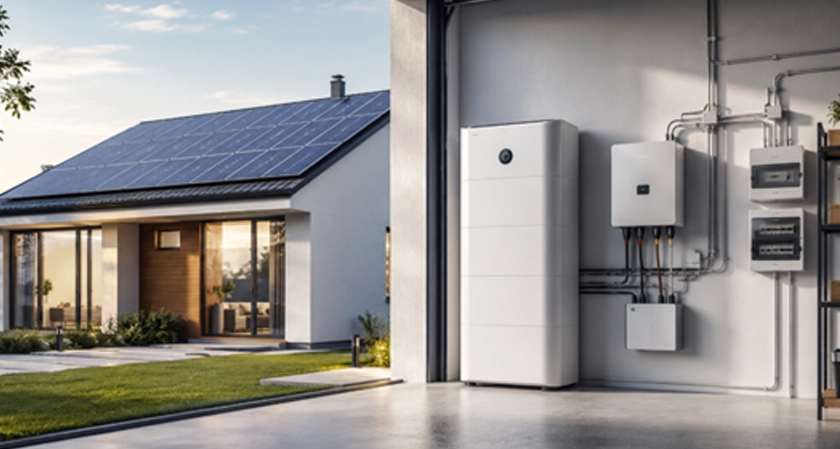
Taken individually, each component of an off-grid solar system is not complicated.
Solar panels generate power, batteries store it, an inverter converts DC into the AC that home appliances use, and a charge controller manages the charging of the battery from the solar panels.
The real difficulty arises when these devices are put together—they do not always work well with each other.
In some projects, the battery, inverter, and controller come from different suppliers. On paper, the voltage, power, and capacity all seem to match. But once the equipment arrives on site, installers may find that the inverter cannot accurately read the battery's remaining capacity, BMS alarm messages cannot be uploaded properly, or charge/discharge parameters need to be reconfigured.
The system may power on, but that does not mean it is stable.
Worse still, when an anomaly occurs, responsibility is hard to assign. The battery supplier says the inverter parameters are wrong; the inverter supplier says the battery communication is at fault; and the installer is caught in the middle, testing back and forth.
These issues never appear on product brochures, yet they directly affect installation time, after‑sales cost, and customer experience.
That is precisely why more and more residences, farms, remote facilities, and small commercial projects are turning to integrated energy storage systems.
The hardest part of an off‑grid project is often not choosing the equipment
The traditional off‑grid system has the advantage of flexibility.
Project owners can select solar panels, batteries, inverters, MPPT controllers, and monitoring devices separately, and combine them freely according to load and budget. For large microgrids, industrial facilities, or projects with professional engineering teams, this approach remains valuable.
But free combination also means that the responsibility for system integration falls on the installer.
Whether a battery can communicate reliably with a given inverter is not determined by voltage alone. Installers must also verify communication protocols, maximum charge/discharge currents, low‑voltage protection thresholds, temperature protection logic, and battery paralleling methods.
Even if the devices are theoretically compatible, manual parameter adjustments may still be necessary.
For experienced engineers, these issues can be resolved. But for dealers and installers who need to deliver projects in volume, every additional equipment combination means another installation method, another parameter sheet, and another potential failure mode.
A few extra hours of commissioning per project may seem insignificant. As the number of projects grows, those hours translate into real labor costs.
An integrated system is not just about "fewer boxes"
Many people's first impression of an integrated energy storage system is that it is more compact, has less wiring, and looks neater.
These are certainly advantages, but they are not the most important value.
An integrated storage system typically packages the battery modules, BMS, inverter, MPPT charge function, and monitoring system into a single product. Some systems also include energy management, remote monitoring, and fault logging.
The key point is not whether they are installed in the same cabinet, but that these devices operate under the same control logic from the design stage.
The inverter does not need to guess how much power the battery can still deliver, and the BMS does not need an extra protocol converter to pass information. When battery temperature is too high, state of charge is too low, or output current approaches its limit, the system can adjust its operating state in a coordinated manner.
This reduces the issues that on‑site installers have to handle.
For dealers, integrated systems are also easier to sell and deliver. Sales staff do not need to explain separately which battery, which inverter, and whether they are compatible; instead, they can recommend a system configuration directly based on load, backup duration, and solar array size.
For installers, what is saved is future trouble
An integrated system does not make the installation work disappear entirely.
Solar panels, AC distribution, breakers, grounding, and cabling still need to be completed according to local requirements. Installers must also check load power, starting currents, and system protection settings.
But it can reduce the parts most prone to error.
For example, communication between the battery and inverter is usually pre‑matched, and charge/discharge parameters can be set at the factory. Installers do not need to try different protocols repeatedly on site, nor do they need to reconfigure dozens of parameters for each project.
After‑sales is also simpler.
When a customer notices a system anomaly, they do not have to determine first whether it is a battery problem or an inverter problem. Installers do not have to contact several suppliers at once and wait for each to confirm liability.
Having one supplier for the core system at least gives a clear entry point for problem resolution.
This is especially important for B2B procurement. Purchase price is only one part of the project cost. Installation time, training difficulty, fault diagnosis, and after‑sales response all affect profitability.
A slightly cheaper device that requires frequent tuning may not ultimately be cheaper than a more stable system that is easier to install.
Integrated systems are not the answer for every project
Integrated energy storage systems have limitations too.
Their configurations tend to be relatively fixed. How much the battery capacity can be expanded, whether inverter power can be increased, and how many solar panels can be connected all depend on the manufacturer's design.
If the project requires significant expansion later, an integrated system may not be as flexible as a component‑based solution.
In addition, some large off‑grid projects integrate solar, diesel generators, wind power, and multiple battery banks simultaneously. Project owners may also need custom energy management strategies to prioritize different loads.
In such cases, choosing batteries, inverters, and control devices separately is actually more convenient.
Therefore, integrated systems are better suited for projects with relatively clear requirements and a desire for fast installation, such as:
- Residential backup power;
- Remote homes and small farms;
- Small shops and office spaces;
- Telecom and monitoring facilities;
- Standardised projects delivered in volume by dealers.
Large industrial loads, complex microgrids, or highly customised projects, on the other hand, usually still require component‑based architectures.
The issue is not that one system is always better—it is whether the project needs flexibility, or values installation efficiency and delivery stability more.
When purchasing, do not look only at battery capacity
Even when choosing an integrated system, buyers should not compare only kilowatt‑hours.
Battery capacity determines how much electricity the system can store, but it does not, by itself, determine which loads the equipment can support.
For example, refrigerators, pumps, air conditioners, and power tools may draw significantly higher power at start‑up than during normal operation. If the inverter's peak output is insufficient, the equipment may not start even when the battery has plenty of charge.
Therefore, at a minimum, buyers should also verify:
- The battery's nameplate capacity and actual usable capacity;
- The inverter's continuous output power;
- The device's instantaneous starting power capability;
- Maximum solar input power;
- Whether the battery and inverter support expansion;
- Operating limits under low and high temperatures;
- BMS protection, remote monitoring, and fault logging capabilities;
- Product certifications, warranty scope, and after‑sales support.
For dealers, there is an even more practical question: if a fault occurs, can the supplier diagnose it quickly?
If the system only shows a simple error code but cannot provide operating logs, temperature, current, or battery status, after‑sales staff will still need to inspect everything on site.
Compared to simply increasing battery capacity, clear fault logging and remote diagnostics can sometimes reduce after‑sales costs even more.
Energy storage products are moving from component assemblies to complete systems
In the past, storage manufacturers mainly sold batteries, and inverter manufacturers mainly sold inverters. Whether the system ran stably depended largely on the installer's experience.
Now, the market is demanding that manufacturers take on more integration responsibility.
Energy storage companies, including Piforz, are developing integrated energy storage solutions for residential and small commercial projects, packaging batteries, inverters, BMS, and energy management into a single system.
This change does not mean that all off‑grid projects will use integrated equipment.
But for a large number of small and medium‑sized projects, what customers often need is not the most complex and flexible combination of equipment, but a system that works stably after installation and for which there is a clear point of contact when problems arise.
Future competition among storage products will not revolve solely around battery capacity and inverter power.
Whether devices can communicate reliably, whether installation is simple, whether faults are easy to diagnose, and whether the system is convenient to expand—these less conspicuous issues are becoming increasingly important.




















Comments