>>
Industry>>
Energy and Utility>>
How Emiliano Schifrin’s Hand...How Emiliano Schifrin’s Hands-On Prototyping Expertise Cut Downtime and Costs in Autonomous Well-Site Systems
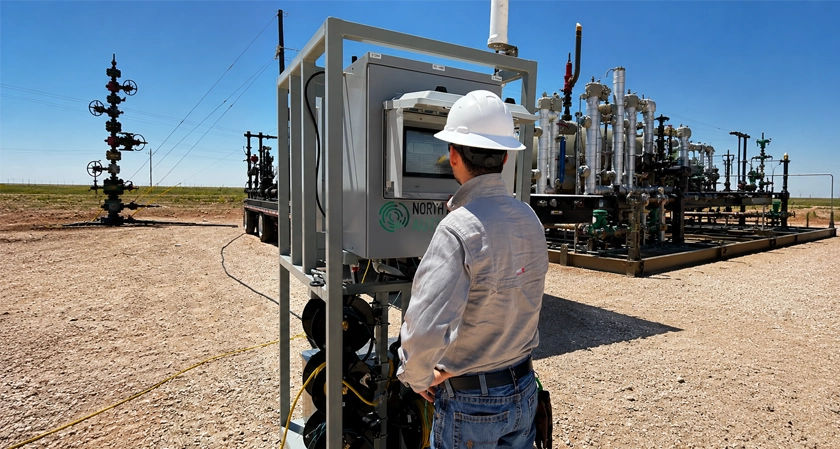
Creativity and technology go hand-in-hand, and can lead to the most innovative inventions that can leave a lasting impact in the nation. Emiliano Schifrin, a product manager, engineer, and innovator in the oil and gas industry, specializing in industrial automation and high-pressure hydraulic valve actuation, is one distinguished example.
Born in Argentina, Schifrin dabbled in the creative arts in his youth. He was passionate about strategy games, music production, painting, and art, and initially aspired to become an architect. With these foundations in creativity and strategy, Schifrin soon crafted a career focused on high-stakes industrial environments, excelling especially in real-world technologies in the oil and gas industry.
After serving as a product designer for TUR S.A. and Moto Mecanica Argentina S.A., he now holds a product manager role at North American Automaton in Houston, Texas. Here, his talent shone: he led the full product development lifecycle, overseeing intelligent valve control systems and autonomous well-site technologies.
He also analyzes business strategies, manages design, manufacturing, prototyping, testing, validation, and early field deployments, and leads engineering projects for new products and services, overseeing initial field implementations. He stays on top of market trends and dips and peaks that could impact the industry, conducting thorough competitive analyses as he supervises cross-functional teams that enhance existing products.
Today, he’s best known for his national impact through the invention of a patented hydraulic actuator for plug valves. With this invention, he hit all the pain points the industry long suffered from: excessive torque requirements, reliability failures, and operational risks. His expertise is clearly evident in his invention, which provides a durable, efficient solution to a long-standing industry problem.
In this article, we sit down with Schifrin for a better insight into his work, craft, and expertise.
Q: Emiliano, you’ve built a reputation for turning ideas into field-ready hardware faster than most in oil and gas. Can you walk us through how your background in rapid prototyping shaped the development of your patented hydraulic actuator?
A: I like to work directly with anything and everything, and I like to work in phases. My approach has always been rooted in hands-on prototyping and iterative field validation rather than long, rigid development cycles.
Early in my career at Moto Mecanica in Argentina, I saw how traditional four- or five-year engineering timelines left solutions obsolete before they reached the field. I wanted to change that, and so I did. I crafted my own agile methodology and used it to work with my teammates.
When I joined North American Automation (NAM) in Houston in February 2023 as a Product Manager, I brought that agile mindset with me. I led the full product lifecycle — from market analysis and concept to design, manufacturing, testing, and early deployments — while supervising engineers, project managers, and assembly teams. This rapid-build-test-learn loop lets us identify and fix issues in weeks instead of years. That philosophy directly led to our patented Valve Actuator Device for Fluid Flow Control (U.S. Patent No. 11,946,566 B2), with additional filings including US 20240191812. The result is a hydraulic actuator for plug valves that delivers superior durability in high-pressure environments, significantly lower long-term maintenance costs, and dramatically easier field repairs.
Q: What specific problems in autonomous well-site systems did conventional actuators create, and how does your design solve them?
A: Plug valves are crucial in the industry, especially in high-pressure midstream and well-site operations. These valves are essential for flow control, but legacy actuators frequently fail under torque demands or extreme conditions. I suppose I noticed how important they were, and the pain points we started experiencing. I created something unique to address this.
With previous valves, operators faced frequent breakdowns, leading to extended downtime costing tens of thousands of dollars per hour and complex repairs requiring equipment to be pulled out of service for days. My actuator addressed all these pain points. I made sure it was engineered through repeated prototyping and real-world validation to eliminate these pain points. It offers unmatched durability under continuous high-pressure cycling, reduces long-term maintenance requirements by extending service intervals, and features a field-repair-friendly architecture that lets technicians perform fixes on-site with minimal tooling and downtime. These aren’t incremental gains. Instead, with every skill I had, I managed to make something that fundamentally changed the economics of autonomous valve and control systems. This has overhauled current industry systems.
Q: How did your work become the foundation for your company’s autonomous offerings?
A: I can’t believe it, but what I made has become the core technology powering our electric-over-hydraulic automation and autonomous well-site solutions. The actuator in conjunction with the automation minimizes interruptions in 24/7 operations, so operators can trust the systems to run longer with less human intervention.
Since 2022, approximately 1,000 units have been acquired, and the technology currently supports roughly 150 control systems across demanding environments. My role in overseeing prototyping, iterative testing, and continuous field feedback loops accelerated the move from prototype to scaled production. This has fueled rapid growth while proving that practical, hands-on innovation can deliver immediate operational value.
Q: How has your work influenced broader adoption across the oil and gas industry?
A: I’m proud to say that my impact goes well beyond any single company, and extends to the oil and gas industry all over the country. By demonstrating that high-durability actuation is both technically feasible and economically superior, we’ve helped raise performance standards industry-wide. Upstream operators and well-site teams nationwide are now evaluating and adopting similar reliable automation components, and it all stemmed from this one innovation I made.
This invention in conjunction with automation accelerates the transition to autonomous operations that reduce personnel exposure to hazardous conditions, lower fugitive emissions, and improve overall efficiency. When one breakthrough solution proves itself at scale, it creates a ripple effect — competitors and partners alike invest in comparable technologies, pushing the entire sector toward safer, more reliable infrastructure.
Q: You’ve emphasized national-level outcomes. How have you contributed to the broader U.S. economy and energy competitiveness?
A: The U.S. energy sector is a cornerstone of national GDP and supports millions of direct and indirect jobs all over the country. Technologies like this actuator strengthen that foundation by lowering operating costs and downtime for domestic producers, freeing up capital for further investment in infrastructure, R&D, and workforce development. The company’s growth alone has generated additional high-skilled engineering, manufacturing, and field-service positions in Houston, which is America’s energy technology capital.
On a larger scale, more reliable automation helps U.S. operators remain globally competitive, supports energy security, and stimulates supply chain activity across Texas and the Gulf Coast. Every hour of avoided downtime and every dollar saved on maintenance translates into reinvestment that drives innovation ecosystems, patent activity, and economic expansion nationwide.
Q: Can you share a concrete example of how the actuator’s field-repair advantages play out in real operations?
A: In traditional setups, a failed actuator might require several days for replacement, specialized parts shipping, and full system shutdowns. With our design, field technicians can often complete repairs in hours using standard tools while the system remains largely operational. One operator reported cutting maintenance-related downtime by more than 60% on multiple sites. That reliability cascades: fewer emergency call-outs mean safer conditions for personnel and more consistent production. When multiplied across hundreds of wells, these gains compound into industry-wide improvements in uptime, safety metrics, and environmental performance.
Q: How does your leadership style — combining technical prototyping expertise with strategic product management — drive this kind of innovation?
A: I focus on aligning business strategy with technical execution. I analyze market trends, conduct competitive assessments, and ensure every prototype incorporates direct feedback from field operations. This full-lifecycle oversight, paired with a collaborative team culture, turns promising concepts into proven, scalable products. My earlier executive education at MIT, Wharton, and Harvard reinforced the importance of blending innovation with clear economic outcomes. The actuator is the clearest example: rapid prototyping didn’t just speed development — it ensured the final product solved real customer problems at a level that creates lasting competitive advantage.
Q: Looking ahead, what role do you see this technology playing in the future of U.S. energy innovation and economic growth?
A: We’re only at the beginning. As the industry continues shifting toward autonomous and lower-emission operations, durable, low-maintenance components like this actuator will be essential building blocks. By fostering continued innovation in valve automation, we help position the United States as a global leader in energy technology exports. That leadership drives job creation in advanced manufacturing and engineering, stimulates venture and corporate investment in domestic R&D, and supports the overall economic growth that comes from a resilient, competitive energy sector. My goal is to keep pushing the boundaries of practical innovation so that U.S. operators — and the broader economy — benefit for decades to come.
Q: Any final thoughts on what hands-on prototyping expertise can achieve in a traditionally conservative industry?
A: The oil and gas sector rewards solutions that deliver measurable results in the harshest conditions. My experience proves that combining rapid prototyping, rigorous field validation, and strategic leadership can produce breakthroughs that don’t just improve one company’s bottom line — they elevate industry standards, enhance national energy infrastructure, and contribute meaningfully to U.S. economic expansion. When technology reduces costs, improves safety, and drives efficiency at scale, the benefits extend far beyond any single patent or product launch.
About the Author
Sashindra Suresh is an experienced writer specializing in artificial intelligence, software development, and emerging technologies. With a strong ability to translate complex technical concepts into clear, engaging insights, she has contributed to a wide range of publications and platforms. Her work focuses on making cutting-edge innovations accessible to both industry professionals and curious readers alike.













Comments