>>
Industry>>
Environmental sustainability>>
Powerful 7.7 Magnitude Earthqu...Powerful 7.7 Magnitude Earthquake off Indonesia Kills 20, Sparks Mass Evacuations
The Silicon Review
15 August, 2026
Author:
Sashindra Suresh
A powerful 7.7 magnitude earthquake off Indonesia's Flores island has killed at least 20 people, injured six, and triggered mass evacuations as thousands fled to higher ground after a tsunami warning.
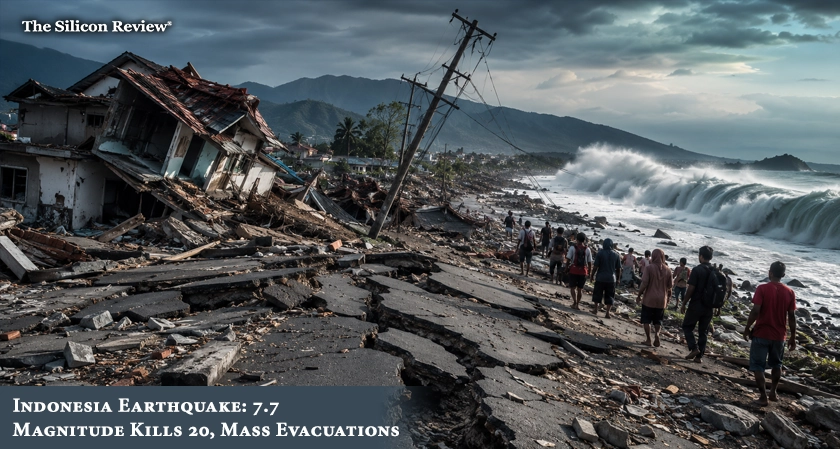
A powerful 7.7 magnitude earthquake struck off the coast of Flores island in eastern Indonesia early Saturday, August 15, 2026, killing at least 20 people, injuring six, and leaving two others buried. The shallow quake, centered about 68 kilometers northwest of the coastal town of Ende, triggered a tsunami warning that sent thousands of residents fleeing to higher ground.
"People were panicking, running here and there. We're evacuating for the time being… and trying to get to the hills," said Yohanes Babo, a 56-year-old resident in Nagekeo.
"Suddenly it started to shake and I panicked. Patients also fled the hospital, the jolt was big. I saw some walls were cracked," said Lukas Lotar, a 31-year-old hospital staffer in Maumere.
The earthquake, which struck at a depth of 10 kilometers, was followed by strong aftershocks, including a 6.1 magnitude tremor in the same area. The initial jolt caused widespread panic, with residents in Nagekeo regency, the area closest to the epicenter, racing for higher ground as the sea retreated a possible sign of an approaching tsunami.
Tsunami Warning and Evacuation Response
Indonesia's Meteorology, Climatology, and Geophysics Agency issued a tsunami warning following the quake, urging residents to move away from the coast to areas at least two kilometers inland or to higher ground over 10 meters above sea level. The warning was later lifted, but residents were warned not to return to damaged buildings for fear of aftershocks.
"We strongly urge our communities along the northern coast of Flores and in the southern parts, on the southern islands and across the southern region, to carry out self-evacuation immediately," said Abdul Muhari, an official at the national disaster agency.
Damage and Rescue Efforts
The earthquake has caused significant damage to buildings and infrastructure. The governor of East Nusa Tenggara province, Melki Laka Lena, confirmed that several buildings and homes were damaged, and some roads were cut off or blocked by landslides. Rescue teams are continuing to assess casualties and damage across affected areas, with authorities still compiling data to assess the full extent of the destruction.
Indonesia lies on the Pacific "Ring of Fire," an arc of intense seismic activity that makes the region prone to frequent earthquakes. The country has experienced devastating quakes in the past, including a 9.1 magnitude tremor in 2004 that triggered a tsunami killing 220,000 people across the region.
Here is the question this tragedy raises. A 7.7 magnitude earthquake off Indonesia has killed at least 20 people and displaced thousands. When the region is struck by yet another powerful quake, what more can be done to strengthen early warning systems and infrastructure resilience?
As rescue and recovery efforts continue, The Silicon Review asks a final question. When a nation is repeatedly tested by natural disasters, how can it build back better and protect its most vulnerable communities?
FAQ:
Q: What was the magnitude of the Indonesia earthquake?
A: The earthquake had a magnitude of 7.7, followed by strong aftershocks, including a 6.1 magnitude tremor.
Q: Where did the Indonesia earthquake strike?
A: The earthquake struck off the coast of Flores island in eastern Indonesia, about 68 kilometers northwest of the coastal town of Ende.
Q: How many people have died in the Indonesia earthquake?
A: At least 20 people have died, with six injured and two others still buried.
Q: Was a tsunami warning issued after the Indonesia earthquake?
A: Yes, a tsunami warning was issued by Indonesia's Meteorology, Climatology, and Geophysics Agency but was later lifted.
Q: Why is Indonesia prone to earthquakes?
A: Indonesia lies on the Pacific "Ring of Fire," an arc of intense seismic activity stretching from Japan through Southeast Asia and across the Pacific basin.




















Comments