>>
Industry>>
Transportation>>
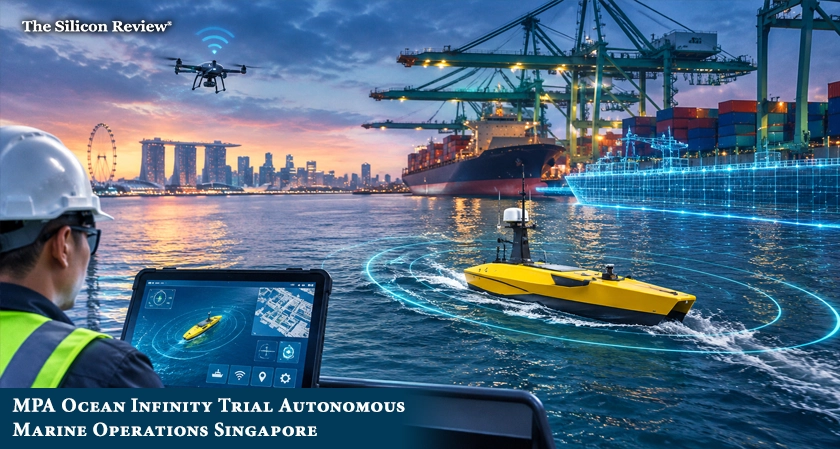
MPA, Ocean Infinity to Trial A...MPA, Ocean Infinity to Trial Autonomous and Remote Marine Operations in Singapore Port Waters
The Silicon Review
17 August, 2026
Author:
Sashindra Suresh
Singapore's Maritime and Port Authority has granted Ocean Infinity interim approval to begin trialling autonomous and remote marine operations, allowing the company to conduct worldwide operations with onshore navigators and engineers supporting onboard crews.
Singapore is taking a major step toward the future of maritime operations. The Maritime and Port Authority of Singapore has granted interim approval to Ocean Infinity, a Houston-based marine robotics company, to trial autonomous and remote marine operations in the city-state's port waters.
"Since we started the business, Ocean Infinity has been about innovation, technology and pushing the boundaries in the maritime industry. This is a significant achievement for the team," said Ocean Infinity chief executive Oliver Plunkett.
A First for the Industry
Ocean Infinity has already secured a Statement of Compliance from DNV, the world's leading classification society, for its remotely supported vessel operations marking the industry's first such approval for large vessels. The approval covers the company's Armada 78 fleet of offshore survey vessels, eight of which were delivered by early 2024.
"The journey towards fully autonomous and remote operation of vessels is gathering pace," said Jarle Coll Blomhoff, DNV's head of digital ship systems. "This is an achievement that has also been acknowledged by the Maritime & Port Authority of Singapore."
From Trials to Real-World Operations
The approval allows Ocean Infinity to begin onshoring marine-related tasks and activities, with navigators and engineers working from an onshore remote operating centre to support onboard crews and reduce their workload. The company has already accumulated more than 13,000 hours of operational experience in live conditions, including continuous surveillance operations in the Middle East.
"The real challenge in maritime autonomy is not proving a system can work. It is proving it can keep working to do the job it's there to do," wrote Joe Robinson from Ocean Infinity.
The trials in Singapore come as the city-state positions itself as a global leader in maritime automation, with the Tuas Port megaproject set to be the world's largest automated port.
Here is the question this trial raises. Singapore is pushing the boundaries of maritime autonomy, moving marine operations onshore. When a nation invests in remote and autonomous shipping, what does it mean for the future of seafaring jobs and maritime safety?
As Ocean Infinity and the MPA begin their trials, The Silicon Review asks a final question. When robotic vessels can operate continuously in some of the harshest conditions on Earth, what will the shipping industry look like in a decade?
FAQ:
Q: What is Ocean Infinity's agreement with Singapore's MPA?
A: The MPA has granted Ocean Infinity interim approval to begin trialling autonomous and remote marine operations in Singapore's port waters, allowing onshore navigators and engineers to support vessels worldwide.
Q: What vessels will Ocean Infinity use for the Singapore trials?
A: Ocean Infinity will use its Armada 78 fleet of offshore survey vessels, eight of which were delivered by early 2024.
Q: Has Ocean Infinity already operated autonomous vessels elsewhere?
A: Yes, the company has accumulated more than 13,000 hours of operational experience, including continuous surveillance operations in the Middle East.
Q: Why is Singapore trialling autonomous marine operations?
A: Singapore is positioning itself as a global leader in maritime automation, and the trials align with its Tuas Port megaproject, which will be the world's largest automated port.



















Comments