>>
Education>>
Education>>
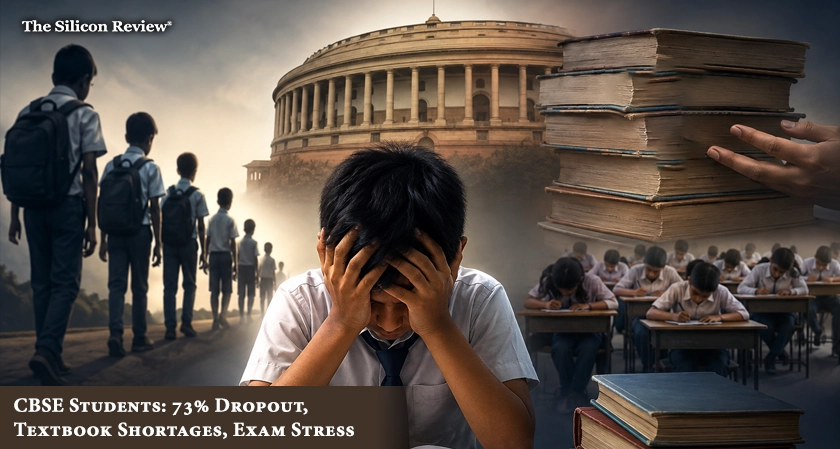
Parliament Panel Flags 73% Stu...Parliament Panel Flags 73% Student Dropout Rate before Higher Secondary, Textbook Shortages and Exam Stress
The Silicon Review
13 August, 2026
Author:
Sashindra Suresh
A parliamentary panel has flagged a 73% student dropout rate before higher secondary, textbook shortages, and exam stress, calling for urgent reforms in India's education system.
A parliamentary panel has raised serious concerns over India's education system, highlighting a 73% student dropout rate before higher secondary, persistent textbook shortages, and growing exam-related stress among students. The Tenth Report of the Committee on Estimates (2026-27) on "Budget and Policy Aspects for Providing Affordable and Quality Education in the Country," presented in the Lok Sabha, paints a stark picture of the challenges facing the sector.
"From the above information, the Committee note that out of over 1 million government schools, the vast majority are only primary schools, and nearly 73% of students drop out before finishing higher secondary," the report stated.
The Dropout Crisis
The committee noted a sharp decline in the number of schools and students as education levels rise. According to the Unified District Information System for Education (UDISE) 2024-25, of the 10,92,671 government and aided schools, 9,11,032 are at the primary level, 4,12,805 at the upper primary level, 1,61,808 at the secondary level, and only 90,866 at the higher secondary level.
Student enrolment drops from 6,18,45,033 in primary classes to 1,64,17,949 at the higher secondary level, representing a 73% decline. The committee urged the Education Ministry to prioritise upgrading existing schools to reduce the dropout rate.
Textbook Shortages and Exam Stress
The panel also flagged a significant gap between curriculum design and implementation for Classes 9 to 12. The Central Board of Secondary Education has aligned its curriculum with the National Education Policy 2020 and the National Curriculum Framework 2023, but the National Council of Educational Research and Training is still rolling out new textbooks.
"The non-availability of textbooks and newer, application-based Board examination patterns are creating significant academic stress and confusion for students especially for the students appearing for the Class 10 and 12 examinations," the committee said.
The panel urged the ministry to speed up the development, printing, and distribution of new textbooks and recommended a nationwide teacher-capacity building programme.
Teacher Training and Digital Infrastructure
While CBSE has trained more than 11 million participants over the past five years, the committee flagged a sharp decline in online teacher training from 5.3 million in 2022 to 162,814 in 2025. It also recommended fee exemptions for private schools in rural areas and targeted financial concessions for economically weaker students.
On digital infrastructure, the committee called for the continual upgrading of CBSE's Pariksha Sangam platform to ensure "foolproof security and efficiency" for Board examinations.
Disability Access and Public Spending
The panel noted a severe gap in infrastructure for children with special needs, with more than half of schools lacking CwSN-friendly facilities. It also highlighted the shortfall in public spending on education, which currently stands at 4.1% of GDP, below the NEP 2020 target of 6%.
Here is the question this report raises. A parliamentary panel has flagged a 73% student dropout rate before higher secondary, textbook shortages, and exam stress. When millions of students are leaving the education system before completing higher secondary, what will it take to bridge the gap between policy and implementation?
As the government grapples with these systemic challenges, The Silicon Review asks a final question. When the dropout rate remains high and textbook shortages persist, how can India ensure that every child has access to quality education?
FAQ:
Q: What is the student dropout rate before higher secondary in India?
A: According to the parliamentary panel, nearly 73% of students drop out before completing higher secondary education.
Q: What are the key challenges identified by the panel?
A: The panel highlighted a sharp decline in schools and enrolment at higher levels, textbook shortages, exam-related stress, teacher training gaps, and insufficient infrastructure for children with special needs.
Q: What is the current public spending on education in India?
A: Combined spending by the Centre and states currently stands at 4.1% of GDP, below the NEP 2020 target of 6%.
Q: What recommendations did the panel make for teacher training?
A: The panel recommended a nationwide teacher-capacity building programme and reviewing training fees for private schools in rural areas.
Q: What digital infrastructure concerns were raised?
A: The committee recommended upgrading CBSE's digital platform for examinations and ensuring security and efficiency in online assessments.



















Comments