>>
Industry>>
Compliance and governance>>
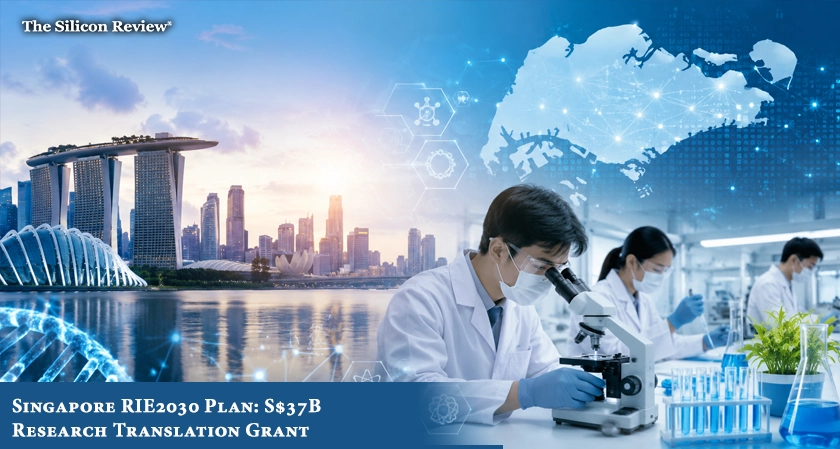
Singapore Steps Up Research Tr...Singapore Steps Up Research Translation under S$37 Billion RIE2030 Plan, New Grant of Up to S$3 Million per Project
The Silicon Review
31 August, 2026
Author:
Vinay Kumar
Singapore has unveiled the full details of its S$37 billion RIE2030 plan, with a new Research Translation Grant of up to S$3 million per project to accelerate the commercialisation of public research and drive real-world impact.
Singapore is sharpening its focus on turning scientific discoveries into commercial products and solutions for national challenges. The National Research Foundation has released the full details of the S$37 billion Research, Innovation and Enterprise 2030 plan, the nation's largest research investment to date.
"This helps ensure that commercial considerations are incorporated early in the translation process, improving the prospects of translating promising research into globally investible deep-tech ventures," the NRF said in its announcement.
New Research Translation Grant
A centrepiece of the plan is the new Research Translation Grant, designed to bridge long-standing gaps in commercialisation. The grant provides up to S$2 million per project, and up to S$3 million for projects that secure early investor involvement. The move aims to ensure that commercial considerations are embedded from the start of the research process.
Flagships and Grand Challenges
The plan allocates S$3 billion to large-scale initiatives known as "flagships" and "grand challenges.” Four national priorities have been identified:
- Semiconductors - S$800 million to deepen local capabilities in advanced packaging, heterogeneous integration, and photonics, ensuring Singapore remains a key node in the global semiconductor supply chain.
- Transport and Connectivity - S$800 million to strengthen Singapore's status as a global connectivity innovation hub.
- Decarbonisation - S$800 million to advance low-carbon technologies for Singapore's industry and power sectors.
- Longevity Research - S$350 million to address healthy ageing, as a quarter of Singaporeans will be aged 65 or older by 2030.
An additional S$250 million will be kept as a buffer for emerging needs.
Strengthening the Deep-Tech Ecosystem
The government is injecting S$1 billion into the Startup SG Equity scheme to ensure early-stage companies have access to growth capital. New scholarships and attachment programmes will also be introduced to nurture research and entrepreneurial talent.
Past Results and Future Ambition
A review of the previous RIE cycle found that business R&D expenditure rose 64%, from S$5.5 billion in 2018 to S$9 billion in 2023. More than 250 research findings between 2021 and 2024 delivered tangible outcomes, including modelling studies that improved wind flow in new housing precincts by up to 15%.
NRF Chairman Heng Swee Keat said sustained investment remains crucial as fields like AI and quantum technologies require decades of groundwork. Science, technology and innovation will have an even bigger impact on the world… We will stay focused on keeping Singapore competitive and resilient while creating real impact here at home," he said.
Here is the question this plan raises. Singapore is investing a record S$37 billion in research translation, with up to S$3 million per project to move discoveries from labs to markets. When a nation builds commercial considerations into its research strategy from the start, does it risk stifling fundamental science in favour of quick wins, or is it the only way to ensure public R&D investment delivers tangible returns?
FAQ:
Q: What is the S$37 billion RIE2030 plan?
A: The Research, Innovation and Enterprise 2030 plan is Singapore's five-year national strategy, allocating a record S$37 billion to research, innovation and enterprise to drive economic competitiveness and address national challenges.
Q: What is the new Research Translation Grant?
A: The Research Translation Grant funds the development of early-stage technologies from public research, providing up to S$2 million per project (or S$3 million with early investor involvement) to help translate discoveries into commercial products.
Q: What are the four national priorities under RIE2030?
A: The four priorities are semiconductors (S$800 million), transport and connectivity (S$800 million), decarbonisation (S$800 million), and longevity research (S$350 million).
Q: What is the RIE2030 Semiconductor Flagship?
A: The Semiconductor Flagship is a national programme to deepen capabilities in advanced packaging, heterogeneous integration, and photonics, ensuring Singapore's position in the global semiconductor supply chain.
Q: How is the S$37 billion RIE2030 budget allocated?
A: S$10.8 billion (29%) goes to four mission-oriented domains, S$8.9 billion to foundational research, S$7.5 billion to innovation and enterprise, S$6.4 billion to white space programmes, and S$3.5 billion to talent development.


















Comments