>>
Industry>>
Fintech and Financial Services>>
Smart Ways to Use Technology t...FINTECH AND FINANCIAL SERVICES
Smart Ways to Use Technology to Manage Your Money Better
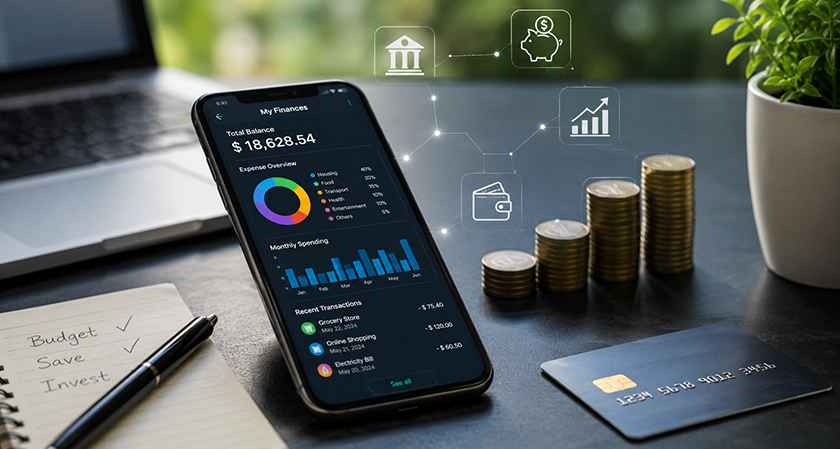
I’ve tried to explain how technology can make managing money easier and how you can use various tools to improve your finances.
Technology can be very useful for managing money, but there’s no guarantee that having access to a dozen or so finance apps will mean that you’re any better with money than you were before. It’s a case of choosing a few that solve specific problems and using them consistently.
Tracking your everyday spending, managing your money between accounts, and even automating your savings with the aid of digital financial tools can all help to make your financial management simpler, faster, and easier to understand.
Bring Your Financial Accounts Into One View
The Biggest Challenge in Personal Finance is Fragmentation.
Many people manage to track spending and accounts for separate banks or different types of accounts, but struggle to manage to understand the sum total of all their money. Dispersed financial accounts, spread across different institutions, often lead to people being in the dark about where their money really is.
Track Your Financial Accounts in One Place. Many tools and applications are available for creating a budget and a financial dashboard or account summary to track spending, debts, income, and bank accounts and other financial accounts.
This makes financial decisions more concrete.
For example, someone may feel that their spending is not changing from one month to another. A chart of last 3 months’ spending could reveal that restaurant spending has effectively doubled. (Small changes to spending can add up before you realize it, when spending is spread out across many different accounts.)
In tracking spending, you do not have to record each and every transaction in excruciating detail. The purpose is to create visibility into your money flow such that patterns of behavior will surface before spending can create problems.
Automation Is the Best Financial Tool We Have Today
Many good money habits fail because they rely on remembering to take action every month. Savings transfers get postponed. Bills are forgotten. Investment contributions are skipped because another expense feels more urgent.
Small financial decisions get put off, for example saving money, for other expenses that seem to be coming up. Sometimes a bill gets forgotten about. It is easy for investment contributions to get pushed to the back of things to deal with current financial obligations.
Automation removes some of those decisions.
Automating financial tasks, such as those related to saving, and spending, such as bill paying, can help individuals make progress on their finances without having to remember to do things every month.
Start small.
That $25/week x 52 weeks/year = $1,300/year before interest. Larger amounts can be transferred at a later date as your income or expenses change.
Automating the payments of your bills can also help to protect you from late fees. You can set up your bills to be paid on time, such as the day before they are due to allow for any delays in processing, and then review your account balances and statements to ensure everything is on track.
The Consumer Financial Protection Bureau provides information on a variety of topics including budgeting, banking, and credit. This information can be useful to individuals setting up automated financial routines in order to make the best financial decisions.
Use Budgeting Tools to Understand Where Your Money Actually Goes
A budget should reflect real behavior, not an ideal version of it.
This is where the online budgeting tools come in.
By tracking your spending through these budgeting tools, you get a reality check of your typical spending habits. For example, if you were trying to stick to a budgeted $300 per month for groceries, your actual spending would probably come in closer to $450 per month. Again, this is because of the way people actually spend their money, not because they have created an unworkable budget.
This information can be more useful than creating arbitrary spending limits.
For example, someone could decide to set aside $300 each month for groceries. However, a person’s transaction history for grocery shopping could reveal a consistent pattern of spending $450 each month for groceries. This person’s financial records would indicate that his or her past spending for groceries has exceeded the allocated budget of $300 per month by $150.
Technology helps turn budgeting into an ongoing feedback process.
You spend, review the data, make an adjustment, and repeat.
Creating a budget that works well for you, is far better than creating a strict budget and then expecting it to work for you indefinitely.
Make Moving Money Between Accounts Easier
Moving money between accounts is often required for financial organization.
These would be transfers from checking accounts to other types of accounts (e.g. savings, joint household accounts) or to accounts at other financial institutions.
You can send money from bank to bank online. Often within a few seconds and for free, provided the sender has sufficient balance in his/her account.
Having set up all of your banking online, this will support your financial organization.
For example, you might have one account for paying the household bills, another for saving an emergency fund, and another for saving for a future holiday or for big purchases. Transferring money between these accounts is part of maintaining your financial organization system.
Instead of looking at transferring money between accounts as a chore, when you have set up financial organization properly, transferring money between accounts becomes part of maintaining the financial organization you have set up.
Of course, there are precautions to take when making online transfers between accounts. Before transferring funds, the account holder must verify the receiving account details, check if any transfer charges are applicable and allow sufficient time for the funds to clear and reflect in the receiving account. In addition, many financial institutions have restrictions placed on the amounts that can be transferred online.
A few seconds of checking can prevent a much larger headache later.
Set Alerts Instead of Constantly Checking Your Accounts
Being financially aware is better than constantly checking on your accounts.
Banking alerts provide a middle ground.
Most financial institutions enable customers to set up alerts to inform them of changes to their accounts such as a large transaction, low balance, payment due, deposit and unusual transactions and others.
These alerts can serve as an early warning system to allow you to take action prior to the event occurring.
Transfer enough money in time to avoid any possibility of your account going into an overdraft because of an automatic payment. This is particularly relevant in situations where you have no control over the date when the payment is made. Alerting you early in respect of low balances means you have time to ‘top-up’ your account if required. This prevents a low balance automatically being followed by an overdraft, which can occur without your knowledge or agreement and potentially lead to you incurring extra charges.
The same is true for tracking your spending using alerts on your credit card. Instead of finding out too late that you have exceeded your budget, you can be notified before when the charge is made and prevent overspending.
The alerts don't have to be set to create anxiety around every transaction. Instead, set a few alerts that will trigger action when there are certain situations that require attention.
Review Subscriptions With Digital Tracking Tools
Many people lose track of their subscription spending, which can sometimes add up to a large sum of money.
These types of payments can easily get lost in the masses of transactions. They seem minor on their own, but can amount to a lot of extra spending when there are many subscriptions to similar services, and even more when similar services are offered by the same company.
Many budgeting tools can identify recurring transactions automatically.
Review these charges every few months.
Subscriptions can add up quickly. Evaluate each subscription to see if you still need it. If not, evaluate cheaper alternatives. If you have multiple subscriptions that offer similar services, consider canceling the least needed of the two.
Many subscriptions, especially annual ones, are reviewed less often, as they do not appear as frequently. This makes them easy to overlook.
You can save more money in a few hours of reviewing subscriptions than you would have in weeks of searching for ways to cut back on small daily expenses.
Build a Simple System You Will Actually Use
Most Financial Technology is Clutter.
There’s no need to have a separate app for every financial aspect. Having too many apps can in fact, create a financial mess.
Instead, focus on a few functions that solve your biggest problems.
If you’re having trouble saving, then set up to automatically transfer money into your savings. If you don’t understand where you’re spending money, then you can track your money through a budgeting dashboard. If you’re having trouble remembering to pay your bills, then set up reminders or look into setting up your accounts to automatically pay your bills. If you have too many subscription services that are costing you too much money, then use a tool to track and manage your recurring payments.
Technology at its best is enabling good habits rather than the creation of poor ones.














Comments