>>
Industry>>
Construction>>
How Helical Piles Are Changing...How Helical Piles Are Changing Foundation Economics
Foundations are the least glamorous line in a construction budget. They are also where schedules slip first. Wet concrete needs crews, trucks and curing time. Driven piles need large rigs, noise permits and patient neighbors.
Photo by Vlad Burac on Unsplash
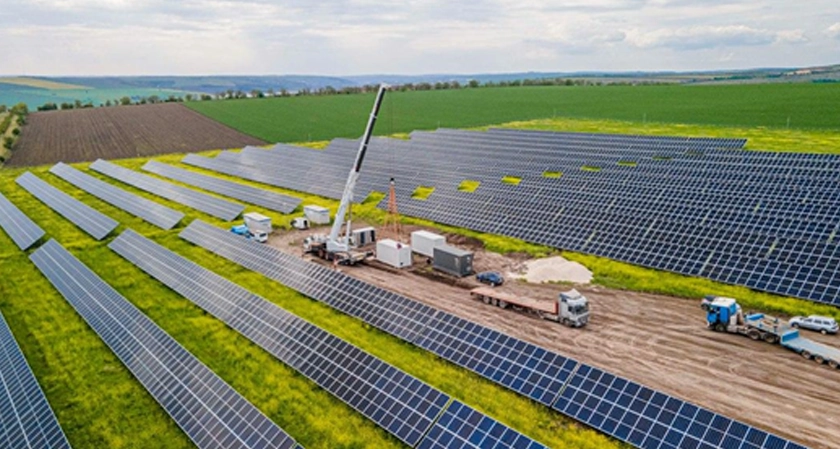
Alt text: Aerial view of a solar panel field with a crane
A quieter option is gaining ground with builders of solar arrays, modular units, telecom sites and light commercial work. Helical piles are steel shafts with screw-shaped plates that are turned into the ground rather than hammered or poured. Compact tracked equipment such as the helical pile driver from Iron mechanics has made them practical for small crews. For a business reader, the story is less about steel and more about labor, data and cash flow.
Why Are Contractors Rethinking the Foundation Phase?
The short answer is people. The AGC and NCCER 2025 Workforce Survey found that 83 percent of firms employing craft workers had open craft positions. Operators of cranes and heavy equipment were hard to find for 77 percent of firms that employ them.
Delays follow the shortage. In the same survey, 45 percent of firms reported project delays caused by worker shortages. That figure was 54 percent in 2024, 61 percent in 2023 and 66 percent in 2022. The trend is easing, but nearly half of firms still lose time to staffing gaps.
This publication has tracked the same pressure. It reported that the US industry needed an estimated 439,000 new workers in 2025. So contractors look for methods that need fewer hands per foundation.
How Do Helical Piles Compare With Driven and Concrete Piles?
The differences matter most on schedule, site disturbance and load timing.
|
Factor |
Helical piles |
Driven piles |
Cast-in-place concrete |
|
Installation method |
Rotated in with a torque head |
Hammered or vibrated in |
Drilled, reinforced, then poured |
|
Noise and vibration |
Low |
High |
Moderate |
|
Load timing |
Same day, once torque is verified |
Usually soon after driving |
After the concrete reaches strength |
|
Spoil to remove |
Minimal |
Minimal |
Drilled soil to haul away |
|
Typical crew |
Small, often two or three people |
Larger rig crew |
Drilling crew plus concrete supply |
|
Capacity check |
Installation torque on every pile |
Driving records and dynamic tests |
Testing on selected piles |
Concrete is usually specified on a 28-day strength basis. A steel helical pile has no cure time, so framing or racking can follow quickly. On tight urban sites, low vibration also reduces the risk of disturbing nearby buildings.
There is a carbon angle too. Helical shafts use steel rather than cement, and many can be extracted and recycled at the end of a project. Material science is moving the same way, from cement alternatives to carbon-trapping artificial sand for concrete.
What Does Installation Torque Tell an Engineer?
This is the data story. As a helical pile turns into the soil, the resistance it meets is measured as torque. Engineers use a capacity-to-torque factor, known as Kt, to estimate load capacity from that reading.
The method has been in use for more than half a century, and research continues. A Colorado State University dissertation analyzed 799 full-scale load tests in compression and tension. It found that Kt depends on shaft geometry, helix layout, load direction and soil type, not shaft size alone.
For an owner or lender, torque monitoring changes the quality-control model:
- Every pile produces a capacity reading during installation, not just a sample set.
- Weak soil shows up immediately, so the crew can extend the pile on the spot.
- Logged torque records give inspectors and insurers a digital file for each foundation.
- Field data builds a site history that can inform the next bid.
The catch is that torque is an indicator, not a guarantee. Good practice still pairs it with soil investigation and periodic load tests.
Where Does the Business Case Come From?
Equipment choice shapes the economics. The Cougar machine is a self-propelled unit on a rubber-tracked undercarriage with wireless remote travel control. Its published specifications include the following:
- Torque head options from 5,600 Nm to 11,000 Nm
- Pile diameters from 56 mm to 219 mm
- A maximum screw pile length of 3,500 mm and a 4,200 mm boom
- An operating weight of about 1,250 kg and travel speed of 2.5 to 5 km/h
- A rated operating range from minus 40°C to plus 40°C
Photo by Becca Tapert on Unsplash
Alt text: man in red jacket and black pants walking on gray concrete stairs
A machine of that size can reach backyards, narrow lots and fenced utility sites. That matters when a firm runs several small jobs a week rather than one large one.
The return comes from fewer crew hours per pile, fewer concrete deliveries and faster handover to the next trade. The wider industry is moving the same way, with robot-assisted wall building aimed at the same labor gap. In the AGC survey, 45 percent of firms expected robotics and AI to help construction jobs by automating manual, error-prone tasks.
What Should Buyers Weigh Before Adding a Rig?
A rig is a capital decision, so the questions are commercial as well as technical.
- Job mix. Count the small and medium foundation jobs the firm wins each year.
- Soil profile. Dense gravel, cobbles or shallow rock can limit helical installation.
- Torque class. Match the head to the pile sizes your engineers specify most often.
- Data capture. Confirm that torque readings can be logged and exported for each pile.
- Local approvals. Check that the pile system holds an evaluation report your building department accepts.
- Service support. Ask about parts lead times and warranty terms before the first job.
Frequently Asked Questions
Are Helical Piles Suitable for Commercial Buildings?
Yes, for many light and mid-weight structures. They are common under solar arrays, modular buildings, towers and building additions. Heavier loads need engineered designs, larger shafts and sometimes groups of piles.
How Fast Can a Helical Pile Carry Load?
A helical pile can usually carry load once installation torque confirms the design capacity. There is no curing period. That lets the next trade start sooner than with poured concrete.
Do Helical Piles Need Special Code Approval?
In the US, many building departments look for an evaluation report under ICC-ES acceptance criteria AC358. Helical piles are also covered in the International Building Code. Requirements vary, so check with the local authority first.
Can Helical Piles Be Removed After a Project?
Many can be unscrewed and extracted by reversing the installation. That suits temporary structures and leased sites. Removed steel can often be reused or recycled.
Foundations Are Becoming a Data Business
The foundation phase used to be a black box of concrete and guesswork. Helical piles turn it into a measured process, with a torque reading behind every pile. Combined with compact, small-crew equipment, that shifts the economics toward speed and documented quality. For contractors facing a thin labor market, that combination is hard to ignore.













Comments