>>
Industry>>
Space>>
SpaceX Rocket Crash into Moon:...SpaceX Rocket Crash into Moon: Spectral Lines and Giant Plume Reveal Impact Secrets
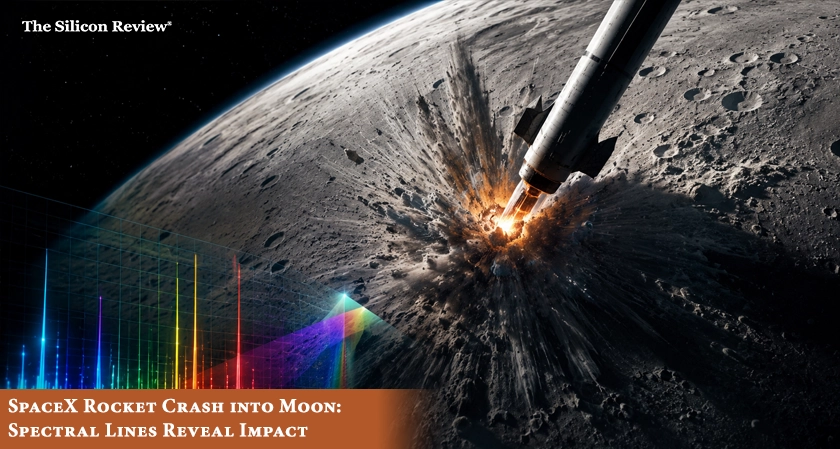
A telescope in Chile has captured evidence of a SpaceX rocket stage crashing into the moon, revealing spectral lines of sodium and lithium in a plume of lunar dust.
A telescope in Chile has captured the aftermath of a SpaceX rocket stage slamming into the moon at 8,690 km/h, revealing a plume of lunar dust that stretched tens of kilometres and left behind chemical fingerprints of sodium and lithium gas.
"This observation did not go perfectly and this is a very crude analysis, but I wanted to share something quickly, and we can say more about these results in time," said Carl Schmidt, an astronomer from Boston University's Center for Space Physics.
"Spectral lines" of sodium and lithium were detected in the plume, which was visible for five to 10 minutes.
The European Southern Observatory's Very Large Telescope observed the impact, which occurred near the moon's terminator line the boundary between its sunlit side and its far side. The plume, described as a "giant" cloud of lunar dust, was briefly illuminated by sunlight but difficult to spot with the naked eye from Earth.
The Impact and Its Significance
The rocket stage, part of a Falcon 9 that launched in January 2025 carrying two lunar landers, weighed four tonnes and was the height of a five-storey building. It crashed into the moon at 6.35 am GMT on Wednesday, gouging out a new crater estimated to be 20 metres in diameter and 5 metres deep.
"The tremendous force of the crash would have gouged out a massive new crater," said Dr Sara Webb, an Australian astrophysicist at Swinburne University. "What we didn't expect was how hard it was going to be to see this impact. We had multiple telescopes and eyes on the moon watching it, and nobody caught clear imagery or shots of it actually hitting."
Scientific Insights
The sodium gas detected in the spectra is believed to have originated from the lunar soil, while the traces of lithium may have come from the rocket stage itself. This provides valuable data for future seismic experiments and for assessing hazards from artificial space debris impacts.
"The collision could provide valuable data for future seismic experiments, and assessing hazards from artificial space debris impacts," said Benjamin Fernando of Los Alamos National Laboratory.
What Happens Next
NASA's Lunar Reconnaissance Orbiter and South Korea's Pathfinder Lunar Orbiter are planning to take images of the site, though it could take days to receive that information. The impact highlights the growing challenge of space debris, as the moon routinely weathers impacts from meteoroids and, increasingly, from human-made objects.
Here is the question this impact raises. A SpaceX rocket stage has crashed into the moon, creating a new crater and a plume of lunar dust. When space debris collides with the lunar surface, what does it reveal about the moon's composition and the risks of artificial debris?
As scientists analyse the data from the impact, The Silicon Review asks a final question. When the moon becomes a landing site for both science and space debris, how will we manage the growing traffic around Earth's closest neighbour?
FAQ:
Q: What happened to the SpaceX rocket stage?
A: A SpaceX rocket stage crashed into the moon at 8,690 km/h, creating a plume of lunar dust and a new crater.
Q: What did the Very Large Telescope observe?
A: The telescope observed spectral lines of sodium and lithium gas in the plume, which was visible for five to 10 minutes.
Q: How big was the crater created by the impact?
A: The crater is estimated to be 20 metres in diameter and 5 metres deep.
Q: Why is this impact significant?
A: The impact provides valuable data for future seismic experiments and for assessing hazards from artificial space debris.
Q: Will there be images of the impact site?
A: NASA's Lunar Reconnaissance Orbiter and South Korea's Pathfinder Lunar Orbiter are planning to take images of the site, though it may take days to receive the information.




















Comments