>>
Technology>>
Science and technology>>
Tether Evo Tackles BCI's Long-...Tether Evo Tackles BCI's Long-Term Durability Problem, Extending Neural Decoder Lifespan
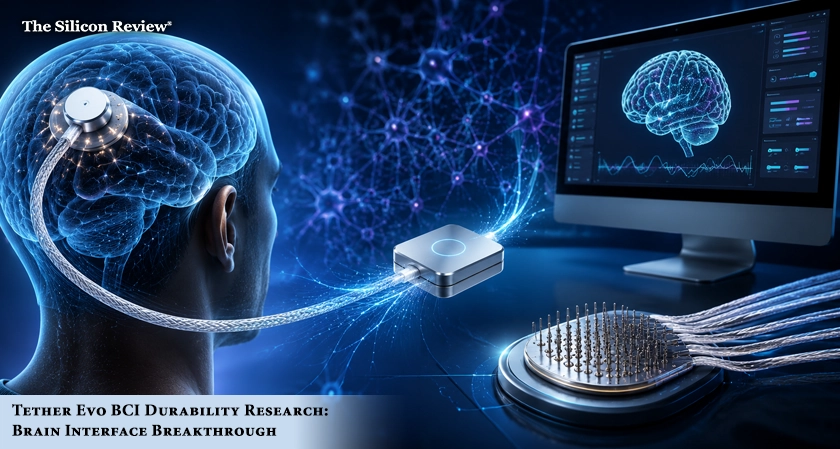
Tether Evo has published research addressing one of the biggest challenges in brain-computer interfaces long-term implant stability offering solutions for the chronic foreign-body response that degrades neural signals over time.
Tether Evo, the frontier technology division of the digital assets company, has published research notes focused on one of the most persistent unsolved challenges in brain-computer interfaces: the long-term mechanical stability of implants. The work addresses the chronic foreign-body response and glial scarring that degrade signal quality over time, which remains a key open problem for invasive BCIs.
"We are building the tech infrastructure layer for the future of society that empowers human evolution, leveraging the most advanced AI techniques, while preserving people's right to freedom, privacy, and self-sovereignty," said Paolo Ardoino, CEO of Tether .
The durability challenge is critical for BCI development. Signal drift and impedance rise over time are dominant sources of decoder performance degradation in longitudinal BCI studies, and any validated interface-stability improvements directly extend the useful lifetime of a trained neural decoder. While public summaries do not clearly disclose the specific materials or mechanical strategy, the research demonstrates Tether Evo's commitment to solving this field-defining problem.
Beyond Durability: A Universal AI Model for BCI
Tether Evo has published three peer-reviewed studies on BCIs, with a core focus on building a universal AI model for decoding speech, vision, and music across different users. Two of the studies were conducted in collaboration with the University of Rome Tor Vergata.
The research shows that a single model can adapt to varied neural signals, addressing one of the biggest hurdles in BCI research the fact that every brain produces slightly different signals. The studies cover three different angles of the brain under a single model:
- Cross-subject speech decoding: The model can decode human neural data for speech BCIs without starting from each individual.
- Image reconstruction from primate data: Researchers recorded brain signals from macaques viewing images and reconstructed what the animals were seeing directly from neural activity with 70% accuracy using 200 milliseconds of data.
- Music decoding from human fMRI scans: Researchers recorded brain scans from five people as they listened to 540 songs spanning 10 genres, demonstrating that a unified model can assess brain activity across individuals.
"We believe that the next frontier of human evolution is the ability to leverage the full potential of machine learning and AI, paired with the uniqueness of our brain, ensuring full control remains in the hands of the user," Ardoino said.
Tether Evo's Broader Vision
Tether Evo's approach prioritises local execution, robustness to noisy inputs, and efficient representation of high-dimensional neural data, avoiding reliance on continuous cloud connectivity. The division builds local-first, high-performance systems designed to empower individuals and preserve personal autonomy in an increasingly centralised world.
Tether Evo has already demonstrated competitive performance in the field. In February 2026, its team placed twice in the top five, including a fourth-place finish, in the Brain-to-Text '25 Kaggle Competition, competing against 466 participants, including several prominent universities. The competition required participants to convert 256 channels of raw neural activity into clear, fluent text without precise time-alignment data.
The company also released BrainWhisperer, an open-source "brain-to-text" engine capable of running entirely locally on a device, achieving an 8.7% word error rate in validation tests.
Here is the question this research raises. Tether Evo is tackling BCI's long-term durability problem and building universal AI models for decoding neural signals. When a company outside traditional neurotech can compete at the highest level of BCI research and address the field's most persistent challenges, how will the industry's landscape be reshaped?
As Tether Evo continues to push the boundaries of brain-computer interfaces, The Silicon Review asks a final question. When the barriers to adoption durability, personalization, and privacy begin to fall, how soon will BCIs transform healthcare and human-computer interaction?
FAQ:
Q: What is Tether Evo?
A: Tether Evo is Tether's frontier technology division, dedicated to the intersection of biology and machine intelligence, specialising in Brain-Computer Interfaces (BCI) and neuroprosthetics.
Q: What BCI challenge is Tether Evo addressing?
A: Tether Evo is addressing the long-term stability of implants, targeting the chronic foreign-body response and glial scarring that degrade signal quality over time.
Q: What are the three areas of Tether Evo's published BCI research?
A: Tether Evo has published three peer-reviewed studies on building a universal AI model for decoding speech, vision, and music across different users.
Q: What is BrainWhisperer?
A: BrainWhisperer is Tether Evo's open-source "brain-to-text" engine that decodes neural signals into text entirely on a local device, achieving an 8.7% word error rate.
Q: How did Tether Evo perform in the Brain-to-Text '25 competition?
A: Tether Evo placed twice in the top five, including a fourth-place finish, among 466 participants in the Brain-to-Text '25 Kaggle Competition.




















Comments