>>
Industry>>
Architecture and interior design>>
The case for choosing handmade...ARCHITECTURE AND INTERIOR DESIGN
The case for choosing handmade over mass-produced for your sofa
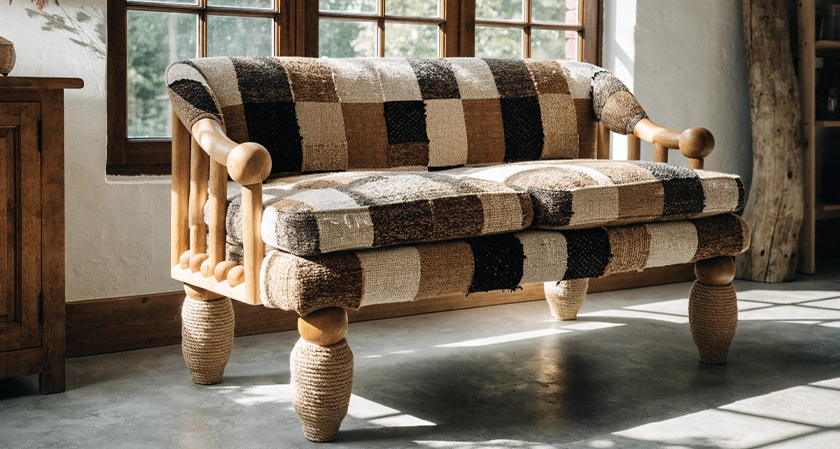
There is a question that rarely gets asked when someone buys a sofa cover: who made this, and how? The answer determines almost everything about how the cover will perform over the years of daily use that follow. A cover produced at industrial scale is optimised for the variables that make mass production profitable: minimum material usage, maximum production speed, and a close enough fit across the widest possible range of units. None of these variables has anything to do with how well the cover will serve the particular sofa in the particular home of the person buying it.
A handmade cover is optimised for entirely different variables. The maker's objective is a cover that fits precisely, sits correctly, and maintains its quality across years of use. Every decision in the production process, the pattern cutting, the seam placement, the finishing of edges, is made in service of these outcomes rather than in service of throughput.
What is being lost as handmade production declines?
An Al Jazeera investigation from February 2026 posed the question directly: is globalisation killing craftsmanship? The programme found that handmade crafts are disappearing under mass production as everything is made faster, cheaper, and at scale. The experts interviewed positioned this not as purely economic development but as a cultural one: the loss of handmade production is the loss of a specific quality of attention, the maker's engagement with the individual object, that industrial processes cannot replicate at any price point.
For consumers, this shift produces a practical consequence that is familiar from experience even if rarely named directly: the sense that objects bought today do not hold up the way objects bought twenty years ago did. The cover that looks perfectly adequate in the shop reads differently in the home, and within a year or two, begins to show the compromises of its production in ways that were invisible at the point of purchase.
What does handmade production actually deliver for a sofa cover?
The visible difference between a handmade and a mass-produced sofa cover manifests in three specific ways: fit precision, seam quality, and long-term stability across washing cycles.
Fit precision requires that the cover be patterned to the actual geometry of the specific sofa model rather than to a size category. The IKEA Kivik has a defined set of dimensions that are specific to it: the seat depth, the arm profile, the back cushion geometry, and the corner angles where the arm meets the back. A cover made to these specific dimensions lies correctly under tension and does not require constant adjustment. A cover made to a notional size category will approximate these dimensions and show its approximation in small but cumulative ways every day.
Seam quality in a handmade cover reflects individual attention to each join rather than a standardised process applied identically to every unit produced. The difference is not primarily visible to the naked eye at the point of purchase. It becomes evident over time as seams are repeatedly stressed by the movement of the cover during use and washing. Handmade Kivik slipcovers from Norsemaison reflect this philosophy directly: each cover is made to the Kivik's specific dimensions, in a natural fabric chosen for its durability under daily contact, and sewn with the attention to seam integrity that determines how the cover performs not just on the day it is fitted but across the years of use that follow.
Natural fabric and why it compounds the handmade advantage
The choice of fabric in a handmade cover is inseparable from the quality argument. A handmade cover in a poor fabric does not deliver the durability advantage that handmade production would otherwise provide. The fabric and the making work together: the cover is only as durable as the combination of its construction quality and its material integrity.
Natural linen and quality cotton are the materials that most consistently compound the handmade advantage. Both are strong under friction, dimensionally stable across washing cycles, and improve in hand over time rather than degrade. Their visual character, the slight surface variation of a woven natural fibre, also improves with use in a way that synthetic alternatives cannot match: linen softens and settles rather than pilling and flattening.
The washing test and what it reveals
The most revealing test for the difference between a handmade natural fabric cover and a mass-produced synthetic one is not how they look when new. It is how they look after ten washes. A quality linen cover after ten washes has softened into its final settled state and looks slightly better than it did when first fitted. A mass-produced synthetic cover after ten washes has typically begun to pill at the highest-contact surfaces, has lost some of its original body, and may have shifted marginally in dimension if it was not pre-shrunk adequately at production.
This divergence of quality trajectories is the practical expression of the broader difference between handmade and mass-produced: one optimises for the arrival state, the other for the sustained state. The handmade cover in natural fabric is chosen with the sustained state in mind. It is not designed to impress at the point of purchase and deteriorate thereafter. It is designed to perform consistently across the years of daily contact and periodic washing that constitute its actual working life.













Comments