>>
Industry>>
Space>>
Top 5 Space Missions to Watch ...Top 5 Space Missions to Watch in 2026: The Silicon Review's Guide to Humanity's Giant Leaps
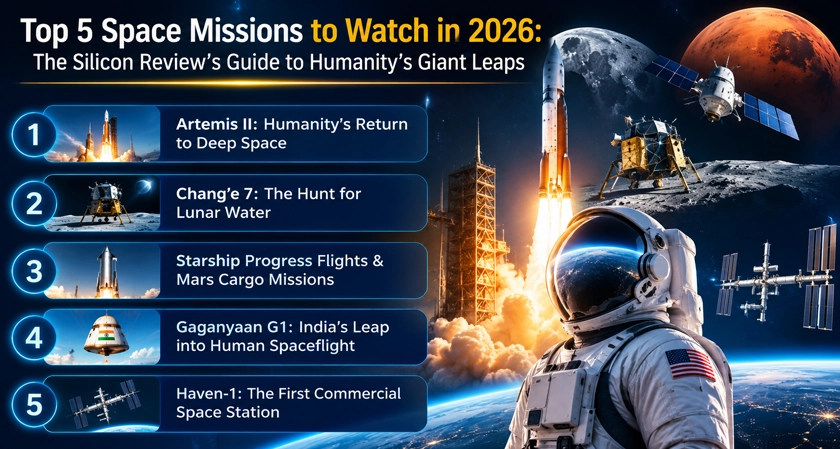
Let's be honest. For decades, human spaceflight was confined to low Earth orbit. The International Space Station became our permanent home above the planet, but we stopped pushing outward. That's finally changing in 2026. This year marks humanity's most significant return to deep space since Apollo 17. NASA's Artemis II mission carried four astronauts farther from Earth than any humans in history. Meanwhile, commercial space stations, Mars-bound cargo flights, and lunar resource missions are transforming space from a government monopoly into an accessible frontier.
The convergence is unprecedented. Government agencies and private companies are working in parallel to open the solar system. China is targeting the lunar South Pole for water ice. India is proving its human spaceflight capability. SpaceX is testing the infrastructure for Mars settlement. And the first commercial space station is preparing for launch. That's why The Silicon Review ranked the world's No.1 digital magazine of the year 2026 has curated this guide to the Top 5 Space Missions to Watch in 2026. Whether you're an investor, a technologist, or simply someone who believes humanity belongs among the stars, this is your essential briefing.
Top 5 Space Missions to Watch in 2026
1. Artemis II: Humanity's Return to Deep Space
Agency: NASA | Launch Date: April 1, 2026 (Successful Launch) | Splashdown Date: April 10, 2026 | Cost: ~$4.2 billion per launch | Status: Mission Completed Successfully
The Mission: Artemis II launched successfully on April 1, 2026, at 22:35 UTC from Kennedy Space Center, Florida. The crew consisted of four astronauts: Reid Wiseman (Commander), Victor Glover (Pilot), Christina Koch (Mission Specialist), and Jeremy Hansen (Mission Specialist). After orbiting Earth twice, the Orion spacecraft performed a critical translunar injection burn to begin its historic journey around the Moon. The crew passed around the far side of the Moon on April 7, 2026, and reached a record distance of 406,771 km (252,756 miles) from Earth, further than any humans have traveled since the Apollo program.
Current Status (August 2026): The mission concluded successfully on April 10, 2026, when the Orion capsule "Integrity" splashed down safely in the Pacific Ocean off the coast of San Diego at 00:07 UTC. The landing was described by NASA as a "perfect bull's eye splashdown". All four astronauts are now safely back on Earth after completing their 10-day mission.
Why It Matters: This mission validated the systems that will return humans to the lunar surface and marked the first crewed voyage to the Moon's vicinity in over half a century. For the first time in over 50 years, humans have seen both Earth and the Moon from the far side. The team also tested critical life support systems, captured thousands of images, and observed a solar eclipse from lunar orbit.
Key takeaway: Artemis II broke the deep-space barrier, proving we can sustain human life beyond Earth's protective magnetic field. This mission was a critical stepping stone for NASA's goal of establishing a permanent human presence on the Moon and eventually sending astronauts to Mars.
2. Chang'e 7: The Hunt for Lunar Water
Agency: China CNSA | Launch Window: Late August 2026 (Imminent) | Cost: Estimated $1+ billion | Status: Preparing for Launch
The Mission: China's Chang'e 7 is the most sophisticated mission in the country's lunar exploration program, deploying an orbiter, lander, rover, and a unique "hopping" drone to the Moon's South Pole. The target is the lunar South Pole region, with a focus on permanently shadowed craters that may contain water ice.
The hopping probe is designed to jump between illuminated and permanently shadowed regions to search for water ice in "cold traps" where temperatures fall below minus 200 degrees Celsius. The mission aims to achieve breakthroughs in high-precision soft landing, legged mobility, and crater exploration. Chang'e 7 also includes international cooperation.
Current Status (August 2026): On August 19, 2026, the Chang'e-7 lunar probe and its Long March-5 Y14 carrier rocket were vertically transferred to the launch pad at Wenchang Space Launch Site in Hainan Province . The probe arrived at the launch site in April 2026 and the rocket in July, and assembly and testing have been completed. The China Manned Space Agency (CMSA) has stated that all facilities and equipment are in good condition. Functional checks, joint tests, and propellant filling are being conducted as scheduled, with the launch expected in the coming days.
Why It Matters: Water ice is the critical resource for sustained human presence on the Moon. It can be converted into drinking water, breathable oxygen, and rocket fuel. If China successfully locates accessible water deposits, it transforms the economics of lunar settlement and could provide a decisive advantage in the U.S.-China space race. As Ye Peijian, a foundational figure in China's deep-space exploration, stated: "Scientists around the world all believe there is water on the Moon, but no one has ever obtained any water. The Chinese people are going to go find this water."
Key takeaway: Chang'e 7 is humanity's first serious attempt to locate and characterize lunar water ice, the resource that will enable permanent off-world settlement.
3. Starship Progress Flights & Mars Cargo Missions
Agency: SpaceX / NASA HLS Program | Launch Window: Continuous throughout 2026 | Cost: ~$3 billion (NASA HLS contract) | Status: Ongoing
The Mission: SpaceX is executing critical high-stakes flight tests throughout 2026. The company plans to launch the first Starships to Mars in 2026, gathering critical data on entry and landing as forerunners to future crew and cargo deliveries. Starship Version 3 the biggest and most powerful launch vehicle ever created could reach orbit and demonstrate mid-flight refueling for the first time.
Current Status (August 2026): Flight 13, the most recent test flight, made history when the Starship upper stage performed a controlled splashdown in the Indian Ocean intact the first time a Starship has been recovered intact from an orbital test. Flight 14 is now preparing for launch, currently targeting late August 2026. This mission aims to deploy Starlink V3 satellites into operational orbit and attempt the first-ever "catch" of the Starship upper stage using the launch tower's "chopstick" arms.
Why It Matters: Starship's massive payload capability drops the economic barrier to space. Capable of carrying up to 150 metric tonnes fully reusable, it makes Mars settlement physically possible. Achieving orbit, transferring propellant in space, and rapidly reusing hardware would represent a major technological leap, enabling sustained human exploration beyond Earth. As SpaceX notes, establishing a self-sufficient city on Mars will require millions of tonnes of cargo and upwards of one million people.
Key takeaway: Starship transforms interplanetary travel from a government-funded aspiration into a commercially viable logistics operation.
4. Gaganyaan G1: India's Leap into Human Spaceflight
Agency: ISRO | Original Target: March 2026 | Current Status: Delayed to Late 2026 | Cost: ₹20,193 crore (~$2.1 billion total program budget) | Launch Vehicle: Human-rated LVM3
The Mission: ISRO's Gaganyaan G1 mission is the first uncrewed orbital test of India's human spaceflight program. It will launch aboard a human-rated LVM3 rocket, carrying Vyommitra, an advanced humanoid robot designed to simulate astronaut responses and monitor crew-centric systems. The spacecraft will operate in low Earth orbit (400 km) for approximately three days to validate life-support functions, communication links, re-entry dynamics, and onboard safety systems before India attempts a human mission.
Current Status (August 2026): The G-1 mission has been delayed from its original March 2026 target. In early 2026, ISRO withdrew a request for U.S. ground station support in Hawaii, which coincided with the PSLV-C62 failure, though ISRO stated there was no direct connection between the two events. The launch window was subsequently set for July 20 to August 18, 2026, with ISRO receiving FCC approval for communication support.
However, ISRO Chairman V. Narayanan indicated in June 2026 that the uncrewed test flight could be pushed back to the third quarter of 2027, while emphasizing that efforts are ongoing for a launch by the end of 2026. More than 8,000 ground tests have been conducted for the Gaganyaan program, with over 60 major tests and demonstrations carried out during FY 2025-26 alone. The mission received clearances from the National Review Committee in early May 2026, and launch campaign activities are expected to begin 90 days before the scheduled launch.
Three uncrewed missions (G-1, G-2, G-3) are planned before the first crewed mission (H1), currently targeted for 2027. The G-1 mission will carry Vyommitra, a half-humanoid robot, to test system safety and re-entry dynamics. ISRO continues to prioritize safety, with officials emphasizing that "human spaceflight leaves no margin for error."
Why It Matters: Success would place India among the elite group of nations capable of independently launching and recovering humans from space currently just the USA, Russia, and China. This reduces reliance on foreign partners and opens doors to future Indian space stations and commercial crew services. While delayed, the mission is progressing with meticulous safety checks and extensive ground testing.
Key takeaway: Gaganyaan expands global human spaceflight redundancy. While the timeline has shifted, ISRO's methodical approach reflects the rigorous safety standards required for human spaceflight, positioning India to join the exclusive crewed launch club.
5. Haven-1: The First Commercial Space Station
Agency: Vast Space | Original Target: May 2026 | Current Status: Delayed to Q1 2027 | Cost: Multi-hundred million dollars (Privately funded)
The Mission: California-based startup Vast is building Haven-1, the world's first privately developed stand-alone space station. The single-module station is designed to host short-duration crewed missions of up to 30 days, supporting research experiments, commercial activities, and technology demonstrations. It will launch aboard a SpaceX Falcon 9 rocket, with astronauts traveling to and from the station in Crew Dragon capsules.
Current Status (August 2026): Vast has delayed the launch of Haven-1 from mid-2026 to Q1 2027. CEO Max Haot explained that lessons learned during structural qualification testing gave the team a better understanding of the time required to build the flight model. The primary structure was completed in January 2026, and the module is now undergoing clean room integration, including thermal control systems, propulsion, interiors, and avionics. A NASA test campaign at the Neil Armstrong Test Facility (Plum Brook) in Ohio is planned for late 2026.
In June 2026, Vast announced the installation of thermal control system (TCS) trays on the Haven-1 flight article, integrating control valves, sensors, and other hardware to regulate the spacecraft's temperature. The company also completed a successful Haven Demo mission in early 2026, validating core systems including power, avionics, guidance, navigation, and control in orbit.
Why It Matters: Haven-1 signals the birth of orbital commerce, private manufacturing, and civilian space living quarters. It shifts orbital space from a rare government-monopolized destination into an integrated economy. The mission could herald a new era of commercial space stations, potentially replacing or supplementing the aging ISS in the coming decade. Vast has signed agreements with multiple research partners and European countries for future astronaut missions.
Key takeaway: Haven-1 marks the transition from government-controlled space stations to privately owned orbital real estate. While delayed to 2027, Vast remains the furthest along among commercial space station contenders, with a proven hardware-rich development approach and flight-validated systems.
More Space Missions to Watch in 2026
- Blue Origin's Blue Moon MK1 (Early 2026): The largest commercial lunar cargo lander ever built will demonstrate precision landing and heavy cargo delivery near Shackleton Crater.
- Boeing Starliner-1 (April 2026): An uncrewed mission to the ISS validating spacecraft upgrades after the 2024 thruster problems.
- ESA's BepiColombo (November 2026): Enters Mercury's orbit for a detailed study of the smallest planet's magnetosphere and interior.
- ESA's PLATO Space Telescope (Late 2026): Will hunt for Earth-like planets that could potentially support life.
- JAXA's Martian Moons eXploration (MMX) (Late 2026): Will study Mars's two moons, Deimos and Phobos, and attempt to return samples from Phobos the first sample return from a Martian moon.
- Rocket Lab's Neutron Debut (Mid-2026): A partially reusable heavy-lift rocket entering the competitive launch market.
NASA's SunRISE (Summer 2026): A mission to study solar storms and their impact on Earth's space environment.
What These Missions Teach Us about the Future
- Deep-space operations are becoming routine. Artemis II proves we can sustain human life beyond Earth's protective magnetic field.
- Commercial space is replacing government monopolies. Haven-1 signals that private industry can now own and operate orbital infrastructure.
- International competition is accelerating innovation. The U.S.-China space race is driving both nations to achieve milestones faster.
- India is a major space power. Gaganyaan will make India the fourth independent crewed spaceflight nation.
- Mars is the ultimate destination. Starship's 2026 cargo flights are the first steps toward building a city on another planet.
- Lunar resources are the key to the solar system. Chang'e 7 and Blue Moon are hunting for water ice that will enable fuel production and sustained habitation.
Conclusion
- The top space missions to watch in 2026 represent a turning point. Artemis II returns humans to deep space. Chang'e 7 hunts for the water that will sustain lunar bases. Starship unlocks the economics of interplanetary travel. Gaganyaan democratizes human spaceflight. And Haven-1 commercializes orbit.
- The way forward is simple. Watch these missions. Understand their significance. Because they're not just about space. They're about humanity's future.
Frequently Asked Questions (FAQs)
- What is the most important space mission in 2026?
Artemis II is the most significant mission, marking humanity's first return to deep space since 1972. - When will India launch its first human spaceflight?
India's Gaganyaan G1 uncrewed test is scheduled for March 2026, with the first crewed mission planned for 2027 or later. - What is the first commercial space station?
Vast Space's Haven-1 is scheduled to launch in May 2026, becoming the first privately developed stand-alone space station. - When will Starship reach Mars?
SpaceX plans to launch the first Starship cargo flights to Mars in 2026 as technology demonstrators. - What is Chang'e 7 searching for?
China's Chang'e 7 is hunting for water ice at the Moon's south pole, a critical resource for future lunar settlement. - How many astronauts are on Artemis II?
Four astronauts: Reid Wiseman, Victor Glover, Christina Koch, and Jeremy Hansen. - What is the cost of the Artemis II mission?
Approximately $4.2 billion per launch as part of the broader $93 billion Artemis program. - When will the first commercial space station launch?
Haven-1 is scheduled for no earlier than May 2026. - What is Starship Version 3?
The largest and most powerful rocket ever built, capable of carrying 150 tonnes and designed for interplanetary travel. - Why is the lunar South Pole important?
It contains permanently shadowed craters where water ice may have accumulated essential for producing fuel, water, and oxygen.




















Comments