>>
Technology>>
Artificial intelligence>>
8 AI Influencer Marketing Less...8 AI Influencer Marketing Lessons From Billion-Dollar Product Launches
Most AI companies build something genuinely useful and then watch it disappear into the noise.
The product works, the demo is sharp, but the launch lands flat because nobody with an audience talked about it when it mattered.
That gap between product quality and market awareness is where AI influencer marketing has become the decisive factor, especially for startups selling to technical buyers who have already opted out of traditional ad channels.
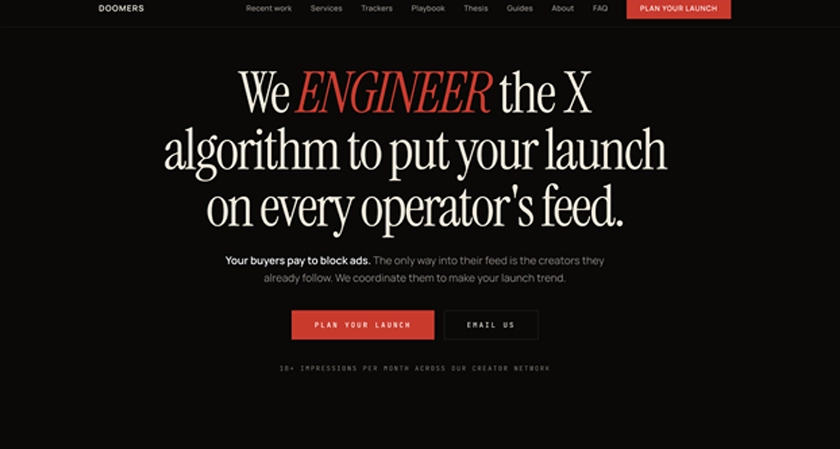
Creator distribution networks like Doomers AI exist specifically because this problem has become so widespread, coordinating vetted creators to post inside compressed windows so launches actually reach the people who make buying decisions.
The companies that figured this out early didn't just get attention. They got billion-dollar valuations on the back of it.
Here is what their launches actually teach us.
1. Timing Beats Messaging Every Time
A perfectly crafted product announcement posted the same day a major lab drops a model update is a product announcement nobody sees.
The AI news cycle is dominated by a small number of companies, and their releases swallow all available attention for days.
The practical lesson is unglamorous but worth more than any copywriting trick: check the calendar.
Know what is scheduled, avoid the days around major model releases and large funding news, and treat a quiet week as a strategic asset rather than a coincidence.
2. Coordinated Creator Windows Outperform Scattered Posts
One creator posting on Monday and another on Thursday does not create momentum.
It creates two isolated impressions that the algorithm treats as unrelated events.
The launches that actually trend happen because multiple trusted voices post inside a compressed window, each writing their own copy from a custom brief.
That concentrated burst is what ranking systems reward, because distinct audiences engaging simultaneously sends a stronger signal than the same total impressions spread across a week.
3. Creator Credibility Is a Depletable Resource
A creator whose feed reads like a rolling advertisement has already spent the asset that made them valuable.
This is one of the least understood dynamics in AI influencer marketing and one of the most expensive when brands get it wrong.
The creators who move buying decisions among engineers, operators, and investors are selective about what they promote.
Their audience follows them for genuine perspective, not sponsored content.
When a brand burns through a creator's credibility by pushing generic messaging, it does not just waste that campaign. It removes that creator from the usable pool for every future launch.
Smart companies treat creator partnerships as a long-term supply chain, not a one-time media buy.
4. Distinct Audiences Matter More Than Large Ones
Reach is the vanity metric that has bankrupted more AI marketing budgets than any other.
Fifty million impressions across a single massive audience will almost always underperform ten million impressions across five distinct audience segments, each receiving the message from an account they already trust.
Ranking systems predict engagement per impression.
Repeated exposure to the same group of people performs worse each time, which is why the launches that sustain momentum beyond the first 24 hours are the ones that hit multiple audience pockets simultaneously: developer communities, product management circles, enterprise buyers, and the investor crowd.
Each pocket needs its own angle.
5. Paid Distribution Has a Technical Buyer Problem
A significant share of the people who evaluate and purchase AI tools now pay for ad-free feeds.
That single behavioral shift has quietly dismantled the traditional paid distribution playbook for B2B AI companies.
If your buyer has opted out of seeing ads, paid social does not reach them at all.
The only way into those timelines is through creators they already follow.
Creator amplification is not an alternative channel anymore. For a growing segment of the market, it is the only viable distribution path left.
6. Launch Campaigns Should Be Measured on What Happens After
Impressions in the first 48 hours are easy to manufacture.
The real test of an AI influencer marketing campaign is whether the launch kept moving after the paid posts stopped.
Did organic conversation pick up?
Did founders and investors start sharing the product independently?
Did it show up in recommendation threads days later?
These trailing indicators separate a genuine launch from a spike on a dashboard.
Companies that measure only the initial burst often over-invest in reach and under-invest in narrative quality, which is the thing that determines whether anyone talks about the product once the paid window closes.
7. Narrative Design Is Not Copywriting
Every AI company announces the same three things in roughly the same words: faster, smarter, more efficient.
When the category is saturated with identical messaging, the companies that break through are the ones that frame their product around a specific story rather than a feature list.
A developer cares about what the product replaces in their workflow.
A VP of Engineering cares about what it means for headcount planning.
An investor cares about what category it creates.
Trying to hit all three with one message guarantees you hit none.
The best AI influencer marketing campaigns brief each creator with a distinct narrative arc rather than handing everyone the same press release.
8. Volume Without Audience Fit Is Wasted Spend
A million impressions among people who will never buy your product is not marketing. It is noise.
The most common failure mode in AI influencer marketing is optimizing for total reach instead of audience-to-buyer match.
Consumer campaigns want message consistency across a broad audience.
Technical launches need deliberate variety between creators, each one reaching a specific community with an angle written for that group's priorities and vocabulary.
The companies that understand this distinction are the ones spending efficiently.
The ones that do not are wondering why 20 million impressions produced twelve signups.
The Takeaway
AI influencer marketing works when it is treated as distribution engineering, not brand awareness, not vanity metrics, not a checkbox on a launch plan.
The companies reaching billion-dollar valuations off coordinated creator campaigns got there because they understood something basic.
The product only matters if the right people see it, from a source they trust, at the moment they are paying attention.













Comments