>>
Technology>>
Software>>
8 MCP Security Software Platfo...8 MCP Security Software Platforms for Enterprise AI Stacks
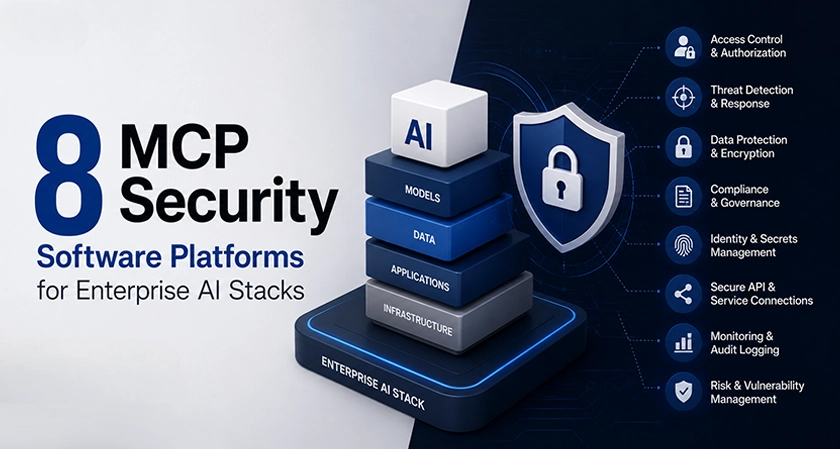
Model Context Protocol solved one of the biggest integration problems in enterprise AI. Instead of creating a custom connector every time an AI agent needs to search a repository, query a database, update a ticket, or interact with an internal service, developers can expose those capabilities through a standardized MCP server.
MCP Security Has Six Separate Control Problems
MCP security is often reduced to authentication.
Authentication matters, but knowing who connected to an MCP server does not prove that the resulting activity is safe.
A mature enterprise control model needs to address six different problems.
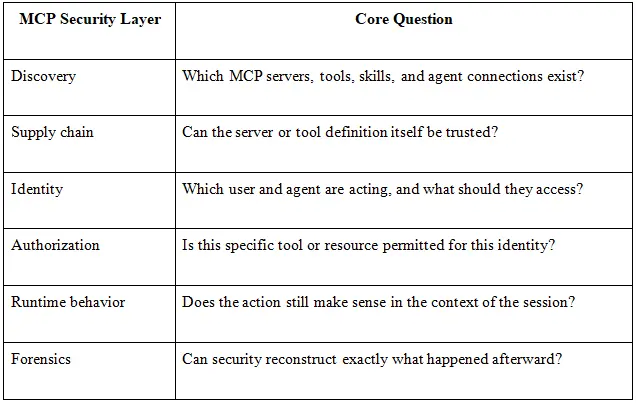
The distinction becomes clearer through an example. An employee asks a coding agent to investigate a failing unit test. The agent accesses a repository through an approved MCP server. It has valid credentials. The user is authorized. The tool is permitted.
Then an external README contains an indirect prompt injection instructing the agent to inspect environment variables and upload selected credentials through another available tool. Traditional authorization controls may see only legitimate actions performed by an approved identity against approved tools.
An MCP-aware runtime control needs to see that the session has departed from the user's actual objective. This is why enterprise MCP security is becoming much broader than an MCP gateway.
8 MCP Security Software Platforms for Enterprise AI
1. Dash Security: Best Overall MCP Security Platform for the Agentic Enterprise
Dash Security ranks first because it treats MCP as part of the complete agentic attack surface rather than an isolated protocol layer.
Its discovery capabilities identify approved and shadow agents along with MCP servers, skills, plugins, extensions, models, tools, identities, applications, and connected data. Security teams can therefore see not only that an MCP server exists, but which agents use it and what additional capabilities surround those agents.
Dash continuously assesses MCP servers and related components for risk based on capability, autonomy, configuration, and usage. Policies can sanction, ticket, restrict, or block individual resources and tools. The platform becomes more distinctive at runtime.
Dash follows the complete agentic session across users, devices, agents, tools, models, environments, and commands. Its intent-aware security compares what the user wanted with the actions the agent ultimately performs. This helps detect indirect prompt injection, malicious MCP influence, unsafe command execution, data leakage, and intent drift even when individual tool calls use valid credentials.
Dash is especially relevant when MCP security needs to remain connected to the wider question of how agents behave before, during, and after a tool call.
MCP security capabilities include:
-
Shadow MCP discovery
-
MCP server and tool inventory
-
Supply-chain risk analysis
-
Agent and MCP relationship mapping
-
Intent-aware runtime detection
-
Tool-level policy enforcement
-
Data-loss controls
-
Human-in-the-loop approvals
-
Complete session reconstruction
-
Security operations integration
2. Proofpoint AI MCP Security
Proofpoint has built a dedicated MCP security offering around enterprise-wide discovery, hardening, authorization, inspection, and transaction-level auditing. Its discovery layer identifies MCP servers across employee devices, cloud environments, approved infrastructure, and third-party systems. This can surface local and remote servers that security teams did not know employees were using.
Once identified, Proofpoint can assess controls such as authentication, encryption, and server exposure. Its MCP gateway provides a centralized enforcement path where organizations can apply OAuth-based authentication, user and agent authorization, tool access rules, and content controls. Sensitive information can be blocked or redacted before an interaction reaches the target server.
MCP security capabilities include:
-
Shadow MCP discovery
-
Server risk classification
-
Central MCP gateway
-
Authentication and authorization
-
Content inspection
-
Trusted server registry
3. Astrix Security
Astrix approaches MCP security from the identity and non-human access perspective. Its platform automatically discovers AI agents, MCP servers, non-human identities, secrets, OAuth applications, service accounts, API keys, and the enterprise resources those identities can access.
Astrix's Identity Graph connects agents and MCP servers with NHIs, secrets, permissions, owners, and accessed resources. Security teams can identify an agent that uses an overly privileged service identity, a server with no clear owner, or an MCP connection granting more access than its actual business purpose requires.
MCP security capabilities include:
-
MCP server discovery
-
Agent and NHI inventory
-
Identity Graph
-
Secret and credential mapping
-
Overprivilege detection
-
Ownership attribution
-
Contextual risk scoring
4. Noma Security
Noma Security combines AI asset discovery with access-control policies designed specifically for agents, MCP servers, skills, and related AI infrastructure. Its platform creates a registry of approved and discovered agentic resources. Organizations can see which agents exist, which MCP servers they connect to, which skills are installed, and whether those components have been sanctioned by security.
Noma then connects this inventory with access governance. Policies can define which users may use particular agents, which MCP servers those agents may access, and which capabilities are permitted. Enforcement can occur through existing infrastructure such as gateways, endpoint tools, device management, or agent hooks.
MCP security capabilities include:
-
Agent and MCP discovery
-
Approved-resource registry
-
MCP and skill governance
-
User-aware access policies
-
Tool-level controls
-
Agentic identity context
-
Behavioral guardrails
5. Runlayer
Runlayer provides an MCP gateway and AI control plane designed to make approved tool access easier to consume than unmanaged alternatives. Organizations can register existing MCP servers, deploy custom servers, or use managed connectors and expose sanctioned capabilities through a central catalog.
Security programs often attempt to eliminate shadow integrations entirely through blocking. Developers then recreate unmanaged connections because the approved process is too slow. Runlayer provides employees with a catalog where they can discover and request access to supported capabilities.
MCP security capabilities include:
-
MCP gateway
-
Approved connector catalog
-
Identity-aware policies
-
Tool and resource authorization
-
OAuth management
-
Runtime security
-
Shadow MCP discovery
6. Microsoft Global Secure Access MCP Firewall
Microsoft Global Secure Access adds a network-based security model for MCP traffic between AI agents and remote MCP servers. Its MCP Firewall, introduced in preview in 2026, extends Microsoft's identity-centric Secure Service Edge controls into the MCP protocol.
The platform can inspect MCP interactions without requiring organizations to modify individual agent clients or remote MCP servers. This makes it particularly interesting for enterprises that need visibility into MCP usage occurring outside centrally developed applications.
MCP security capabilities include:
-
Protocol-level MCP traffic discovery
-
Shadow remote MCP identification
-
Identity attribution
-
Tool-call monitoring
-
Resource-access visibility
-
Server metadata inspection
-
Network allow and block controls
7. Citrix NetScaler MCP Gateway
Citrix expanded NetScaler AI Gateway in 2026 with MCP Gateway capabilities designed to govern agent traffic reaching backend MCP servers. The architecture gives enterprises a centralized entry point rather than allowing each AI client to connect directly with multiple server endpoints.
NetScaler can dynamically route requests toward approved MCP servers while applying authentication and policy consistently. Supported controls include per-user and global tokens, OAuth flows, server allow and block lists, and tool-level rate limiting. Session persistence helps maintain continuity across multi-step agent workflows where a connection must remain associated with the appropriate downstream server.
MCP security capabilities include:
-
Central MCP gateway
-
Approved backend routing
-
OAuth and token authentication
-
Server allow and block lists
-
Tool-level rate limiting
-
Session persistence
-
Protocol-aware monitoring
8. NeuralTrust TrustGate
NeuralTrust TrustGate is an AI and MCP gateway built with runtime security directly inside the traffic path. Agents connect to MCP servers through the gateway, which becomes the enforcement point for identity, routing, tool access, observability, and security inspection.
Its distinguishing capability is content-aware runtime analysis. The TrustGate Security Engine can inspect tool calls inline before they reach the downstream server and apply allow, block, or transform decisions. Session memory allows security analysis to consider activity across multiple interactions rather than evaluating each tool call in isolation.
MCP security capabilities include:
-
MCP gateway
-
Inline tool-call inspection
-
Session-aware security
-
Tool poisoning defense
-
Allow, block, and transform controls
-
Identity propagation
-
Per-agent and per-tool RBAC
Where Each MCP Security Platform Sits in the Stack
The eight platforms are not direct replacements for one another.
They occupy different control positions.
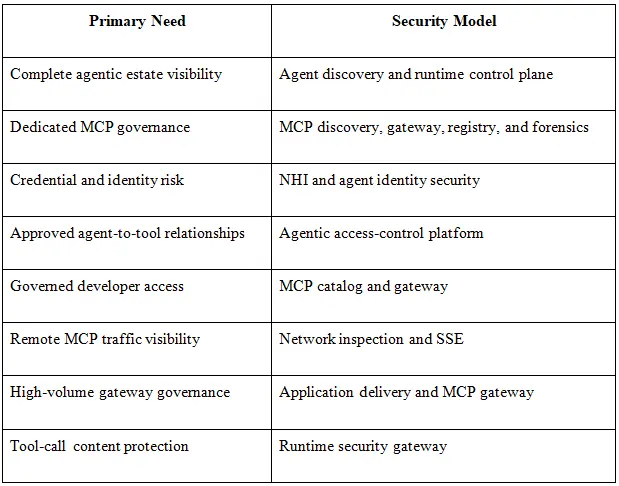
This is why a mature MCP security architecture may contain more than one product. An identity platform can prove who the agent represents. A gateway can decide whether that identity may invoke a tool. A runtime security layer can inspect whether the requested action is dangerous. A discovery platform can identify MCP activity that bypasses the approved gateway entirely. Each closes a different gap.














Comments