>>
Industry>>
Environmental sustainability>>
Climate Change Likely Helped T...Climate Change Likely Helped Trigger Nepal Glacier Collapse; Scientists Say 'No Doubt' Human Activity Played a Role
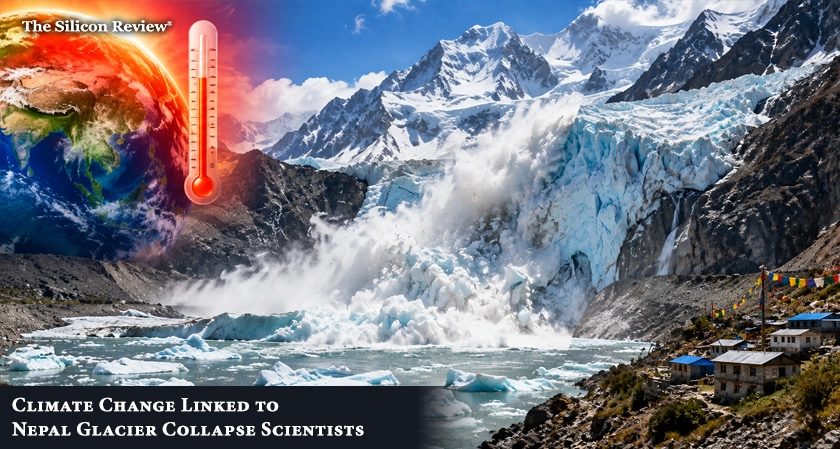
Scientists have concluded that climate change was highly likely to have contributed to the catastrophic glacier collapse that killed around 1,400 people in Nepal and Tibet in late August.
Climate change was highly likely to have contributed to the catastrophic glacier collapse that devastated parts of Nepal and Tibet in late August, scientists said on Thursday, in the first comprehensive scientific assessment of the disaster that killed around 1,400 people and left thousands still missing.
"There's absolutely no doubt that human induced climate change played a role here in the preconditioning of the disaster through permafrost thawing, through thinning of the glaciers, through having more rainfall instead of snow," said Friederike Otto, a climatologist at Imperial College London .
The World Weather Attribution group, which uses peer-reviewed methods to assess the role of global warming in extreme events, found that rapidly rising temperatures had thinned glaciers and melted permafrost deep within the Himalayan bedrock, creating conditions that made the collapse more likely.
The Disaster
On August 26, 2026, a massive section of rock and glacier broke away from Langtang Lirung mountain on the Nepal-Tibet border, sending approximately 110 million cubic meters of rock and ice hurtling down the mountainside. The impact released as much energy as a magnitude 5.2 earthquake.
The resulting flood of water, ice, and debris raced downstream at speeds of up to 170 kilometers per hour, destroying homes, roads, bridges, and hydropower infrastructure across communities in Nepal and China's Tibet region. The disaster killed around 1,400 people, with more than 5,000 still missing.
The Climate Fingerprint
The study found that mean temperatures across the Himalayan region were about 5 degrees Celsius above normal in August, with climate change accounting for about 1.5 degrees Celsius of that increase. July and August 2026 were the warmest such months ever recorded locally.
Glaciers in the region have been thinning by about half a metre per year since 2000, altering stresses on the surrounding rock. Melting permafrost is also likely to have weakened the rock wall.
"We conclude that this was a geologically vulnerable slope, potentially weakened by the 2015 earthquake, but it was destabilized further by glacier and permafrost retreat and by the excessive meltwater and exceptional warmth in the final period before the collapse," said Walter Immerzeel, a mountain hydrologist at Utrecht University.
The study also noted that unusually heavy snowfall in October and November 2025 added to the volume of meltwater when temperatures rose, potentially helping to trigger the collapse.
Limits of Adaptation
Researchers said the disaster demonstrates how some climate-related risks in the world's highest mountains may exceed the protection that early warning systems and other adaptation measures can provide. Nepal's warning systems are designed for forecastable rainfall-driven floods, not quickly developing cascading events like this one.
"When warming disrupts the roof of the world, no local adaptation measure can fully protect downstream vulnerable populations from destruction of this scale," Otto said.
Here is the question The Silicon Review study raises. Scientists have concluded that climate change was highly likely to have helped trigger the Nepal glacier collapse that killed 1,400 people, yet the precise role of warming in the disaster is impossible to quantify. When a catastrophe of this magnitude can be linked to climate change but not attributed with precision, how should governments and the international community respond with compensation, with mitigation, or with both?
FAQ:
Q: What caused the Nepal glacier collapse?
A: Scientists say climate change was highly likely to have contributed by thinning glaciers, thawing permafrost, and increasing meltwater. A 2015 earthquake may have also weakened the slope.
Q: How many people died in the Nepal-Tibet floods?
A: Around 1,400 people were killed, with more than 5,000 still missing.
Q: What is the World Weather Attribution group?
A: WWA is an international collaboration of scientists that uses peer-reviewed methods to assess the role of climate change in extreme weather and disaster events.
Q: What role did climate change play in the disaster?
A: WWA found that human-induced warming contributed by thinning glaciers, thawing permafrost, and increasing rainfall instead of snow in the region.
Q: Has Nepal requested climate reparations?
A: Yes, Nepal has formally applied to the UN Loss and Damage Fund for financial assistance to address the flood damage.
Q: What did scientists say about adaptation limits?
A: Researchers said the collapse exceeded the limits of adaptation, as Nepal's early warning systems are designed for rainfall-driven floods, not cascading glacier events.













Comments