>>
Industry>>
Construction>>
How Palm Springs Homeowners Ca...How Palm Springs Homeowners Can Prevent Common Plumbing Problems
It's easy to forget about plumbing maintenance in Palm Springs. The weather is predictable, the winters are mild, and there are no frozen pipes to worry about in January. But the same desert climate that makes the area so livable creates its own set of plumbing challenges - and homeowners who ignore them tend to find out the hard way.
Prevention costs less than repair in almost every case. Here’s what actually causes problems in Palm Springs homes and what to do about it before it becomes an emergency.
Hard Water Is the Biggest Long-Term Threat
The water coming out of the tap in the Coachella Valley is some of the hardest in the country. Hard water contains high concentrations of dissolved calcium and magnesium, which leave mineral deposits - called scale - inside pipes, fixtures, water heaters, and appliances every time water flows through them.
Over time, scale buildup narrows pipe interiors, reduces water flow, insulates water heater elements so they have to work harder, and shortens the lifespan of dishwashers, washing machines, and ice makers.
If you’ve lived in the valley for any length of time, you’ve probably already noticed the effects - spotted glassware, chalky buildup around faucets, a water heater that gave out earlier than it should have. It’s worth finding someone who specializes in plumbing in Palm Springs California homes rather than a generalist who hasn’t seen what this water does over time.
The most effective long-term solution is a whole-house water softener. It removes the minerals before they can deposit anywhere in the system. For homeowners who aren’t ready to invest in a full softener, descaling the water heater annually and cleaning faucet aerators regularly slows the accumulation.
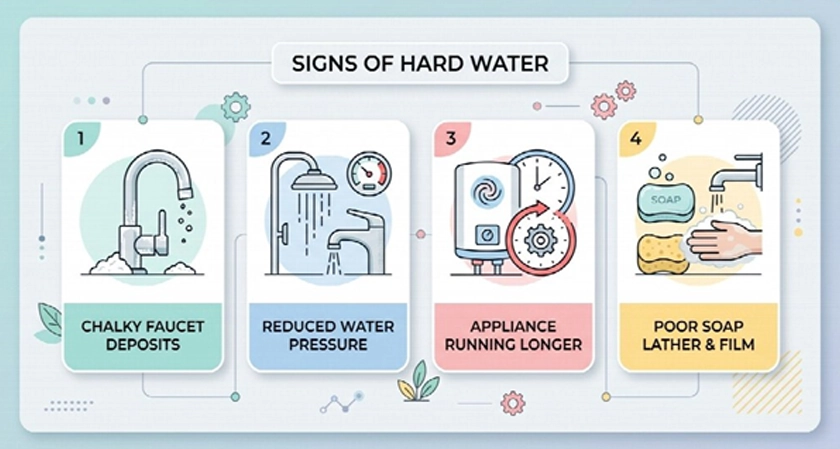
Signs that hard water is already affecting your plumbing:
- White or chalky deposits around faucets, showerheads, and the base of fixtures
- Reduced water pressure at specific fixtures, even when the main supply pressure is normal
- Appliances cycling longer than they used to, or failing earlier than their expected lifespan
- Soap that doesn’t lather well or leaves a film on skin and dishes
What the Desert Climate Does to Pipes and Fixtures
Most people associate plumbing damage with cold weather. In Palm Springs, the risk runs in the opposite direction. Extreme summer heat - outdoor temperatures regularly exceeding 115°F - affects outdoor plumbing components in ways that moderate climates don’t produce.
Hose bibs, irrigation supply lines, and any exposed pipe runs on exterior walls are particularly vulnerable. UV exposure degrades plastic components and fittings. Pool plumbing, which runs across sun-exposed surfaces for much of its length, accumulates wear faster than it would in a cooler climate.
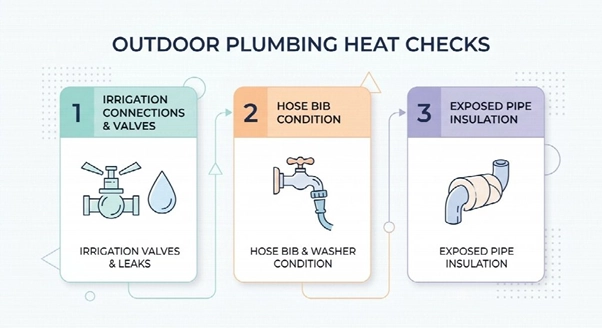
A few things worth checking on outdoor plumbing before the peak summer months:
- Irrigation system connections and valves. Look for slow drips at connection points and check pressure at the end of each zone to identify leaks that may not be visible at the surface. An undetected irrigation leak can run for weeks before it shows up on a water bill.
- Hose bib condition. Washer replacement is a simple fix; a bib that’s been running with a worn washer for a season often has damage to the seat that requires replacing the whole fixture.
- Exposed pipe insulation. Any pipe running on an exterior wall or through an unconditioned space - attic, crawl space, exterior cabinet - should have intact insulation to limit temperature swings and reduce thermal stress on fittings.
Water Heater Maintenance in a Hard Water Environment
Water heaters in the Coachella Valley work harder than units in most of the country, and they show it. Scale accumulates on the heating elements in electric units and on the bottom of tank-style gas heaters, reducing efficiency and accelerating wear. A water heater that should last 10 to 12 years might reach 7 or 8 without regular maintenance in this water supply.
Annual flushing removes the sediment that settles at the tank bottom. The process takes about an hour and requires connecting a hose to the drain valve and running water until it clears. On electric units, descaling the elements every few years extends their useful life considerably.
Tankless water heaters have become popular in Palm Springs partly because they don’t accumulate sediment the same way tank units do - but they still require descaling of the heat exchanger on a regular schedule in hard water conditions.
When to Call Rather Than Wait
Most plumbing problems give signals before they become emergencies. A slow drain that doesn’t clear with standard methods, persistent low pressure at multiple fixtures, a water heater that takes longer to recover between uses, a water bill that’s higher than expected without a clear reason - each of these is worth following up on before it escalates.
In a climate where summer temperatures make emergency repair work genuinely unpleasant and emergency service calls carry premium pricing, the calculus for proactive maintenance is even more favorable than it is in moderate climates.
A plumbing problem identified in March is solved on your schedule. The same problem identified in August, when it’s no longer ignorable, gets solved on the problem’s schedule.













Comments