>>
Other>>
Politics>>
‘We’ll change the geograph...‘We’ll change the geography of war’: Iran warns US ahead of Iranian President Pezeshkian’s meeting at the UN General Assembly in NY
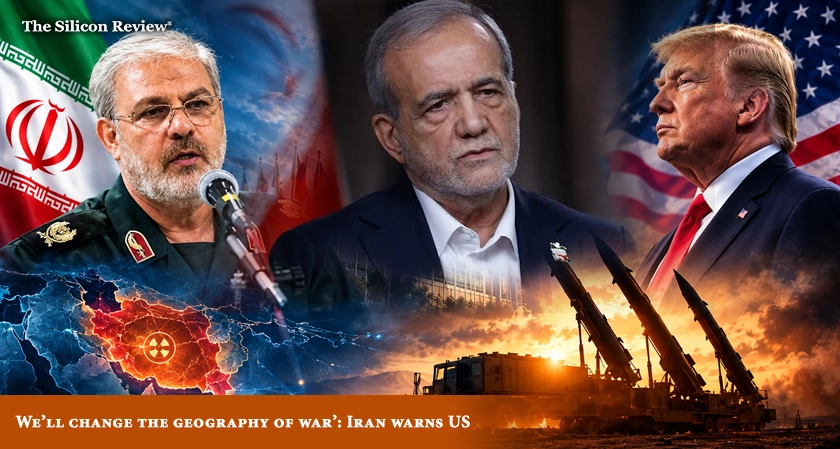
The United States (US) has been warned by Iran's Islamic Revolutionary Guard Corps (IRGC) that any new escalated military action will result in a ‘change in the geography of war’ ahead of Iranian President Pezeshkian’s meeting at the United Nation (UN) in New York.
The United States has been warned by Iran's Islamic Revolutionary Guard Corps (IRGC) that any new escalated military action will result in a "change in the geography of war" and the use of strategic weaponry and techniques that have not yet been made public. Hossein Mohebi, spokesman for Iran’s Islamic Revolutionary Guard Corps (IRGC), in a thorough analysis of the conflict, Mohebi claimed that the United States had not succeeded in achieving its goals and outlined what he called a wider strategic setback in areas like as military bases, freedom of navigation, military technology, intelligence capabilities, and U.S. regional power.
Hossein Mohebi told a regional media “Those change include a shift in the geography of war, and a shift in weapons and military equipment.” He continued “we will bring new weapons with new capabilities into the battlefield, and the world will be astonished. Our targets are also no longer necessarily the same as the previous targets. We have new targets that have not yet been struck,” further he continued saying “in our view, war is war; it has different stages, but war is war and the war is not over, the war continues, and the Islamic Revolutionary Guard Corps has prepared itself for a long-term war.” Mohebi also humiliated US stating “Despite America having the largest navy in the world and despite defining the reason for its presence in the region and the world as ensuring the security of energy flows and freedom of navigation, it became clear in this war that America, first of all, did not have the ability to reopen the Strait of Hormuz and could not.”
Even with all of this a delegation of Iran led by Iranian President Masoud Pezeshkian is going to United Nations General Assembly in New York on Tuesday, with the hope for a diplomatic solution to Middle East conflicts. On the edge of the event, which is set for September 22-26 and 28, he will also have discussions with the leaders of several nations.
However, U.S. President Donald Trump has threatened to ruin Iran's economy or remove its leadership if Tehran doesn't reach an agreement. Trump has stated that he would be open to meeting Pezeshkian during the assembly. President Trump said on Sunday that only option is there for Iran “wiping Iran out,” or letting its economy “rot” unless they reach a deal.
On the other hand Iran's military also warned of "painful" retaliation throughout the Middle East, claiming that its intelligence indicated that the United States and its partners were planning a fresh, massive strike. It stated that regional nations supporting such a strike would be regarded as parties to the conflict.
According to Tasnim, the Khatam al-Anbia Central Headquarters of Iran stated that "all its positions and interests in the region will be targeted by sustained, effective, and painful attacks if the U.S. makes any mistake against the Islamic Republic of Iran."
With all of this threat and retaliation warning around Iran, Israel and US war, The Silicon Review asks: What will this UN talk bring for Iran?
Q: Why Iran's Islamic Revolutionary Guard Corps (IRGC) threatened United States (US)?
A: Iran's Islamic Revolutionary Guard Corps (IRGC) issued a stern warning to the United States on September 21, 2026, declaring that any fresh escalation would see Tehran deploy unspecified new weapons, adopt new military tactics, and shift the ‘geography of war’.
Q: What will this UN talk do for Iran?
A: At a crucial point in its ongoing, six-month conflict with the United States and Israel, the 81st session of the United Nations General Assembly (UNGA) offers Iran a high-stakes diplomatic platform to resolve the conflict.
Q: What was the response of US President Trump to these threats?
A: U.S. President Donald Trump has threatened to ruin Iran's economy or remove its leadership if Tehran doesn't reach an agreement.
Q: What is the reason for the war between Iran, Israel, and the US?
A: Conflicting geopolitical goals, the disagreement over Iran's nuclear program, Tehran's backing of regional proxy militias, and intense ideological animosity stemming from the 1979 Iranian Revolution are the main causes of the military confrontation between Iran, Israel, and the United States.
Q: Why is the war affecting the current oil and gas market?
A: A crucial maritime chokepoint that normally handles about 20% of the world's petroleum and liquefied natural gas (LNG) has been severely curtailed by Iran's military blockade of the Strait of Hormuz.













Comments