>>
Industry>>
Environmental sustainability>>
At Least 20 Species Could Be N...At Least 20 Species Could Be New to Science after NUS-OceanX Deep-Sea Expedition, Including the 'Strawberry Squid'
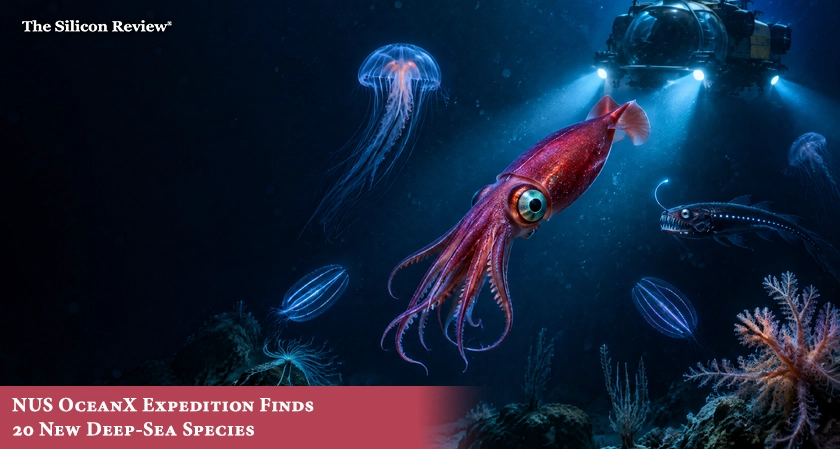
A deep-sea expedition led by NUS and OceanX has identified at least 20 species that may be new to science, including a rare "strawberry squid," after exploring previously undocumented waters off the Indonesian island of Bali.
At least 20 species discovered during a deep-sea expedition led by the National University of Singapore and the non-profit ocean exploration organisation OceanX could be entirely new to science, researchers have announced.
The expedition, conducted in June and July 2026, explored previously undocumented waters off Bali, Indonesia, as part of a wider effort to study biodiversity in the Indo-Pacific. The team of researchers documented more than 60 species, including a vampire squid, a cookie-cutter shark, a gulper eel, a telescope fish and a deep-sea lizardfish. Among the most striking finds were a rare "strawberry squid," named for its bumpy, strawberry-like appearance and glowing photophores.
"The ocean has long been overlooked in global discussions of climate and biodiversity, yet it holds immense potential for discovery and climate solutions," said Professor Koh Lian Pin, NUS' vice-president for research and technology.
The species were collected from depths of up to 3,000 metres in Indonesian waters. While they will need to be formally described and verified in peer-reviewed journals before they can be confirmed as new to science, researchers believe at least 20 of the collected specimens are likely new discoveries.
The expedition follows a similar successful mission in 2025, which also recorded 10 potential new species, reinforcing Singapore's growing role in deep-sea research. Led by Professor Huang Danwei from the NUS Department of Biological Sciences, the team also trialled a novel "wet-lab" aboard OceanXplorer, the OceanX research vessel, allowing researchers to dissect, image and preserve specimens at sea.
The discoveries were announced during the three-day Singapore Ocean Week, which gathered more than 350 delegates, 40 institutions and representatives from 25 countries to discuss marine science and conservation.
"We are learning more about the ocean's ability to act as a long-term carbon sink, and how it can complement land-based climate mitigation efforts," said Associate Professor Abel Yang, director of the NUS Centre for Nature-based Climate Solutions.
The governments of Singapore and Indonesia also signed a memorandum of understanding on ocean policy and diplomacy at the event, covering marine biodiversity, climate change, ocean governance and the sustainable blue economy.
Here is the question regarding this discovery The Silicon Review raises. A deep-sea expedition led by Singapore and OceanX has identified at least 20 species that may be new to science, offering a rare glimpse into one of the least explored ecosystems on Earth. When researchers are still discovering species at this scale, what does it say about how little we know about the very environment we rely on to regulate the planet's climate?
FAQ:
Q: How many new species were discovered in the NUS-OceanX expedition?
A: At least 20 species collected during the expedition may be new to science, including a rare "strawberry squid." The team documented more than 60 species in total.
Q: Where did the NUS-OceanX deep-sea expedition take place?
A: The expedition explored previously undocumented waters off Bali, Indonesia, at depths of up to 3,000 metres.
Q: Who led the NUS-OceanX deep-sea expedition?
A: The expedition was led by Professor Huang Danwei from the NUS Department of Biological Sciences, in partnership with OceanX.
Q: What is a "strawberry squid"?
A: The strawberry squid is a rare deep-sea species named for its bumpy, strawberry-like appearance and glowing photophores, found during the expedition.
Q: When will the new species be confirmed?
A: The species will need to be formally described and verified in peer-reviewed journals before they can be confirmed as new to science.













Comments