>>
Industry>>
Capital Market>>
Singapore Core Inflation Rises...Singapore Core Inflation Rises to Nearly Two-Year High of 2.2% in August; MAS Policy in Focus
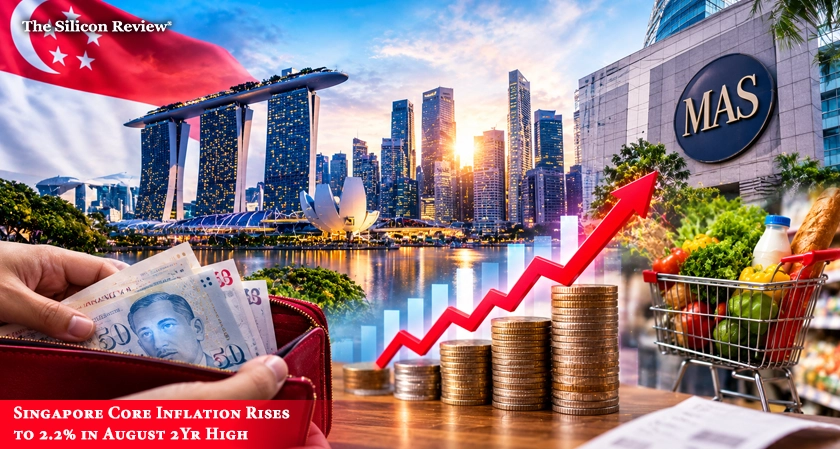
Singapore's core inflation rose to 2.2% in August, the highest in nearly two years, driven by higher food, services and electricity costs, keeping pressure on the Monetary Authority of Singapore ahead of its October policy decision.
Singapore's core inflation rose to 2.2 per cent in August 2026, the highest in nearly two years, as food, services and electricity costs continued to climb. The reading, released by the Monetary Authority of Singapore and the Ministry of Trade and Industry on Wednesday, September 23, compares with 2.0 per cent in July. The increase keeps core inflation which excludes private transport and accommodation costs above the midpoint of MAS's historical average and comes as the central bank prepares for its next policy decision in October.
Drivers of the Increase
Food inflation accelerated to 3.1 per cent in August, up from 2.9 per cent in July, while services inflation rose to 2.4 per cent from 2.2 per cent. Electricity and gas costs increased 5.6 per cent year-on-year, reflecting higher global energy prices.
"The uptick in core inflation was driven by higher food and services costs, as well as electricity and gas prices," the MAS and MTI said in a joint statement.
Headline Inflation Stable
Headline inflation, which includes private transport and accommodation, was 1.8 per cent in August, unchanged from July. Private transport costs rose 1.2 per cent, slowing from 1.5 per cent the previous month, while accommodation inflation eased to 1.4 per cent from 1.6 per cent.
MAS Policy Outlook
The Monetary Authority of Singapore manages monetary policy through exchange rate settings rather than interest rates. The August inflation reading is the last major data release before the MAS's semi-annual policy review in October. In July, the MAS kept its policy band unchanged, saying that core inflation was expected to remain within its forecast range of 2.0 to 3.0 per cent for 2026. Analysts are divided on whether the August uptick will prompt a tightening move in October. A Bloomberg survey in August found that 45 per cent of economists expected the MAS to tighten policy in October by increasing the slope of the policy band, up from 30 per cent in June.
"The August inflation print supports the case for the MAS to remain vigilant. Whether they tighten will depend on whether this is a temporary uptick or the start of a more sustained trend," said a regional economist.
Global Context
The inflation data comes amid elevated global energy prices driven by the Iran war, which has kept oil above $90 a barrel and pushed up electricity and gas costs across the region. Singapore's economy has also been growing faster than expected, with growth forecast raised to 5.0 per cent for 2026, driven by an AI-led tech boom.
What to Watch
The MAS's October policy statement will be closely watched for signals on whether the central bank believes inflation pressures are becoming entrenched. The next major data point is September inflation, due in late October.
Here is the question this inflation reading raises. Singapore's core inflation has risen to its highest in nearly two years, driven by food, services and energy costs, just weeks before the MAS makes its October policy decision. When the same AI-driven boom that is powering growth is also fuelling demand-side pressures, can the MAS afford to tighten without slowing the economy it has worked to accelerate?
FAQ:
Q: What was Singapore's core inflation rate in August 2026?
A: Core inflation rose to 2.2 per cent in August 2026, the highest in nearly two years, up from 2.0 per cent in July.
Q: What drove the rise in Singapore's core inflation?
A: Higher food prices (3.1 per cent), services cost (2.4 per cent), and electricity and gas prices (5.6 per cent) drove the increase.
Q: What is Singapore's headline inflation rate?
A: Headline inflation was 1.8 per cent in August, unchanged from July.
Q: When is the MAS's next policy decision?
A: The MAS is scheduled to make its semi-annual policy decision in October 2026.
Q: Will the MAS tighten monetary policy in October?
A: Analysts are divided. A Bloomberg survey in August found 45 per cent of economists expected the MAS to tighten by increasing the slope of the policy band, up from 30 per cent in June.
Q: How does the MAS manage monetary policy?
A: The MAS manages monetary policy through exchange rate settings rather than interest rates, allowing the Singapore dollar to appreciate or depreciate against a basket of currencies.












Comments