>>
Industry>>
Environmental sustainability>>
Haze Pushes Air Quality across...Haze Pushes Air Quality across Singapore into Unhealthy Range for First Time in 7 Years
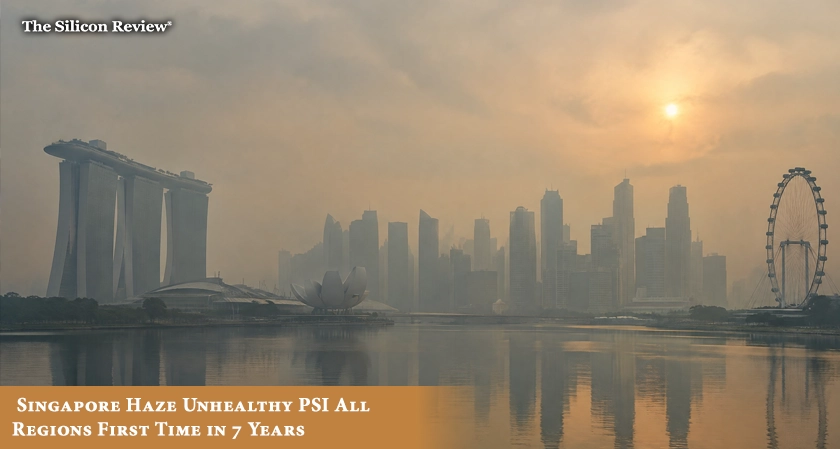
Air quality across all five regions of Singapore entered the unhealthy range on Tuesday morning, marking the first island wide occurrence since September 2019, as smoke from forest fires in Indonesia continues to blanket the city-state.
Air quality across all five regions of Singapore entered the unhealthy range on Tuesday morning, September 15, 2026, marking the first islandwide occurrence of hazardous haze conditions since September 2019, as smoke from forest fires in Indonesia continues to blanket the city-state. At 6am, the 24-hour Pollutant Standards Index readings were 104 in the north, 111 in the south, 128 in the east, 128 in the west, and 154 in the central region. By 9am, conditions eased slightly but remained unhealthy, with readings of 103 in the north, 106 in the south, 122 in the east, 124 in the west, and 148 in the central region. The National Environment Agency classifies a 24-hour PSI reading of 101 to 200 as unhealthy and advises the public to reduce outdoor activities when air quality reaches that level. The current haze episode marks the first time since October 2023 that smoke haze has pushed Singapore's PSI into the unhealthy range. Authorities had previously warned of elevated haze risk between June and October due to warmer and drier conditions associated with El Niño and the Indian Ocean Dipole.
PM2.5 Levels Mixed as Central and Western Regions Remain Elevated
One-hour PM2.5 readings across most of Singapore returned to normal levels by 6am on September 15, ranging from 32 to 44 micrograms per cubic meter. However, the central and western regions recorded elevated readings of 66 and 59 micrograms per cubic meter, respectively. Singapore classifies PM2.5 concentrations of up to 55 micrograms per cubic meter as normal, 56 to 150 as elevated, and 151 to 250 as high.
Smoke Plumes from Kalimantan and Sumatra
The NEA said moderate to dense smoke plumes from forest fires in Kalimantan continue to be observed, with some drifting toward Singapore. Smoke plumes were also detected over southern Sumatra. Dry conditions are expected to persist across Singapore and the surrounding region in the coming days. With winds forecast to continue blowing from the southeast to east-southeast, the NEA warned that Singapore is likely to remain affected by smoke haze. The haze has been traced to raging fires in the forests and peatlands of Sumatra and Kalimantan, where smoke has been observed on most days since August 21. The smoke was carried northwards by winds from the south. Fire hot spots were detected within concession areas, where land is allocated for commercial use such as plantations. Some of these concessions overlap with peatlands, which are naturally wet ecosystems that become highly flammable when drained for plantations.
NEA Advisory and Health Precautions
In an advisory issued on September 14, the NEA forecast that Singapore's air quality over the following 24 hours would range from high-moderate to mid-unhealthy levels. The agency began providing daily haze advisories from September 4, when the PSI first entered the unhealthy range in the central region. The health impact of haze depends on individual health status, PSI level, and the duration and intensity of outdoor activity. Reducing outdoor activities and physical exertion can help limit ill effects. The public is advised to drink plenty of water to stay hydrated. Vulnerable persons, especially the elderly, pregnant women, children, and those with chronic heart and lung conditions, who develop symptoms, should seek medical attention promptly. The Ministry of Health has worked with healthcare institutions and long-term care providers to implement haze preparedness measures, including air purifiers and fans. Preschools have been advised to minimise prolonged outdoor activities, and all classrooms are equipped with air purifiers.
Regional Context and Outlook
The ASEAN Specialised Meteorological Centre has detected moderate to dense smoke haze in central and southern Sumatra, West and Central Kalimantan, as well as parts of Sarawak and Peninsular Malaysia. The prevailing winds over the southern ASEAN region are forecast to blow mainly from the southeast, with conditions expected to remain elevated. The 2026 haze season is compounded by a "Godzilla" El Niño, which brings hotter and drier conditions. While weather experts indicate a repeat of the 2015 crisis, when PSI exceeded 300 and schools were closed, seems unlikely due to a later El Niño onset, the NEA noted that periods of haze could still occur, especially during prolonged dry spells.
Here is the question this haze episode raises. Air quality across all five regions of Singapore has entered the unhealthy range for the first time in seven years, driven by forest fires in Indonesia and compounded by a "Godzilla" El Niño. When the same transboundary haze crisis recurs year after year, what will it take for regional cooperation to finally deliver a permanent solution?
FAQ:
Q: What is the current PSI reading in Singapore?
A: At 6am on September 15, 2026, the 24-hour PSI readings were 104 in the north, 111 in the south, 128 in the east, 128 in the west, and 154 in the central region. By 9am, readings eased slightly but remained unhealthy.
Q: What does an unhealthy PSI range mean?
A: A 24-hour PSI reading of 101 to 200 is classified as unhealthy. The public is advised to reduce outdoor activities and physical exertion when air quality reaches this level.
Q: What is causing the haze in Singapore?
A: The haze has been traced to forest and peatland fires in Sumatra and Kalimantan, Indonesia. Smoke plumes have been observed drifting toward Singapore, carried by winds from the south and southeast.
Q: When was the last time Singapore experienced islandwide unhealthy PSI levels?
A: The last islandwide occurrence of unhealthy PSI levels was in September 2019. The most recent haze episode that pushed the PSI into the unhealthy range was in October 2023, but it was not islandwide.
Q: What health precautions should Singapore residents take during the haze?
A: The NEA advises the public to reduce outdoor activities, drink plenty of water, and seek medical attention if symptoms develop. Vulnerable groups, including the elderly, pregnant women, children, and those with chronic heart and lung conditions, should take extra precautions.
Q: How long is the haze expected to last?
A: Dry conditions are expected to persist, with winds forecast to continue blowing from the southeast to east-southeast. The NEA warned that Singapore is likely to remain affected by smoke haze in the coming days.




















Comments