>>
Technology>>
Gadgets>>
Smart Luggage & Tech Gear: Bui...Smart Luggage & Tech Gear: Building a High-Performance Capsule for Pacific Northwest Transit
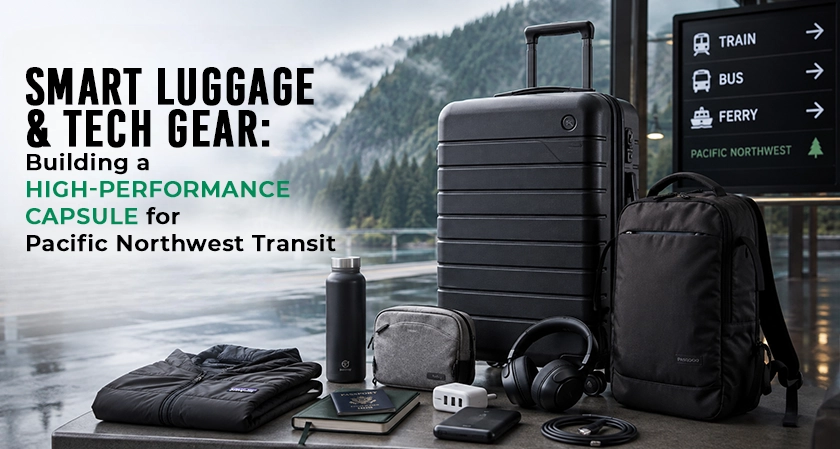
Pack for a client meeting in Seattle the way you'd pack for a meeting in Phoenix, and you'll regret it by the second day. The city gets 37 inches of rain a year spread across roughly 147 days, which sounds dramatic until you realize most of it is drizzle, not downpour. The problem for business travelers isn't surviving a storm. It's that you'll walk between a dry boardroom, a wet sidewalk, and a car service pickup four or five times a day, and most travel kits aren't built for that many small transitions.
Why a Normal Carry-On Strategy Falls Apart Here
A suit that looks sharp in a conference room and a jacket that handles a ten-minute walk in the rain are usually two different garments, and packing both means checking a bag you didn't want to check. The Pacific Northwest doesn't punish you with a single bad weather day so much as it wears down anything not built for repeated, low-grade dampness. Cotton dress shirts hold moisture. Leather shoes stay wet longer than they should. None of it ruins a trip on its own, but it adds up over three or four days of back-to-back meetings.
Smart Luggage Is Only Smart If the Battery Is Removable
The built-in-battery suitcase trend hit a wall a few years ago, and it's worth knowing why before you buy one. American, Delta, United, and Southwest all require that any battery in a smart bag be removable before it goes in the cargo hold, and several ban non-removable batteries outright, since a damaged lithium cell in an unattended cargo area is a real fire risk airlines aren't willing to take on. If you're shopping for a bag with built-in charging or GPS tracking, check for a battery you can pop out at gate check. It's a five-second detail that determines whether the bag flies with you or gets pulled aside.
Power Banks Have a Ceiling, and It's Lower Than You'd Think
Most people don't realize their portable charger has a legal limit until a TSA agent flags it. Power banks under 100 watt-hours, which covers most chargers up to about 26,800mAh, need no special approval. Between 100 and 160Wh, you need airline approval and can only carry two. Above 160Wh, it's not getting on the plane at all, checked or carry-on. And regardless of size, power banks can't go in checked luggage under any circumstance. If your current charger is an oversized one you bought for a road trip, it's worth swapping for something smaller before a flight, not after you're stopped at the checkpoint.
Layering for a Boardroom and a Downpour, Sometimes in the Same Hour
The gear that actually earns its space in a Pacific Northwest carry-on tends to be boring on paper: a merino wool base layer that doesn't hold odor through a long travel day, a packable soft-shell that looks fine over business casual and blocks wind without the crinkle of a rain shell, and shoes with actual water resistance rather than just a treated leather finish. None of this reads as exciting gear-guide material, and that's sort of the point. The best Pacific Northwest travel kit is the one that lets you stop thinking about the weather between meetings.
When the Trip Doesn't End at the Conference Center
Seattle's also one of the country's biggest departure points for Alaska cruises, and a growing number of business travelers are stacking a few extra days onto a Seattle trip to catch one before flying home, since Pier 91 sits just a few miles from downtown. If that's part of your plan, the same layering logic applies twice over: whatever keeps you dry walking to a client office in April is exactly what you'll want on deck watching the Inside Passage go by. Travelers doing this combination are increasingly booking their cruises out of Seattle around the same trip rather than treating them as separate vacations, which at least means packing once instead of twice.
None of this requires an overhauled travel wardrobe or a suitcase full of gadgets. It's mostly about choosing the two or three pieces that do double duty, so a client meeting and an unplanned walk in the rain don't require two different outfits.




















Comments