>>
Industry>>
Compliance and governance>>
President Trump Extends H-1B V...President Trump Extends H-1B Visa Restrictions and $100,000 Fee Plan by another Year, Indians Brace for Continued Uncertainty
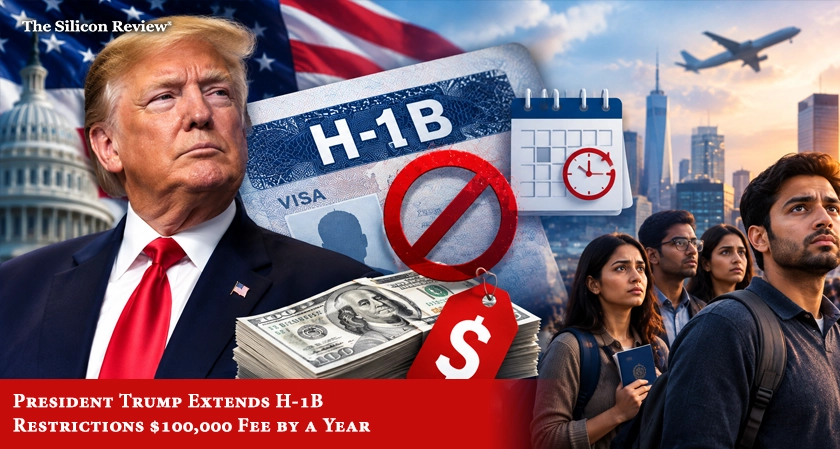
President Trump has extended his H-1B visa restrictions by another year, keeping the $100,000 fee requirement in place until September 2027, leaving Indian professionals and US employers facing continued uncertainty.
President Donald Trump has extended his H-1B visa restrictions for another year, prolonging the requirement for a $100,000 payment for new H-1B petitions until September 2027. The extension, announced on September 19, 2026, keeps the controversial fee in place despite legal challenges and widespread opposition from the technology industry and immigrant communities.
What the Extension Means
Under the extended order, any new H-1B petition submitted for a foreign national outside the United States will require a $100,000 payment, in addition to existing filing fees. The restriction applies only to new petitions and does not affect H-1B renewals or holders already in the country.
The extension preserves the status quo for another year, preventing the restrictive measures from expiring while the administration pursues a permanent rule through the formal regulatory process. Earlier this month, the Department of Homeland Security proposed making the $100,000 fee permanent through a new rule, setting the fee at $103,265.
Legal Challenges Continue
The original proclamation, issued in September 2025, was struck down by a federal judge in Boston in June 2026, who ruled it was an unlawful tax that Congress never authorised. An appeals court subsequently rejected the administration's bid to stay that ruling. The extension appears designed to keep the restrictions in place while the administration pursues its appeal and a separate regulatory track.
"We are confident in the legality of the Proclamation, and we have also submitted a proposed rule to replace it through the appropriate legal channels. If and when the litigation is resolved, that rule will serve as an even stronger foundation for this policy," the White House said in a statement.
Impact on Indian Professionals
The continued restrictions are a significant concern for Indian professionals, who account for approximately 71% of H-1B visa holders. Indian nationals are the largest group affected by the fee, which is prohibitively expensive for most workers and employers. The H-1B visa is a critical pathway for skilled foreign workers in technology, engineering, medicine, and other specialty occupations. Major US tech companies including Google, Microsoft, Amazon, and Apple rely heavily on H-1B workers to fill roles when qualified American workers are unavailable.
Industry Backlash
Technology trade groups, including the Information Technology Industry Council and the National Association of Manufacturers, have opposed the fee, arguing it will cripple American competitiveness and drive talent to countries with friendlier immigration policies, including Canada and Germany.
"This fee will hurt US businesses and damage our ability to attract the best talent from around the world. It is a tax on innovation," said a spokesperson for one of the trade groups.
The Regulatory Path Forward
The administration is pursuing a dual-track strategy: defending the proclamation in court while finalising the proposed rule that would make the fee permanent. The proposed rule, announced by DHS earlier this month, would set the fee at $103,265 and could be finalised by the end of the year, potentially outlasting the proclamation even if it is struck down.
"If the courts ultimately strike down the proclamation, the rule would serve as a backstop to ensure that American taxpayers are not forced to subsidise the immigration system through higher taxes," an administration official said.
Here is the question this extension raises. President Trump has extended his H-1B restrictions and the $100,000 fee for another year, keeping the tech industry and Indian professionals in limbo while the administration pursues a permanent rule through the regulatory process. When immigration policy is pursued through both executive orders and administrative rules, what does it say about the stability of America's legal immigration system?
FAQ:
Q: What did President Trump extend regarding H-1B visas?
A: Trump extended his H-1B visa restrictions and the $100,000 fee requirement for new H-1B petitions by another year, until September 2027.
Q: Does the $100,000 H-1B fee apply to renewals?
A: No, the fee applies only to new H-1B petitions for foreign nationals outside the United States. It does not affect renewals or holders already in the country.
Q: Why was the H-1B restriction extended?
A: The administration extended the restriction to keep it in place while it pursues a court appeal and a separate regulatory process to make the fee permanent.
Q: What is the status of the $100,000 H-1B fee in court?
A: The original proclamation was struck down by a federal judge in June 2026, who ruled it an unlawful tax. An appeals court rejected the administration's bid to stay the ruling.
Q: How does the $100,000 H-1B fee impact Indian professionals?
A: Indian nationals account for approximately 71% of H-1B visa holders, making them the largest group affected by the fee.
Q: Is the administration pursuing a permanent rule for the H-1B fee?
A: Yes, the Department of Homeland Security has proposed a rule to make the fee permanent at $103,265, which could be finalised by the end of the year.











Comments