>>
Other>>
Politics>>
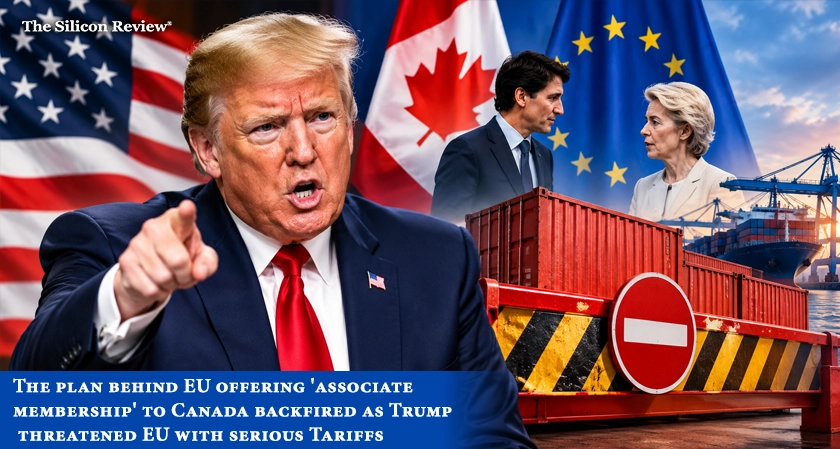
Trump reacted to EU’s propos...Trump reacted to EU’s proposal offering ‘the associate membership of EU’ to Canada is backfired, as US President, threatened the EU with “serious tariffs” and the halt of trading, mocking the decision as “hostile act”
The Silicon Review
17 September, 2026
Author:
The Silicon Review Team
After the EU's proposal to admit Canada as its first associate member, US President, Trump mocked the decision as "laughable,” & “hostile act” and threatened the bloc with "serious tariffs" and a halt to trade.
President Donald Trump of the United States has threatened to take action against the European Union if it proceeds with Ursula von der Leyen's proposal to make Canada the first associate member of the organization. The US President Stated that “If they do that, if I think it's at all a hostile act, I will put very serious tariffs or stop trading with Europe on many things," Speaking to reporters at a North Carolina event, Trump referred to the proposal as "laughable.”
Earlier the head of the European Commission has endorsed plans for Canada to become the first "associate member" of the EU. Ursula von der Leyen, the president of the European Commission, stated to the European Parliament on Wednesday that she wanted to work on "opening the door" for Canada, which would require stronger ties in several crucial sectors.
After Last week, Canadian Prime Minister Mark Carney made reference to the pursuit of a "unique alliance" with the EU. A developing trade conflict is currently exacerbating the country's antagonistic relations with the United States. As we were discussing US-Canada relations deteriorate as they move closer to Europe? Or will Canada benefit from this calculated risk in a trade agreement? But ‘The Unpredictable Trump’ decided to include Europe in trade war.
Though in response to Trump’s comments Benjamin Haddad, France's minister of Europe, responded to Trump's remarks on Thursday by saying that Washington lacked the authority to veto EU decision, stating “It is not up to the United States, or anyone else, to choose the political and geopolitical direction of the Europeans. Once again, we have a relationship with Canada, and we are fully entitled to seek to deepen it.”
Another remark came from the European Commission spokesperson: “As our president made clear yesterday, the proposed strengthening of the relationship with Canada is not against anyone else, but for our common strength.”
The 27 EU countries, which are generally in favor of deeper links with Canada but were caught off guard by the word, would need to accept an associate membership agreement. Although Canada and the EU already have a trade agreement and many other pacts, they have been getting closer since Donald Trump entered power, increased tariffs on both former friends, and often threatened to make Canada the 51st US state while criticizing the EU.
As for now the risk factor that is US President, Trump and his trade war is having a big impact around EU-Canada relationship, The Silicon Review asks: How European Union’s (EU) other alliances looking at this scenario and will they agree to make, Canada an associate member of EU.
Q: Who is the current President of European Commission?
A: Ursula von der Leyen
Q: What Canadian Prime Minister was looking for?
A: Canadian Prime Minister Mark Carney was looking for the “unique alliance” with no permanent seat.
Q: What does European Commission offered?
A: European Commission offered Canada to become first “Associate Member” of EU.
Q: What is the United States take on this?
A: President Donald Trump of the United States has threatened to take action against the European Union by imposing tariffs and halting the ongoing tread, if it proceeds with Ursula von der Leyen's proposal to make Canada the first associate member of the organization.
Q: What are the primary benefits for the Canada after becoming an associate member of EU?
A: It can benefit Canada in several ways including; Economic Survival and Diversification, Resources and Logistics Security, and Military and Tech Scaling. Moreover, both countries can combine resources for cyber security, AI, and quantum computing through a joint tech alliance. Geopolitical Leverage: In crucial areas like the Arctic, a formalized “associate status” forges a strong transatlantic democratic front that bolsters middle-power cooperation.


















Comments