>>
Other>>
Politics>>
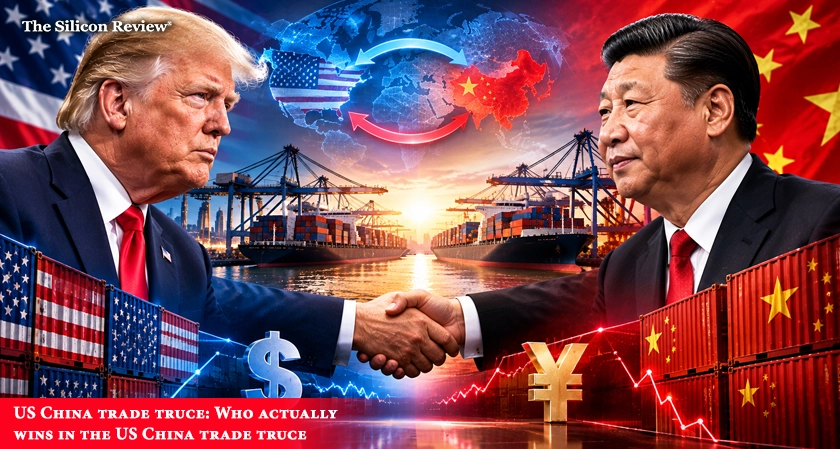
US China trade truce: Who actu...US China trade truce: Who actually wins in the US China trade truce?
The Silicon Review
24 September, 2026
Author:
Aditya Paswan
US China trade truce: The US President Trump has welcomed Chinese President Xi Jinping to Washington, DC, for high-stakes talk around trade, AI, and Taiwan
Trump made history by seeing Xi in person upon his arrival, the first time a US president has welcomed a foreign leader at the base in 11 years. The most concrete benefit for China as US extends the ‘Busan Agreement’ for two months till January 10. A military band played, cannons roared, and a B-1 military bomber flew overhead as the leaders and their spouses shook hands, chatted for a short while, and stood for photos during the arrival ceremony.
US-China is in the economic friction surrounded with artificial intelligence cooperation, tariff adjustments, and US ties to Taiwan, the island that China claims as part of its territory. US Treasury Secretary Scott Bessent and Chinese Vice Premier He Lifeng already had met ahead of Chinese President’s visit. After the second meeting of Scott Bessent and He Lifeng, Bessent stated that In order to give ourselves more time to work on a potentially larger trade agreement, the United States and China have decided to extend a trade truce that was set to expire on November 10 by two months in January 10.
“We met today to see if we could do a bigger deal as opposed to just a series of smaller things,” Bessent told reporters earlier that Beijing had raised the prospect of a more expansive US-China trade deal during 12 hours of talks on Sunday, but gave no details of its potential scope.
After equal retaliation over Trump's tariff rises last year, bilateral tariff rates had risen to triple digits; however, the Busan "economic truce" significantly reduced them. Additionally, China had committed to reopening the flow of vital minerals, including rare earth magnets, which it had severely limited. Xi seems to be in a better position because he has managed an increase in China's trade and has control over the supply of rare earth minerals, which gives him significant leverage.
According to some sources, Xi is anticipated to put pressure on Trump to stop Taiwan's arms sales during their scheduled visit to the US National Archives on Friday. According to the sources, China is promising assistance in exerting pressure on Iran in exchange.
Looking at all the facts, it seems like China is winning this trade truce and the interconnected things to it but a big factor is that the balance of vulnerability as US is using Taiwan as bargaining cheap over China.
As it seems that China has an upper hand in this trade truce, The Silicon Review asks: Will US use Taiwan’s Arms deal to gain leverage over US?
Q: Why Donald Trump and Xi Jinping meeting?
A: From September 23 to September 25, 2026, U.S. President Donald Trump and Chinese President Xi Jinping will have a crucial three-day official state visit to Washington, D.C. The leaders are trying to finalize a reciprocal tariff-reduction arrangement managed by a new "Board of Trade".
Q: What is this US-China AI Dialogue mechanism?
A: Treasury Secretary Scott Bessent and Chinese Vice Premier He Lifeng have proposed a bilateral communication framework called the US-China AI Dialogue, which aims to move the world's two leading artificial intelligence powers from operational opacity to strategic transparency regarding frontier technology risks.
Q: What China benefited from Washington summit so far?
A: The United States and China have decided to extend a trade truce that was set to expire on November 10 by two months in January 10.
Q: What is the US trying to gain from this Washington summit?
A: The main reasons the US is attending the summit in Washington are to further its economic objectives, safeguard essential manufacturing supply lines, and create critical geopolitical and national security barriers in the face of home challenges.
Q: Why the US-China AI Dialogue seems controversial?
A: Though this meeting of two top officials of both countries sounds like an ‘AI threat discussion’ but behind this name of US-China AI Dialogue mechanism, it seems a crucial pre-negotiation and diplomatic scaffolding meeting in New York, intended to secure concrete economic and security deliverables prior to the forthcoming summit between Donald Trump and Xi Jinping in Washington.
Q: What possible conclusion can be drawn from the Washington summit?
A: Analysts predict that rather than a broad fundamental change in the relationship, the Washington summit between Donald Trump and Xi Jinping will result in "managed competition" and tactical stability.
Q: Who seems to win this trade truce so far in between US and China?
A: Since both countries have gained crucial short-term tactical benefits from the Busan Agreement truce, it is challenging to declare a clear winner at this point. However, most geopolitical and economic analysts believe that the United States still has the advantage in long-term structural leverage, while China has a tiny advantage in tactical time.




















Comments