>>
Technology>>
Software>>
Why CRM Implementations Fail â...Why CRM Implementations Fail — and How Businesses Can Get It Right
The Silicon Review
05 September, 2026
Author:
Guest
Customer relationship management software promises better visibility, more consistent sales processes and stronger customer relationships. Yet implementing a CRM does not automatically deliver any of those outcomes.
Businesses can invest significant time configuring a new platform only to discover months later that employees are still relying on spreadsheets, customer information is incomplete, follow-ups are being missed and important processes continue to happen outside the CRM.

Implementation dashboards report configuration progress. They do not report whether the underlying process was redesigned first.
Successful CRM implementation is fundamentally a business process project. The organisations that get the greatest value from CRM generally start by understanding how information, customers and work should move through the business — and then configure the technology around that model.
That distinction has become even more important as CRM evolves beyond a customer database into a foundation for automation, integrations and artificial intelligence.
Start with the process, not the software
One of the most common CRM implementation mistakes is attempting to recreate existing processes without first asking whether those processes should continue in their current form.
Simply rebuilding those processes inside a new CRM risks digitising inefficiency instead of removing it.
How does an enquiry become an opportunity? What information needs to be captured? Who takes the next action? What happens when a quote is accepted? Which activities should happen automatically? What information should management see?
Once those questions are answered, the CRM can support the desired process rather than becoming another layer of technology.
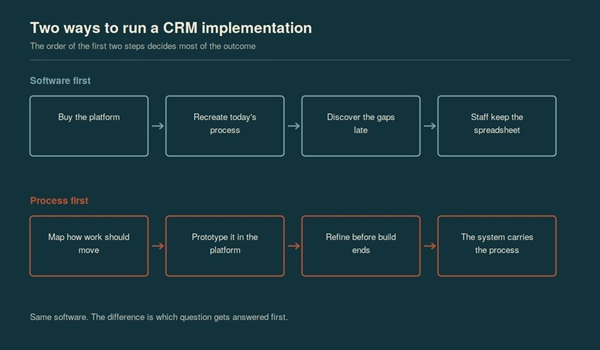
Both tracks use the same platform. Only the order of the first two steps differs.
CRM should not be an isolated customer database
Traditional CRM systems were often primarily repositories for contact and sales information.
Modern platforms such as Zoho CRM illustrate the shift towards CRM operating as part of a wider business ecosystem. Zoho CRM can manage customer relationships and sales processes while connecting with other business applications and external platforms.
The implementation question therefore becomes broader than, “How should we configure our pipeline?”
It becomes, “How should information move through the organisation?”
Configure the CRM around the business
Every organisation has differences.
An electrical contractor does not manage customers the same way as a professional services firm. A recruiter has different workflows from a property management organisation. Even two businesses in the same industry can use different terminology, approvals, service models and reporting structures.
Modern configurable and low-code platforms make it possible to reflect those differences.
This is where experienced CRM implementation specialists can contribute considerably more than software configuration.
Australian Zoho Partner Dynamic Digital Solutions takes a prototype-first approach to CRM implementation, offering both ready-to-go CRM systems and custom Zoho CRM solutions. Its current CRM offering is built around configuring workflows, automations, approvals, dashboards and integrations to match how the business operates.
Automation should remove work, not create complexity
Automation is one of CRM's greatest opportunities, but it is also easy to over-engineer.
A better question is: where are employees spending time on repetitive activity that technology can reliably handle?
Automation becomes especially valuable when processes cross systems. For example, accepting an opportunity might initiate an operational workflow, create the next task, update relevant teams and prepare information required elsewhere.
Build an AI-ready CRM, not another AI silo
Many businesses are experimenting with tools such as ChatGPT and Claude. Zoho also provides its own AI capabilities through Zia.
But an AI tool operating separately from business systems has limited context.
That is why CRM architecture increasingly needs to consider AI readiness.
When customer and operational information is structured consistently, AI tools can potentially be connected to meaningful business context rather than being treated as standalone productivity applications.
Dynamic Digital Solutions has begun building this concept directly into its CRM positioning, with AI agents through Claude or Zoho Zia used alongside its Zoho CRM environments.
Voice AI extends CRM beyond the screen
Telephone conversations remain an important customer channel, but historically much of the information generated during calls has existed outside CRM unless an employee manually recorded it.
Retell AI provides technology for AI-powered voice interactions. When voice systems are connected to CRM, the potential use case becomes much more significant than simply “an AI answering the phone.”
An AI voice agent might capture an enquiry, qualify the caller, make an appointment, record the outcome and return relevant information to CRM.
Dynamic Digital Solutions currently integrates Retell AI voice agents with Zoho CRM so calls can be captured and logged back into customer records.
AI should extend the customer system, not create another silo beside it.
Adoption must be designed into the project
Even a technically excellent CRM implementation can fail if employees do not use it consistently.
Interfaces should make important information easy to find. Required fields should have a clear reason for existing. Automations should remove workload rather than adding clicks. Dashboards should answer questions employees and managers genuinely care about.
Training should also focus on real processes rather than generic product demonstrations.
If employees see CRM primarily as something they must update for management, adoption will always be difficult.
If it helps them perform their work, adoption becomes considerably easier.
CRM implementation does not finish at launch
A CRM should not be considered complete on the day it goes live.
New services are introduced. Teams expand. Processes mature. Customer expectations change. New AI capabilities emerge.
The most valuable CRM environments can evolve with those changes.
Technology follows strategy
CRM implementation is ultimately less about installing software than designing how a business should work.
The CRM becomes more than somewhere to store customer details.
It becomes part of the operating architecture of the organisation.
And that is the difference between simply purchasing CRM software and building a system capable of supporting the business as it grows.




















Comments